

the formation of an intermediate are common in surface reactions. An
example would be the attachment of a small molecule onto a surface
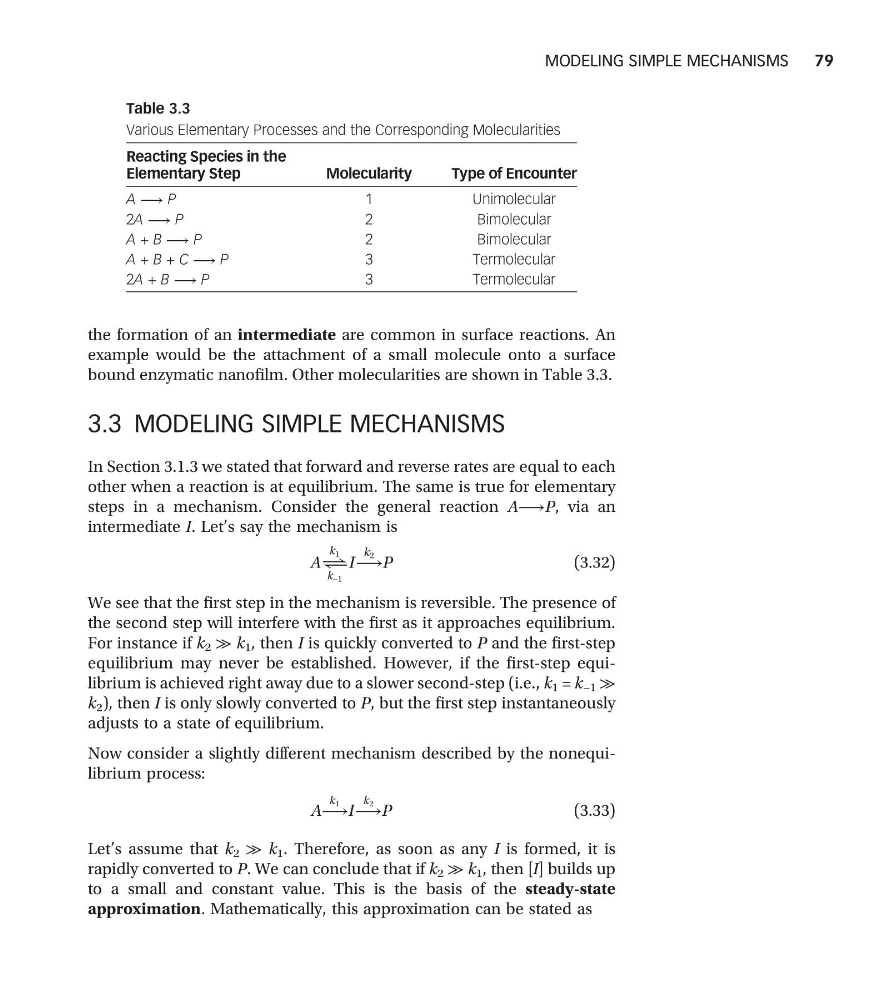
bound enzymatic nanofilm. Other molecularities are shown in Table 3.3.
3.3 MODELING SIMPLE MECHANISMS
In Section 3.1.3 we stated that forward and reverse rates are equal to each
other when a reaction is at equilibrium. The same is true for elementary
steps in a mechanism. Consider the general reaction A⟶P, via an
intermediate I. Let’s say the mechanism is
A⇌
k 1
k −1
I⟶
k 2 P
(3.32)
We see that the first step in the mechanism is reversible. The presence of
the second step will interfere with the first as it approaches equilibrium.
For instance if k 2 ≫ k 1 , then I is quickly converted to P and the first-step
equilibrium may never be established. However, if the first-step equilibrium is achieved right away due to a slower second-step (i.e., k 1 = k −1 ≫
k 2 ), then I is only slowly converted to P, but the first step instantaneously
adjusts to a state of equilibrium.
Now consider a slightly different mechanism described by the nonequilibrium process:
A⟶
k 1 I⟶
k 2 P
(3.33)
Let’s assume that k 2 ≫ k 1 . Therefore, as soon as any I is formed, it is
rapidly converted to P. We can conclude that if k 2 ≫ k 1 , then [I] builds up
to a small and constant value. This is the basis of the steady-state
approximation. Mathematically, this approximation can be stated as
Table 3.3
Various Elementary Processes and the Corresponding Molecularities
Reacting Species in the
Elementary Step
Molecularity
Type of Encounter
A ⟶ P
1
Unimolecular
2A ⟶ P
2
Bimolecular
A + B ⟶ P
2
Bimolecular
A + B + C ⟶ P
3
Termolecular
2A + B ⟶ P
3
Termolecular
MODELING SIMPLE MECHANISMS
79
example would be the attachment of a small molecule onto a surface
bound enzymatic nanofilm. Other molecularities are shown in Table 3.3.
3.3 MODELING SIMPLE MECHANISMS
In Section 3.1.3 we stated that forward and reverse rates are equal to each
other when a reaction is at equilibrium. The same is true for elementary
steps in a mechanism. Consider the general reaction A⟶P, via an
intermediate I. Let’s say the mechanism is
A⇌
k 1
k −1
I⟶
k 2 P
(3.32)
We see that the first step in the mechanism is reversible. The presence of
the second step will interfere with the first as it approaches equilibrium.
For instance if k 2 ≫ k 1 , then I is quickly converted to P and the first-step
equilibrium may never be established. However, if the first-step equilibrium is achieved right away due to a slower second-step (i.e., k 1 = k −1 ≫
k 2 ), then I is only slowly converted to P, but the first step instantaneously
adjusts to a state of equilibrium.
Now consider a slightly different mechanism described by the nonequilibrium process:
A⟶
k 1 I⟶
k 2 P
(3.33)
Let’s assume that k 2 ≫ k 1 . Therefore, as soon as any I is formed, it is
rapidly converted to P. We can conclude that if k 2 ≫ k 1 , then [I] builds up
to a small and constant value. This is the basis of the steady-state
approximation. Mathematically, this approximation can be stated as
Table 3.3
Various Elementary Processes and the Corresponding Molecularities
Reacting Species in the
Elementary Step
Molecularity
Type of Encounter
A ⟶ P
1
Unimolecular
2A ⟶ P
2
Bimolecular
A + B ⟶ P
2
Bimolecular
A + B + C ⟶ P
3
Termolecular
2A + B ⟶ P
3
Termolecular
MODELING SIMPLE MECHANISMS
79