

measures a physical quantity (such as optical absorbance) that is proportional to the concentration [A] in that ratio.
An important characteristic of a first-order process is the half-life value
(t 1/2 ). This is the time taken for the reactant concentration [A] to reach
exactly one half of its initial value—the half-life of the Ag 2 C 2 O 4 decomposition reaction is illustrated in Figure 3.1. Substituting the condition
[A] = [A] 0 /2 into Equation 3.21 yields
ln
A
½ 0 2
=
A
½ 0
!
= −kt1
2
=
(3.25)
which can be simplified and rearranged to Equation 3.26:
t1
2
= =
ln 2
k
:
(3.26)
The half-life is an intuitive measure of how fast a reaction proceeds.
However, the half-life has practical use for comparing reactions for firstorder processes because it is independent of the initial concentration [A] 0 .
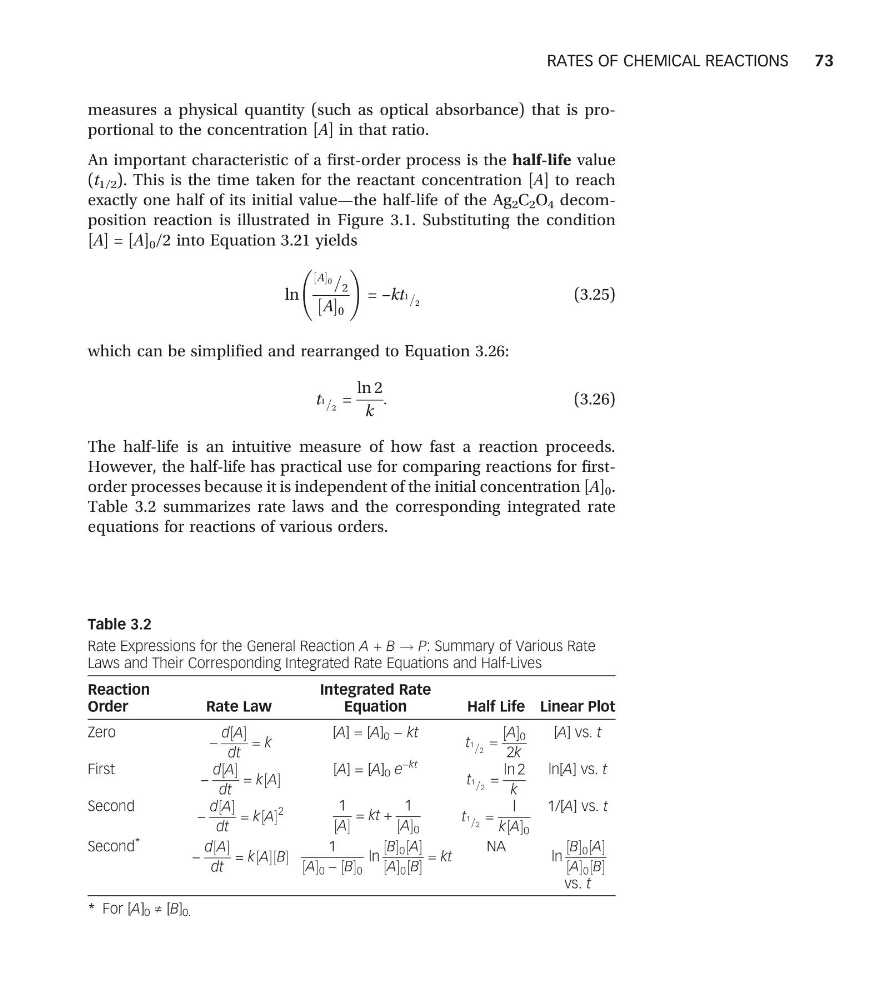
Table 3.2 summarizes rate laws and the corresponding integrated rate
equations for reactions of various orders.
Table 3.2
Rate Expressions for the General Reaction A + B ! P: Summary of Various Rate
Laws and Their Corresponding Integrated Rate Equations and Half-Lives
Reaction
Order
Rate Law
Integrated Rate
Equation
Half Life Linear Plot
Zero
−
d½A
dt
= k
[A] = [A] 0 − kt
t1
2
= =
½A 0
2k
[A] vs. t
First
−
d½A
dt
= k½A
[A] = [A] 0 e
−kt
t1
2
= =
ln 2
k
ln[A] vs. t
Second
−
d½A
dt
= k½A
2
1
½A
= kt +
1
½A 0
t1
2
= =
l
k½A 0
1/[A] vs. t
Second
*
−
d½A
dt
= k½A½B
1
½A 0 − ½B 0
ln
½B 0 ½A
½A 0 ½B
= kt
NA
ln
½B 0 ½A
½A 0 ½B
vs. t
* For [A] 0 ≠ [B] 0.
RATES OF CHEMICAL REACTIONS
73
An important characteristic of a first-order process is the half-life value
(t 1/2 ). This is the time taken for the reactant concentration [A] to reach
exactly one half of its initial value—the half-life of the Ag 2 C 2 O 4 decomposition reaction is illustrated in Figure 3.1. Substituting the condition
[A] = [A] 0 /2 into Equation 3.21 yields
ln
A
½ 0 2
=
A
½ 0
!
= −kt1
2
=
(3.25)
which can be simplified and rearranged to Equation 3.26:
t1
2
= =
ln 2
k
:
(3.26)
The half-life is an intuitive measure of how fast a reaction proceeds.
However, the half-life has practical use for comparing reactions for firstorder processes because it is independent of the initial concentration [A] 0 .
Table 3.2 summarizes rate laws and the corresponding integrated rate
equations for reactions of various orders.
Table 3.2
Rate Expressions for the General Reaction A + B ! P: Summary of Various Rate
Laws and Their Corresponding Integrated Rate Equations and Half-Lives
Reaction
Order
Rate Law
Integrated Rate
Equation
Half Life Linear Plot
Zero
−
d½A
dt
= k
[A] = [A] 0 − kt
t1
2
= =
½A 0
2k
[A] vs. t
First
−
d½A
dt
= k½A
[A] = [A] 0 e
−kt
t1
2
= =
ln 2
k
ln[A] vs. t
Second
−
d½A
dt
= k½A
2
1
½A
= kt +
1
½A 0
t1
2
= =
l
k½A 0
1/[A] vs. t
Second
*
−
d½A
dt
= k½A½B
1
½A 0 − ½B 0
ln
½B 0 ½A
½A 0 ½B
= kt
NA
ln
½B 0 ½A
½A 0 ½B
vs. t
* For [A] 0 ≠ [B] 0.
RATES OF CHEMICAL REACTIONS
73