

In this example, doubling the reactant concentration quadruples the
reaction rate. A plot of initial rate versus [C 2 H 6 ]
2 will be linear with a slope
equal to the rate constant.
So far, we have considered the simple rate law of the form
n t
ð Þ = k A
½
n
(3.8)
When n = 1, as in the case of the Ag 2 C 2 O 4 decomposition reaction, we say
that the rate is first order with respect to the concentration of the reactant,
Ag 2 C 2 O 4 . When n = 2, as in the case of the C 2 H 6 decomposition reaction,
we say that the rate is second order with respect to the reactant. A thirdorder reaction would have n = 3, and so on. If the order with respect to A is
zero, then the rate is equal to the rate constant, since [A]
0 = 1. In other
words, the concentration of A does not affect the reaction rate. For the
general reaction described by Equation 3.4, the rate law can be defined as
n t
ð Þ = k A
½
n B
½
m
(3.9)
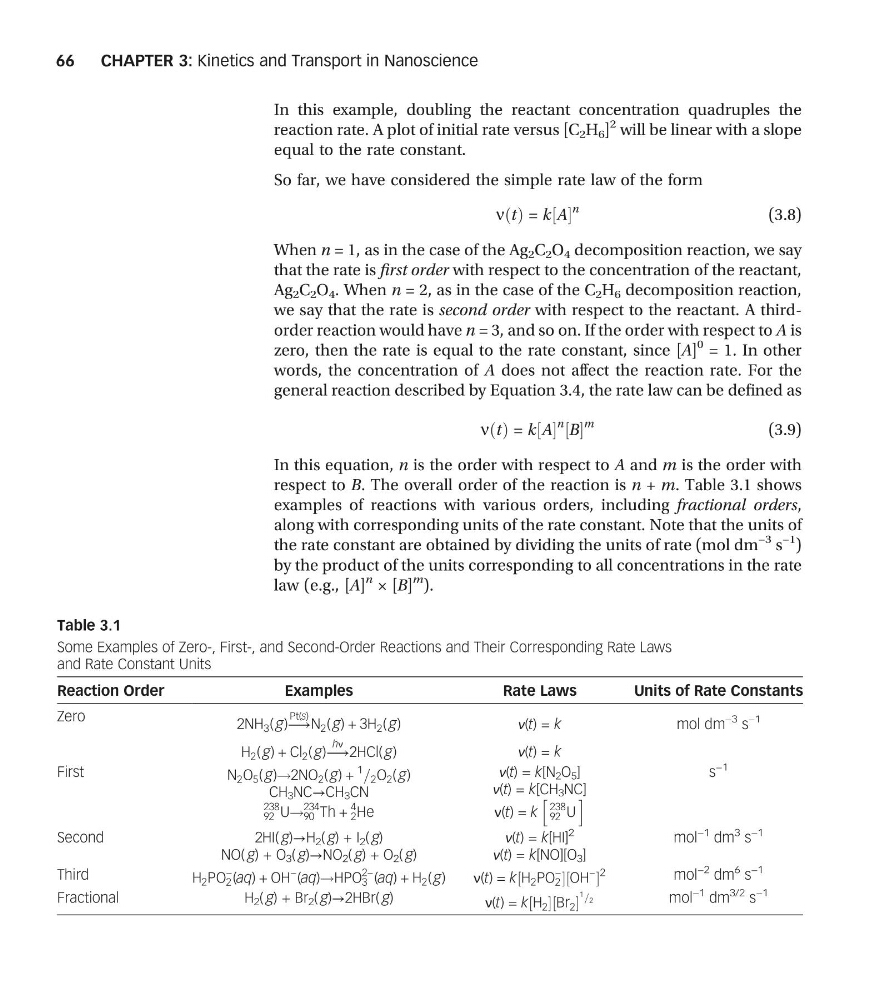
In this equation, n is the order with respect to A and m is the order with
respect to B. The overall order of the reaction is n + m. Table 3.1 shows
examples of reactions with various orders, including fractional orders,
along with corresponding units of the rate constant. Note that the units of
the rate constant are obtained by dividing the units of rate (mol dm
−3 s
−1 )
by the product of the units corresponding to all concentrations in the rate
law (e.g., [A]
n × [B]
m ).
Table 3.1
Some Examples of Zero-, First-, and Second-Order Reactions and Their Corresponding Rate Laws
and Rate Constant Units
Reaction Order
Examples
Rate Laws
Units of Rate Constants
Zero
2NH 3 ( g)⟶
Pt(s) N 2 ( g) + 3H 2 ( g)
ν(t) = k
mol dm
−3 s
−1
H 2 ( g) + Cl 2 ( g)⟶
hν 2HCl( g)
ν(t) = k
First
N 2 O 5 ( g)!2NO 2 ( g) +
1
2
= O 2 ( g)
CH 3 NC→CH 3 CN
238
92 U!
234
90 Th +
4
2 He
ν(t) = k[N 2 O 5 ]
ν(t) = k[CH 3 NC]
ν(t) = k
h
238
92 U
i
s
−1
Second
2HI( g)→H 2 ( g) + I 2 ( g)
NO( g) + O 3 ( g)→NO 2 ( g) + O 2 ( g)
ν(t) = k[HI]
2
ν(t) = k[NO][O 3 ]
mol
−1 dm
3 s
−1
Third
H 2 PO
−
2 (aq) + OH
− (aq)!HPO
2−
3 (aq) + H 2 ( g)
ν(t) = k½H 2 PO
−
2 ½OH
−
2
mol
−2 dm
6 s
−1
Fractional
H 2 ( g) + Br 2 ( g)→2HBr( g)
ν(t) = k½H 2 ½Br 2
1
2
=
mol
−1 dm
3/2 s
−1
CHAPTER 3: Kinetics and Transport in Nanoscience
66
reaction rate. A plot of initial rate versus [C 2 H 6 ]
2 will be linear with a slope
equal to the rate constant.
So far, we have considered the simple rate law of the form
n t
ð Þ = k A
½
n
(3.8)
When n = 1, as in the case of the Ag 2 C 2 O 4 decomposition reaction, we say
that the rate is first order with respect to the concentration of the reactant,
Ag 2 C 2 O 4 . When n = 2, as in the case of the C 2 H 6 decomposition reaction,
we say that the rate is second order with respect to the reactant. A thirdorder reaction would have n = 3, and so on. If the order with respect to A is
zero, then the rate is equal to the rate constant, since [A]
0 = 1. In other
words, the concentration of A does not affect the reaction rate. For the
general reaction described by Equation 3.4, the rate law can be defined as
n t
ð Þ = k A
½
n B
½
m
(3.9)
In this equation, n is the order with respect to A and m is the order with
respect to B. The overall order of the reaction is n + m. Table 3.1 shows
examples of reactions with various orders, including fractional orders,
along with corresponding units of the rate constant. Note that the units of
the rate constant are obtained by dividing the units of rate (mol dm
−3 s
−1 )
by the product of the units corresponding to all concentrations in the rate
law (e.g., [A]
n × [B]
m ).
Table 3.1
Some Examples of Zero-, First-, and Second-Order Reactions and Their Corresponding Rate Laws
and Rate Constant Units
Reaction Order
Examples
Rate Laws
Units of Rate Constants
Zero
2NH 3 ( g)⟶
Pt(s) N 2 ( g) + 3H 2 ( g)
ν(t) = k
mol dm
−3 s
−1
H 2 ( g) + Cl 2 ( g)⟶
hν 2HCl( g)
ν(t) = k
First
N 2 O 5 ( g)!2NO 2 ( g) +
1
2
= O 2 ( g)
CH 3 NC→CH 3 CN
238
92 U!
234
90 Th +
4
2 He
ν(t) = k[N 2 O 5 ]
ν(t) = k[CH 3 NC]
ν(t) = k
h
238
92 U
i
s
−1
Second
2HI( g)→H 2 ( g) + I 2 ( g)
NO( g) + O 3 ( g)→NO 2 ( g) + O 2 ( g)
ν(t) = k[HI]
2
ν(t) = k[NO][O 3 ]
mol
−1 dm
3 s
−1
Third
H 2 PO
−
2 (aq) + OH
− (aq)!HPO
2−
3 (aq) + H 2 ( g)
ν(t) = k½H 2 PO
−
2 ½OH
−
2
mol
−2 dm
6 s
−1
Fractional
H 2 ( g) + Br 2 ( g)→2HBr( g)
ν(t) = k½H 2 ½Br 2
1
2
=
mol
−1 dm
3/2 s
−1
CHAPTER 3: Kinetics and Transport in Nanoscience
66