

There is no simple way of predicting the order of a reaction based on the
identities of the reactions and products; it cannot be arrived at from the
stoichiometric equation. Only through experiments examining the effect
of changing concentration of the reactants on the rate of that reaction can
we determine the rate law. Example 3.1 illustrates the method of initial
rates, which is a method for determining the order and rate constant for a
reaction based on observations of the initial rate of a reaction under
several different starting conditions.
Example 3.1 Method of Initial Rates
The reaction between nitrogen monoxide and chlorine at −15
o C is
given by the following equation:
2NO g
ð Þ + Cl 2 g
ð Þ ! 2NOCl
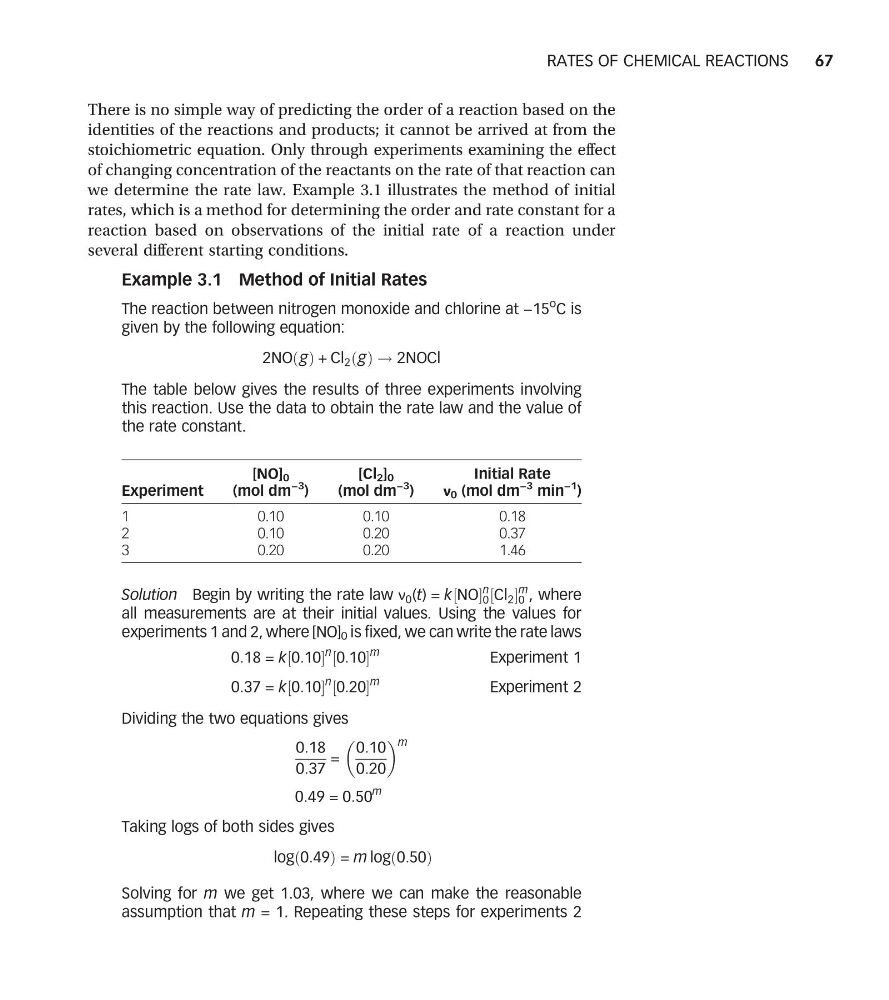
The table below gives the results of three experiments involving
this reaction. Use the data to obtain the rate law and the value of
the rate constant.
Experiment
[NO] 0
(mol dm
−3
)
[Cl 2 ] 0
(mol dm
−3
)
Initial Rate
ν 0 (mol dm
−3 min
−1
)
1
2
3
0.10
0.10
0.20
0.10
0.20
0.20
0.18
0.37
1.46
Solution Begin by writing the rate law ν 0 (t) = k½NO
n
0 ½Cl 2
m
0 , where
all measurements are at their initial values. Using the values for
experiments 1 and 2, where [NO] 0 is fixed, we can write the rate laws
0:18 = k 0:10
½
n 0:10
½
m
Experiment 1
0:37 = k 0:10
½
n 0:20
½
m
Experiment 2
Dividing the two equations gives
0:18
0:37
=
0:10
0:20
m
0:49 = 0:50
m
Taking logs of both sides gives
log 0:49
ð
Þ= m log 0:50
ð
Þ
Solving for m we get 1.03, where we can make the reasonable
assumption that m = 1. Repeating these steps for experiments 2
RATES OF CHEMICAL REACTIONS
67
identities of the reactions and products; it cannot be arrived at from the
stoichiometric equation. Only through experiments examining the effect
of changing concentration of the reactants on the rate of that reaction can
we determine the rate law. Example 3.1 illustrates the method of initial
rates, which is a method for determining the order and rate constant for a
reaction based on observations of the initial rate of a reaction under
several different starting conditions.
Example 3.1 Method of Initial Rates
The reaction between nitrogen monoxide and chlorine at −15
o C is
given by the following equation:
2NO g
ð Þ + Cl 2 g
ð Þ ! 2NOCl
The table below gives the results of three experiments involving
this reaction. Use the data to obtain the rate law and the value of
the rate constant.
Experiment
[NO] 0
(mol dm
−3
)
[Cl 2 ] 0
(mol dm
−3
)
Initial Rate
ν 0 (mol dm
−3 min
−1
)
1
2
3
0.10
0.10
0.20
0.10
0.20
0.20
0.18
0.37
1.46
Solution Begin by writing the rate law ν 0 (t) = k½NO
n
0 ½Cl 2
m
0 , where
all measurements are at their initial values. Using the values for
experiments 1 and 2, where [NO] 0 is fixed, we can write the rate laws
0:18 = k 0:10
½
n 0:10
½
m
Experiment 1
0:37 = k 0:10
½
n 0:20
½
m
Experiment 2
Dividing the two equations gives
0:18
0:37
=
0:10
0:20
m
0:49 = 0:50
m
Taking logs of both sides gives
log 0:49
ð
Þ= m log 0:50
ð
Þ
Solving for m we get 1.03, where we can make the reasonable
assumption that m = 1. Repeating these steps for experiments 2
RATES OF CHEMICAL REACTIONS
67