

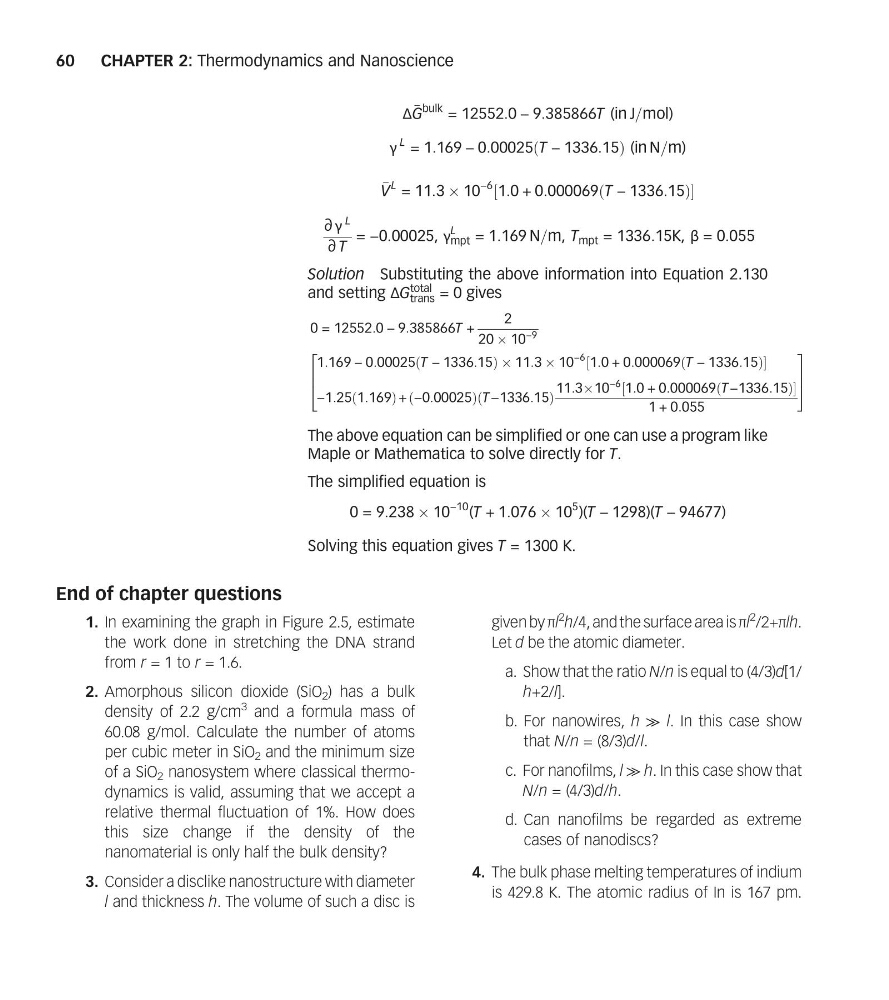
Δ
G
bulk = 12552:0 − 9:385866T (in J=mol)
γ
L = 1:169 − 0:00025 T − 1336:15
ð
Þ(in N=m)
V
L = 11:3 Â 10
−6 1:0 + 0:000069 T − 1336:15
ð
Þ
½
∂ γ
L
∂ T
= −0:00025, γ
L
mpt = 1:169 N=m, T mpt = 1336:15K, β = 0:055
Solution Substituting the above information into Equation 2.130
and setting ΔG
total
trans = 0 gives
0 = 12552:0 − 9:385866T +
2
20 Â 10
−9
1:169 − 0:00025 T − 1336:15
ð
Þ Â 11:3 Â 10
−6 1:0 + 0:000069 T − 1336:15
ð
Þ
½
−1:25 1:169
ð
Þ+ −0:00025
ð
ÞT−1336:15 ð
Þ
11:3Â10
−6 1:0 + 0:000069 T−1336:15
ð
Þ
½
1 + 0:055
2
6
4
3
7
5
The above equation can be simplified or one can use a program like
Maple or Mathematica to solve directly for T.
The simplified equation is
0 = 9:238 Â 10
−10 (T + 1:076 Â 10
5 )(T − 1298)(T − 94677)
Solving this equation gives T = 1300 K.
End of chapter questions
1. In examining the graph in Figure 2.5, estimate
the work done in stretching the DNA strand
from r = 1 to r = 1.6.
2. Amorphous silicon dioxide (SiO 2 ) has a bulk
density of 2.2 g/cm
3 and a formula mass of
60.08 g/mol. Calculate the number of atoms
per cubic meter in SiO 2 and the minimum size
of a SiO 2 nanosystem where classical thermodynamics is valid, assuming that we accept a
relative thermal fluctuation of 1%. How does
this size change if the density of the
nanomaterial is only half the bulk density?
3. Consider a disclike nanostructure with diameter
l and thickness h. The volume of such a disc is
given by πl
2
h/4, and the surface area is πl
2
/2+πlh.
Let d be the atomic diameter.
a. Show that the ratio N/n is equal to (4/3)d[1/
h+2/l].
b. For nanowires, h ≫ l. In this case show
that N/n = (8/3)d/l.
c. For nanofilms, l ≫ h. In this case show that
N/n = (4/3)d/h.
d. Can nanofilms be regarded as extreme
cases of nanodiscs?
4. The bulk phase melting temperatures of indium
is 429.8 K. The atomic radius of In is 167 pm.
CHAPTER 2: Thermodynamics and Nanoscience
60
G
bulk = 12552:0 − 9:385866T (in J=mol)
γ
L = 1:169 − 0:00025 T − 1336:15
ð
Þ(in N=m)
V
L = 11:3 Â 10
−6 1:0 + 0:000069 T − 1336:15
ð
Þ
½
∂ γ
L
∂ T
= −0:00025, γ
L
mpt = 1:169 N=m, T mpt = 1336:15K, β = 0:055
Solution Substituting the above information into Equation 2.130
and setting ΔG
total
trans = 0 gives
0 = 12552:0 − 9:385866T +
2
20 Â 10
−9
1:169 − 0:00025 T − 1336:15
ð
Þ Â 11:3 Â 10
−6 1:0 + 0:000069 T − 1336:15
ð
Þ
½
−1:25 1:169
ð
Þ+ −0:00025
ð
ÞT−1336:15 ð
Þ
11:3Â10
−6 1:0 + 0:000069 T−1336:15
ð
Þ
½
1 + 0:055
2
6
4
3
7
5
The above equation can be simplified or one can use a program like
Maple or Mathematica to solve directly for T.
The simplified equation is
0 = 9:238 Â 10
−10 (T + 1:076 Â 10
5 )(T − 1298)(T − 94677)
Solving this equation gives T = 1300 K.
End of chapter questions
1. In examining the graph in Figure 2.5, estimate
the work done in stretching the DNA strand
from r = 1 to r = 1.6.
2. Amorphous silicon dioxide (SiO 2 ) has a bulk
density of 2.2 g/cm
3 and a formula mass of
60.08 g/mol. Calculate the number of atoms
per cubic meter in SiO 2 and the minimum size
of a SiO 2 nanosystem where classical thermodynamics is valid, assuming that we accept a
relative thermal fluctuation of 1%. How does
this size change if the density of the
nanomaterial is only half the bulk density?
3. Consider a disclike nanostructure with diameter
l and thickness h. The volume of such a disc is
given by πl
2
h/4, and the surface area is πl
2
/2+πlh.
Let d be the atomic diameter.
a. Show that the ratio N/n is equal to (4/3)d[1/
h+2/l].
b. For nanowires, h ≫ l. In this case show
that N/n = (8/3)d/l.
c. For nanofilms, l ≫ h. In this case show that
N/n = (4/3)d/h.
d. Can nanofilms be regarded as extreme
cases of nanodiscs?
4. The bulk phase melting temperatures of indium
is 429.8 K. The atomic radius of In is 167 pm.
CHAPTER 2: Thermodynamics and Nanoscience
60