

Determine the melting point for (a) an In
nanowire of length 20 nm, and (b) an In
nanofilm of thickness 15 nm.
5. Using a graphing program of your choice,
generate a theoretical plot showing how the
melting temperature of an indium nanowire
changes from 2 nm to 20 nm. Use the information given in Problem 5.
6. For the reaction describing the synthesis of silica
nanoparticles, determine the equilibrium constant at 298 K and at 350 K. Assume that the
standard enthalpy of the reaction is constant in
this temperature range. Refer to the data in
Example 2.9 to answer this question.
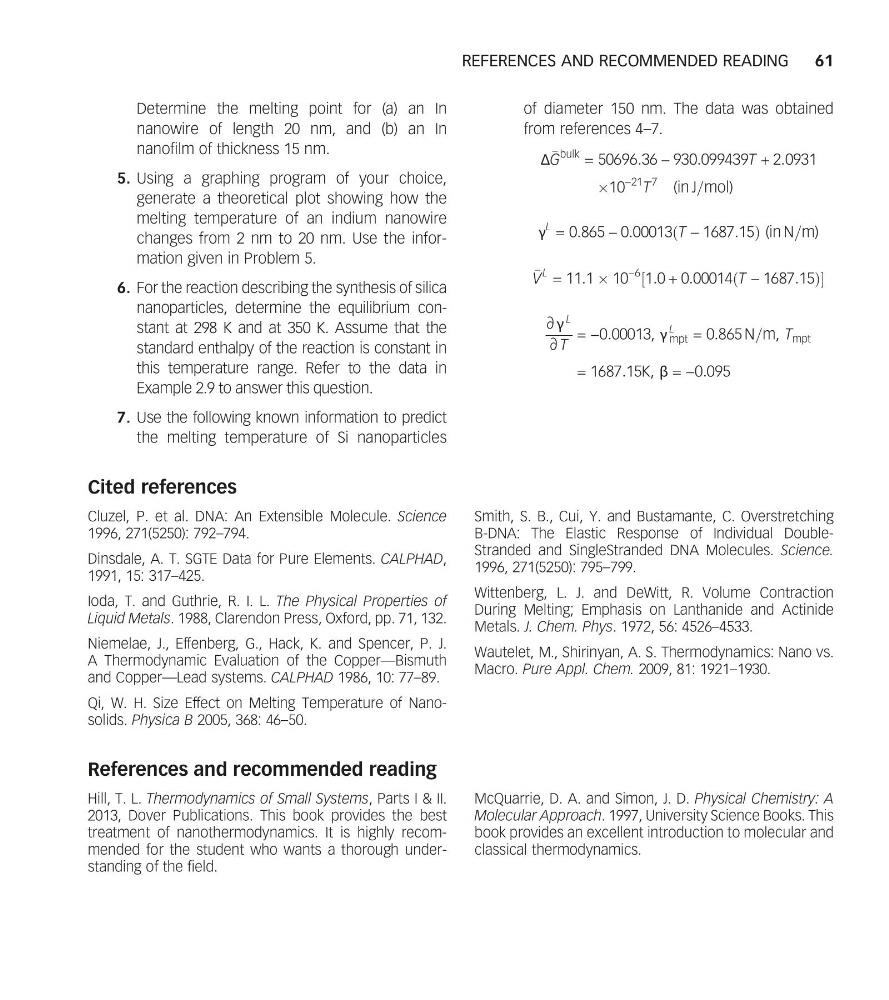
7. Use the following known information to predict
the melting temperature of Si nanoparticles
of diameter 150 nm. The data was obtained
from references 4–7.
Δ
G
bulk = 50696:36 − 930:099439T + 2:0931
Â10
−21 T
7
(in J=mol)
γ
L = 0:865 − 0:00013 T − 1687:15
ð
Þ(in N=m)
V
L = 11:1 Â 10
−6 1:0 + 0:00014 T − 1687:15
ð
Þ
½
∂ γ
L
∂ T
= −0:00013, γ
L
mpt = 0:865 N=m, T mpt
= 1687:15K, β = −0:095
Cited references
Cluzel, P. et al. DNA: An Extensible Molecule. Science
1996, 271(5250): 792–794.
Dinsdale, A. T. SGTE Data for Pure Elements. CALPHAD,
1991, 15: 317–425.
Ioda, T. and Guthrie, R. I. L. The Physical Properties of
Liquid Metals. 1988, Clarendon Press, Oxford, pp. 71, 132.
Niemelae, J., Effenberg, G., Hack, K. and Spencer, P. J.
A Thermodynamic Evaluation of the Copper—Bismuth
and Copper—Lead systems. CALPHAD 1986, 10: 77–89.
Qi, W. H. Size Effect on Melting Temperature of Nanosolids. Physica B 2005, 368: 46–50.
Smith, S. B., Cui, Y. and Bustamante, C. Overstretching
B-DNA: The Elastic Response of Individual DoubleStranded and SingleStranded DNA Molecules. Science.
1996, 271(5250): 795–799.
Wittenberg, L. J. and DeWitt, R. Volume Contraction
During Melting; Emphasis on Lanthanide and Actinide
Metals. J. Chem. Phys. 1972, 56: 4526–4533.
Wautelet, M., Shirinyan, A. S. Thermodynamics: Nano vs.
Macro. Pure Appl. Chem. 2009, 81: 1921–1930.
References and recommended reading
Hill, T. L. Thermodynamics of Small Systems, Parts I & II.
2013, Dover Publications. This book provides the best
treatment of nanothermodynamics. It is highly recommended for the student who wants a thorough understanding of the field.
McQuarrie, D. A. and Simon, J. D. Physical Chemistry: A
Molecular Approach. 1997, University Science Books. This
book provides an excellent introduction to molecular and
classical thermodynamics.
REFERENCES AND RECOMMENDED READING
61
nanowire of length 20 nm, and (b) an In
nanofilm of thickness 15 nm.
5. Using a graphing program of your choice,
generate a theoretical plot showing how the
melting temperature of an indium nanowire
changes from 2 nm to 20 nm. Use the information given in Problem 5.
6. For the reaction describing the synthesis of silica
nanoparticles, determine the equilibrium constant at 298 K and at 350 K. Assume that the
standard enthalpy of the reaction is constant in
this temperature range. Refer to the data in
Example 2.9 to answer this question.
7. Use the following known information to predict
the melting temperature of Si nanoparticles
of diameter 150 nm. The data was obtained
from references 4–7.
Δ
G
bulk = 50696:36 − 930:099439T + 2:0931
Â10
−21 T
7
(in J=mol)
γ
L = 0:865 − 0:00013 T − 1687:15
ð
Þ(in N=m)
V
L = 11:1 Â 10
−6 1:0 + 0:00014 T − 1687:15
ð
Þ
½
∂ γ
L
∂ T
= −0:00013, γ
L
mpt = 0:865 N=m, T mpt
= 1687:15K, β = −0:095
Cited references
Cluzel, P. et al. DNA: An Extensible Molecule. Science
1996, 271(5250): 792–794.
Dinsdale, A. T. SGTE Data for Pure Elements. CALPHAD,
1991, 15: 317–425.
Ioda, T. and Guthrie, R. I. L. The Physical Properties of
Liquid Metals. 1988, Clarendon Press, Oxford, pp. 71, 132.
Niemelae, J., Effenberg, G., Hack, K. and Spencer, P. J.
A Thermodynamic Evaluation of the Copper—Bismuth
and Copper—Lead systems. CALPHAD 1986, 10: 77–89.
Qi, W. H. Size Effect on Melting Temperature of Nanosolids. Physica B 2005, 368: 46–50.
Smith, S. B., Cui, Y. and Bustamante, C. Overstretching
B-DNA: The Elastic Response of Individual DoubleStranded and SingleStranded DNA Molecules. Science.
1996, 271(5250): 795–799.
Wittenberg, L. J. and DeWitt, R. Volume Contraction
During Melting; Emphasis on Lanthanide and Actinide
Metals. J. Chem. Phys. 1972, 56: 4526–4533.
Wautelet, M., Shirinyan, A. S. Thermodynamics: Nano vs.
Macro. Pure Appl. Chem. 2009, 81: 1921–1930.
References and recommended reading
Hill, T. L. Thermodynamics of Small Systems, Parts I & II.
2013, Dover Publications. This book provides the best
treatment of nanothermodynamics. It is highly recommended for the student who wants a thorough understanding of the field.
McQuarrie, D. A. and Simon, J. D. Physical Chemistry: A
Molecular Approach. 1997, University Science Books. This
book provides an excellent introduction to molecular and
classical thermodynamics.
REFERENCES AND RECOMMENDED READING
61