

ΔG
total
trans = ΔG
bulk
trans + ΔG
surf
trans
(2.125)
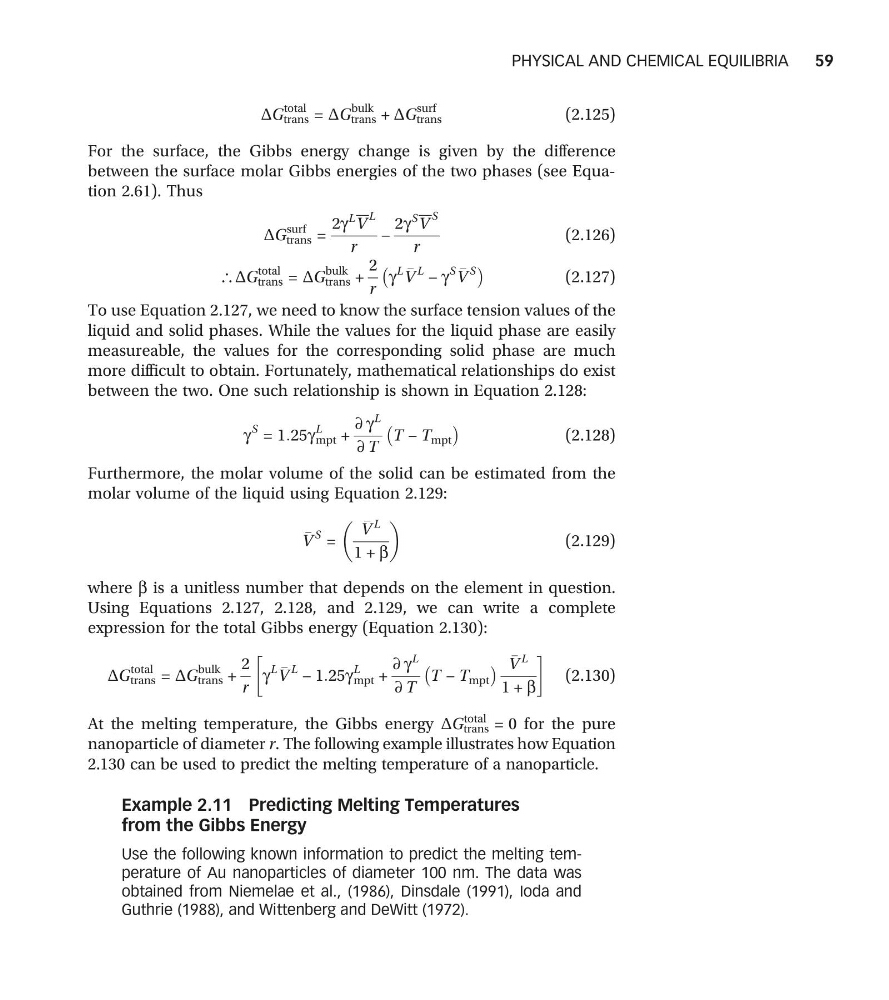
For the surface, the Gibbs energy change is given by the difference
between the surface molar Gibbs energies of the two phases (see Equation 2.61). Thus
ΔG
surf
trans =
2g
L V
L
r
−
2g
S V
S
r
(2.126)
∴ ΔG
total
trans = ΔG
bulk
trans +
2
r
g
L
V
L
− g
S
V
S
À
Á
(2.127)
To use Equation 2.127, we need to know the surface tension values of the
liquid and solid phases. While the values for the liquid phase are easily
measureable, the values for the corresponding solid phase are much
more difficult to obtain. Fortunately, mathematical relationships do exist
between the two. One such relationship is shown in Equation 2.128:
g
S = 1:25g
L
mpt +
∂ g
L
∂ T
T − T mpt
À
Á
(2.128)
Furthermore, the molar volume of the solid can be estimated from the
molar volume of the liquid using Equation 2.129:
V
S =
V
L
1 + b
(2.129)
where b is a unitless number that depends on the element in question.
Using Equations 2.127, 2.128, and 2.129, we can write a complete
expression for the total Gibbs energy (Equation 2.130):
ΔG
total
trans = ΔG
bulk
trans +
2
r
g
L
V
L
− 1:25g
L
mpt +
∂ g
L
∂ T
T − T mpt
À
Á
V
L
1 + b
!
(2.130)
At the melting temperature, the Gibbs energy ΔG
total
trans = 0 for the pure
nanoparticle of diameter r. The following example illustrates how Equation
2.130 can be used to predict the melting temperature of a nanoparticle.
Example 2.11 Predicting Melting Temperatures
from the Gibbs Energy
Use the following known information to predict the melting temperature of Au nanoparticles of diameter 100 nm. The data was
obtained from Niemelae et al., (1986), Dinsdale (1991), Ioda and
Guthrie (1988), and Wittenberg and DeWitt (1972).
PHYSICAL AND CHEMICAL EQUILIBRIA
59
total
trans = ΔG
bulk
trans + ΔG
surf
trans
(2.125)
For the surface, the Gibbs energy change is given by the difference
between the surface molar Gibbs energies of the two phases (see Equation 2.61). Thus
ΔG
surf
trans =
2g
L V
L
r
−
2g
S V
S
r
(2.126)
∴ ΔG
total
trans = ΔG
bulk
trans +
2
r
g
L
V
L
− g
S
V
S
À
Á
(2.127)
To use Equation 2.127, we need to know the surface tension values of the
liquid and solid phases. While the values for the liquid phase are easily
measureable, the values for the corresponding solid phase are much
more difficult to obtain. Fortunately, mathematical relationships do exist
between the two. One such relationship is shown in Equation 2.128:
g
S = 1:25g
L
mpt +
∂ g
L
∂ T
T − T mpt
À
Á
(2.128)
Furthermore, the molar volume of the solid can be estimated from the
molar volume of the liquid using Equation 2.129:
V
S =
V
L
1 + b
(2.129)
where b is a unitless number that depends on the element in question.
Using Equations 2.127, 2.128, and 2.129, we can write a complete
expression for the total Gibbs energy (Equation 2.130):
ΔG
total
trans = ΔG
bulk
trans +
2
r
g
L
V
L
− 1:25g
L
mpt +
∂ g
L
∂ T
T − T mpt
À
Á
V
L
1 + b
!
(2.130)
At the melting temperature, the Gibbs energy ΔG
total
trans = 0 for the pure
nanoparticle of diameter r. The following example illustrates how Equation
2.130 can be used to predict the melting temperature of a nanoparticle.
Example 2.11 Predicting Melting Temperatures
from the Gibbs Energy
Use the following known information to predict the melting temperature of Au nanoparticles of diameter 100 nm. The data was
obtained from Niemelae et al., (1986), Dinsdale (1991), Ioda and
Guthrie (1988), and Wittenberg and DeWitt (1972).
PHYSICAL AND CHEMICAL EQUILIBRIA
59