

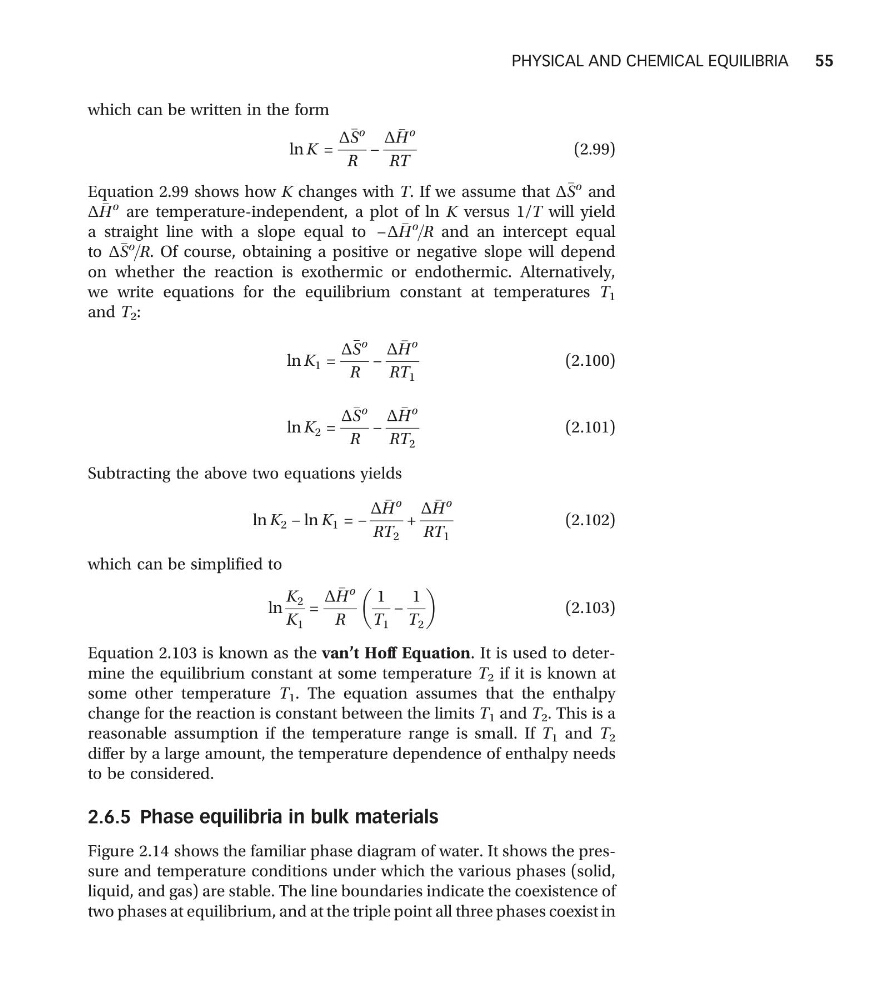
which can be written in the form
ln K =
Δ
S
o
R
−
Δ
H
o
RT
(2.99)
Equation 2.99 shows how K changes with T. If we assume that Δ
S
o and
Δ
H
o are temperature-independent, a plot of ln K versus 1/T will yield
a straight line with a slope equal to −Δ
H
o
=R and an intercept equal
to Δ
S
o
=R. Of course, obtaining a positive or negative slope will depend
on whether the reaction is exothermic or endothermic. Alternatively,
we write equations for the equilibrium constant at temperatures T 1
and T 2 :
ln K 1 =
Δ
S
o
R
−
Δ
H
o
RT 1
(2.100)
ln K 2 =
Δ
S
o
R
−
Δ
H
o
RT 2
(2.101)
Subtracting the above two equations yields
ln K 2 − ln K 1 = −
Δ
H
o
RT 2
+
Δ
H
o
RT 1
(2.102)
which can be simplified to
ln
K 2
K 1
=
Δ
H
o
R
1
T 1
−
1
T 2
(2.103)
Equation 2.103 is known as the van’t Hoff Equation. It is used to determine the equilibrium constant at some temperature T 2 if it is known at
some other temperature T 1 . The equation assumes that the enthalpy
change for the reaction is constant between the limits T 1 and T 2 . This is a
reasonable assumption if the temperature range is small. If T 1 and T 2
differ by a large amount, the temperature dependence of enthalpy needs
to be considered.
2.6.5 Phase equilibria in bulk materials
Figure 2.14 shows the familiar phase diagram of water. It shows the pressure and temperature conditions under which the various phases (solid,
liquid, and gas) are stable. The line boundaries indicate the coexistence of
two phases at equilibrium, and at the triple point all three phases coexist in
PHYSICAL AND CHEMICAL EQUILIBRIA
55
ln K =
Δ
S
o
R
−
Δ
H
o
RT
(2.99)
Equation 2.99 shows how K changes with T. If we assume that Δ
S
o and
Δ
H
o are temperature-independent, a plot of ln K versus 1/T will yield
a straight line with a slope equal to −Δ
H
o
=R and an intercept equal
to Δ
S
o
=R. Of course, obtaining a positive or negative slope will depend
on whether the reaction is exothermic or endothermic. Alternatively,
we write equations for the equilibrium constant at temperatures T 1
and T 2 :
ln K 1 =
Δ
S
o
R
−
Δ
H
o
RT 1
(2.100)
ln K 2 =
Δ
S
o
R
−
Δ
H
o
RT 2
(2.101)
Subtracting the above two equations yields
ln K 2 − ln K 1 = −
Δ
H
o
RT 2
+
Δ
H
o
RT 1
(2.102)
which can be simplified to
ln
K 2
K 1
=
Δ
H
o
R
1
T 1
−
1
T 2
(2.103)
Equation 2.103 is known as the van’t Hoff Equation. It is used to determine the equilibrium constant at some temperature T 2 if it is known at
some other temperature T 1 . The equation assumes that the enthalpy
change for the reaction is constant between the limits T 1 and T 2 . This is a
reasonable assumption if the temperature range is small. If T 1 and T 2
differ by a large amount, the temperature dependence of enthalpy needs
to be considered.
2.6.5 Phase equilibria in bulk materials
Figure 2.14 shows the familiar phase diagram of water. It shows the pressure and temperature conditions under which the various phases (solid,
liquid, and gas) are stable. The line boundaries indicate the coexistence of
two phases at equilibrium, and at the triple point all three phases coexist in
PHYSICAL AND CHEMICAL EQUILIBRIA
55