

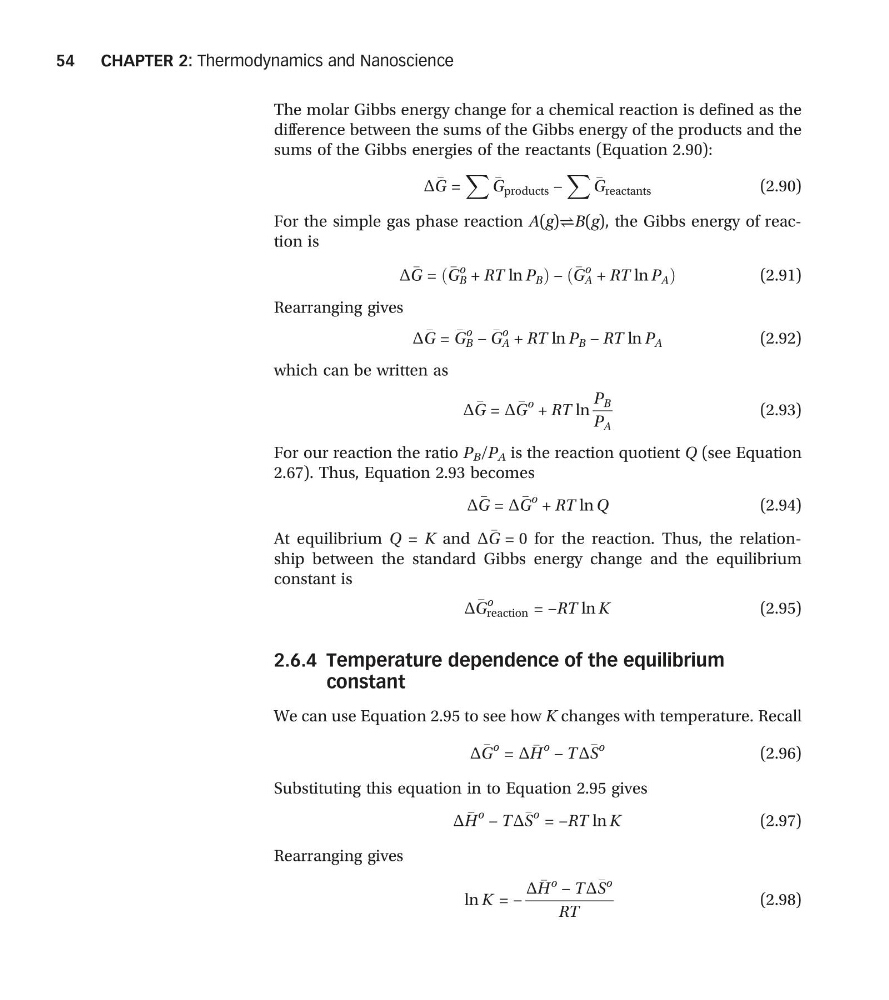
The molar Gibbs energy change for a chemical reaction is defined as the
difference between the sums of the Gibbs energy of the products and the
sums of the Gibbs energies of the reactants (Equation 2.90):
Δ
G =
X
G products −
X
G reactants
(2.90)
For the simple gas phase reaction A(g)⇌B(g), the Gibbs energy of reaction is
Δ
G =
G
o
B + RT ln P B
ð
Þ−
G
o
A + RT ln P A
ð
Þ
(2.91)
Rearranging gives
Δ
G =
G
o
B −
G
o
A + RT ln P B − RT ln P A
(2.92)
which can be written as
Δ
G = Δ
G
o + RT ln
P B
P A
(2.93)
For our reaction the ratio P B /P A is the reaction quotient Q (see Equation
2.67). Thus, Equation 2.93 becomes
Δ
G = Δ
G
o + RT ln Q
(2.94)
At equilibrium Q = K and Δ
G = 0 for the reaction. Thus, the relationship between the standard Gibbs energy change and the equilibrium
constant is
Δ
G
o
reaction = −RT ln K
(2.95)
2.6.4 Temperature dependence of the equilibrium
constant
We can use Equation 2.95 to see how K changes with temperature. Recall
Δ
G
o = Δ
H
o
− TΔ
S
o
(2.96)
Substituting this equation in to Equation 2.95 gives
Δ
H
o
− TΔ
S
o = −RT ln K
(2.97)
Rearranging gives
ln K = −
Δ
H
o
− TΔ
S
o
RT
(2.98)
CHAPTER 2: Thermodynamics and Nanoscience
54
difference between the sums of the Gibbs energy of the products and the
sums of the Gibbs energies of the reactants (Equation 2.90):
Δ
G =
X
G products −
X
G reactants
(2.90)
For the simple gas phase reaction A(g)⇌B(g), the Gibbs energy of reaction is
Δ
G =
G
o
B + RT ln P B
ð
Þ−
G
o
A + RT ln P A
ð
Þ
(2.91)
Rearranging gives
Δ
G =
G
o
B −
G
o
A + RT ln P B − RT ln P A
(2.92)
which can be written as
Δ
G = Δ
G
o + RT ln
P B
P A
(2.93)
For our reaction the ratio P B /P A is the reaction quotient Q (see Equation
2.67). Thus, Equation 2.93 becomes
Δ
G = Δ
G
o + RT ln Q
(2.94)
At equilibrium Q = K and Δ
G = 0 for the reaction. Thus, the relationship between the standard Gibbs energy change and the equilibrium
constant is
Δ
G
o
reaction = −RT ln K
(2.95)
2.6.4 Temperature dependence of the equilibrium
constant
We can use Equation 2.95 to see how K changes with temperature. Recall
Δ
G
o = Δ
H
o
− TΔ
S
o
(2.96)
Substituting this equation in to Equation 2.95 gives
Δ
H
o
− TΔ
S
o = −RT ln K
(2.97)
Rearranging gives
ln K = −
Δ
H
o
− TΔ
S
o
RT
(2.98)
CHAPTER 2: Thermodynamics and Nanoscience
54