

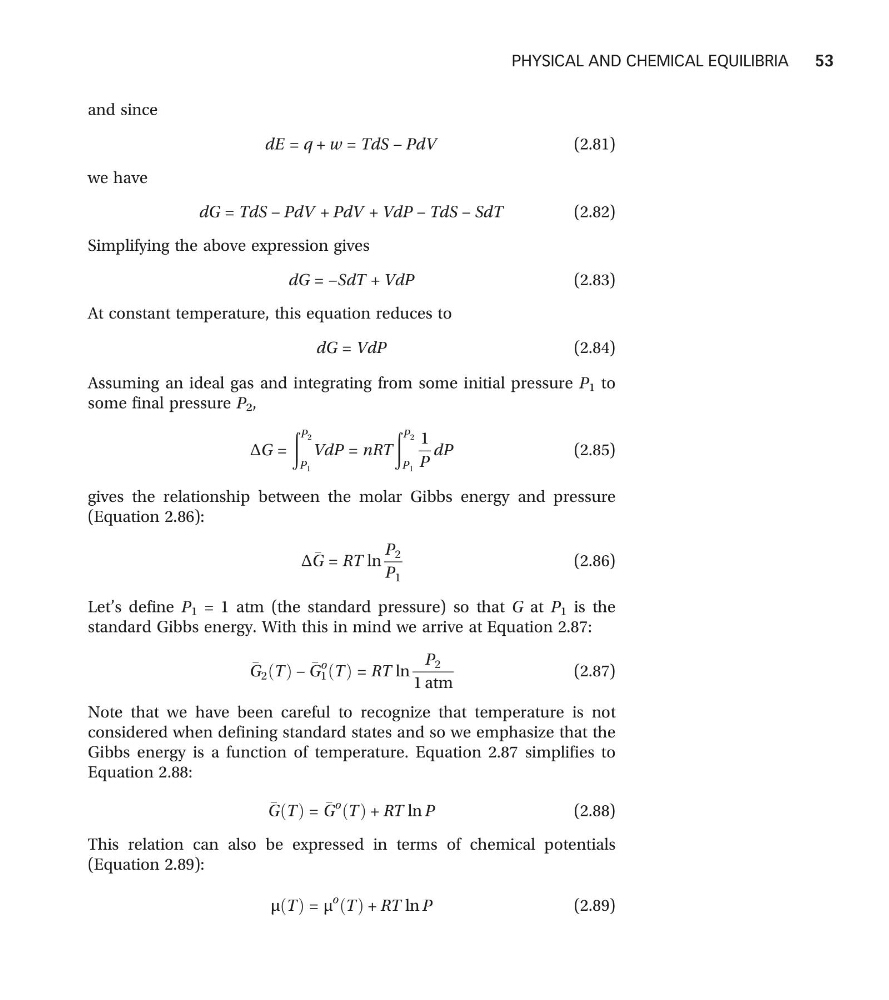
and since
dE = q + w = TdS − PdV
(2.81)
we have
dG = TdS − PdV + PdV + VdP − TdS − SdT
(2.82)
Simplifying the above expression gives
dG = −SdT + VdP
(2.83)
At constant temperature, this equation reduces to
dG = VdP
(2.84)
Assuming an ideal gas and integrating from some initial pressure P 1 to
some final pressure P 2 ,
ΔG =
ð P 2
P 1
VdP = nRT
ð P 2
P 1
1
P
dP
(2.85)
gives the relationship between the molar Gibbs energy and pressure
(Equation 2.86):
Δ
G = RT ln
P 2
P 1
(2.86)
Let’s define P 1 = 1 atm (the standard pressure) so that G at P 1 is the
standard Gibbs energy. With this in mind we arrive at Equation 2.87:
G 2 T
ð Þ −
G
o
1 T
ð Þ = RT ln
P 2
1 atm
(2.87)
Note that we have been careful to recognize that temperature is not
considered when defining standard states and so we emphasize that the
Gibbs energy is a function of temperature. Equation 2.87 simplifies to
Equation 2.88:
G T
ð Þ =
G
o T
ð Þ + RT ln P
(2.88)
This relation can also be expressed in terms of chemical potentials
(Equation 2.89):
μ T
ð Þ = μ
o T
ð Þ + RT ln P
(2.89)
PHYSICAL AND CHEMICAL EQUILIBRIA
53
dE = q + w = TdS − PdV
(2.81)
we have
dG = TdS − PdV + PdV + VdP − TdS − SdT
(2.82)
Simplifying the above expression gives
dG = −SdT + VdP
(2.83)
At constant temperature, this equation reduces to
dG = VdP
(2.84)
Assuming an ideal gas and integrating from some initial pressure P 1 to
some final pressure P 2 ,
ΔG =
ð P 2
P 1
VdP = nRT
ð P 2
P 1
1
P
dP
(2.85)
gives the relationship between the molar Gibbs energy and pressure
(Equation 2.86):
Δ
G = RT ln
P 2
P 1
(2.86)
Let’s define P 1 = 1 atm (the standard pressure) so that G at P 1 is the
standard Gibbs energy. With this in mind we arrive at Equation 2.87:
G 2 T
ð Þ −
G
o
1 T
ð Þ = RT ln
P 2
1 atm
(2.87)
Note that we have been careful to recognize that temperature is not
considered when defining standard states and so we emphasize that the
Gibbs energy is a function of temperature. Equation 2.87 simplifies to
Equation 2.88:
G T
ð Þ =
G
o T
ð Þ + RT ln P
(2.88)
This relation can also be expressed in terms of chemical potentials
(Equation 2.89):
μ T
ð Þ = μ
o T
ð Þ + RT ln P
(2.89)
PHYSICAL AND CHEMICAL EQUILIBRIA
53