

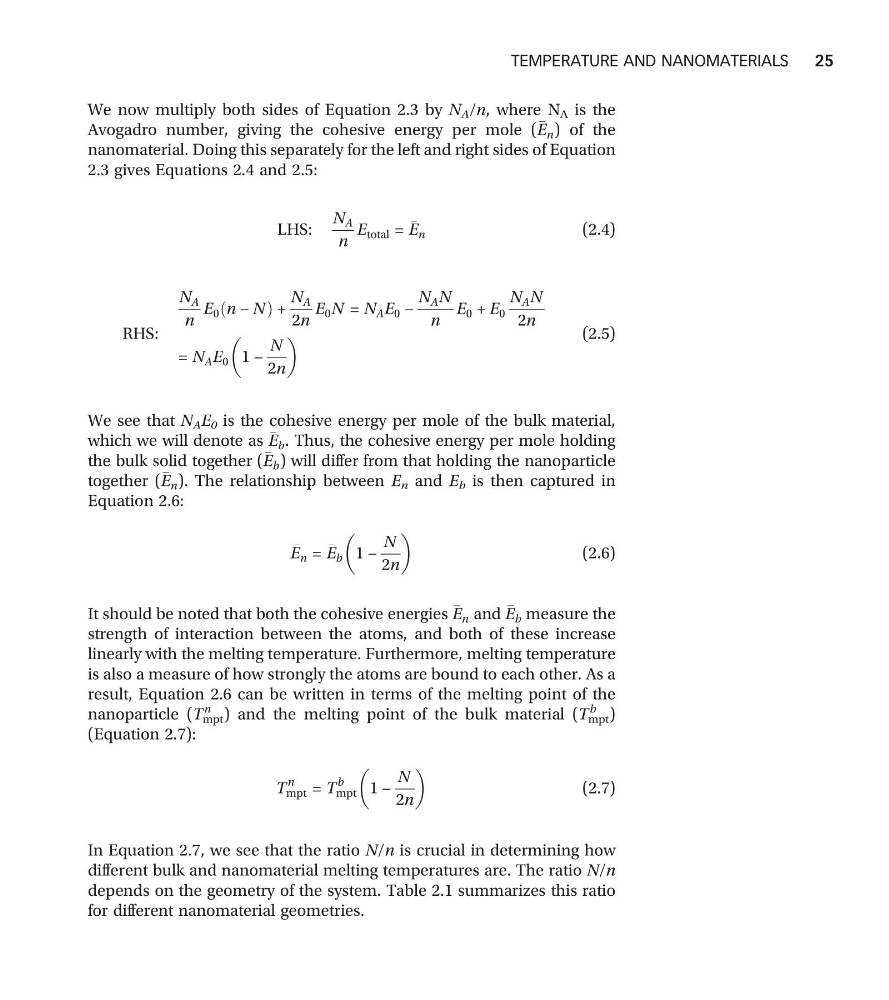
We now multiply both sides of Equation 2.3 by N A /n, where N A is the
Avogadro number, giving the cohesive energy per mole (
E n ) of the
nanomaterial. Doing this separately for the left and right sides of Equation
2.3 gives Equations 2.4 and 2.5:
LHS:
N A
n
E total =
E n
(2.4)
RHS:
N A
n
E 0 n − N
ð
Þ+
N A
2n
E 0 N = N A E 0 −
N A N
n
E 0 + E 0
N A N
2n
= N A E 0 1 −
N
2n
(2.5)
We see that N A E 0 is the cohesive energy per mole of the bulk material,
which we will denote as
E b . Thus, the cohesive energy per mole holding
the bulk solid together (
E b ) will differ from that holding the nanoparticle
together (
E n ). The relationship between E n and E b is then captured in
Equation 2.6:
E n =
E b 1 −
N
2n
(2.6)
It should be noted that both the cohesive energies
E n and
E b measure the
strength of interaction between the atoms, and both of these increase
linearly with the melting temperature. Furthermore, melting temperature
is also a measure of how strongly the atoms are bound to each other. As a
result, Equation 2.6 can be written in terms of the melting point of the
nanoparticle (T
n
mpt ) and the melting point of the bulk material (T
b
mpt )
(Equation 2.7):
T
n
mpt = T
b
mpt 1 −
N
2n
(2.7)
In Equation 2.7, we see that the ratio N/n is crucial in determining how
different bulk and nanomaterial melting temperatures are. The ratio N/n
depends on the geometry of the system. Table 2.1 summarizes this ratio
for different nanomaterial geometries.
TEMPERATURE AND NANOMATERIALS
25
Avogadro number, giving the cohesive energy per mole (
E n ) of the
nanomaterial. Doing this separately for the left and right sides of Equation
2.3 gives Equations 2.4 and 2.5:
LHS:
N A
n
E total =
E n
(2.4)
RHS:
N A
n
E 0 n − N
ð
Þ+
N A
2n
E 0 N = N A E 0 −
N A N
n
E 0 + E 0
N A N
2n
= N A E 0 1 −
N
2n
(2.5)
We see that N A E 0 is the cohesive energy per mole of the bulk material,
which we will denote as
E b . Thus, the cohesive energy per mole holding
the bulk solid together (
E b ) will differ from that holding the nanoparticle
together (
E n ). The relationship between E n and E b is then captured in
Equation 2.6:
E n =
E b 1 −
N
2n
(2.6)
It should be noted that both the cohesive energies
E n and
E b measure the
strength of interaction between the atoms, and both of these increase
linearly with the melting temperature. Furthermore, melting temperature
is also a measure of how strongly the atoms are bound to each other. As a
result, Equation 2.6 can be written in terms of the melting point of the
nanoparticle (T
n
mpt ) and the melting point of the bulk material (T
b
mpt )
(Equation 2.7):
T
n
mpt = T
b
mpt 1 −
N
2n
(2.7)
In Equation 2.7, we see that the ratio N/n is crucial in determining how
different bulk and nanomaterial melting temperatures are. The ratio N/n
depends on the geometry of the system. Table 2.1 summarizes this ratio
for different nanomaterial geometries.
TEMPERATURE AND NANOMATERIALS
25