

Example 2.3 Determining the N/n Ratio
for a Spherical Nanoparticle
The volume and the corresponding surface area of a sphere is
πD
3
6
and πD
2
, respectively, where D is the diameter. Show that
N
n
=
4d
D
for
a nanophere, where d is the diameter of an individual atom in the
nanoparticle.
Solution The volume of an atom is
πd
3
6
. The total number of
atoms can be obtained by dividing the nanoparticle volume by the
volume of a single atom. Thus
n =
πD
3
=6
πd 3 =6
=
D
3
d 3
Each atom’s contribution to the surface area of the nanoparticle is
simply the area of its great circle (i.e., π
d
2
2
=
πd
2
4
). To determine
N, the total number of surface atoms, we divide the total surface
area of the nanoparticle by the area of the great circle of the atom.
Thus
N =
πD
2
πd
2
=4
=
4D
2
d
2
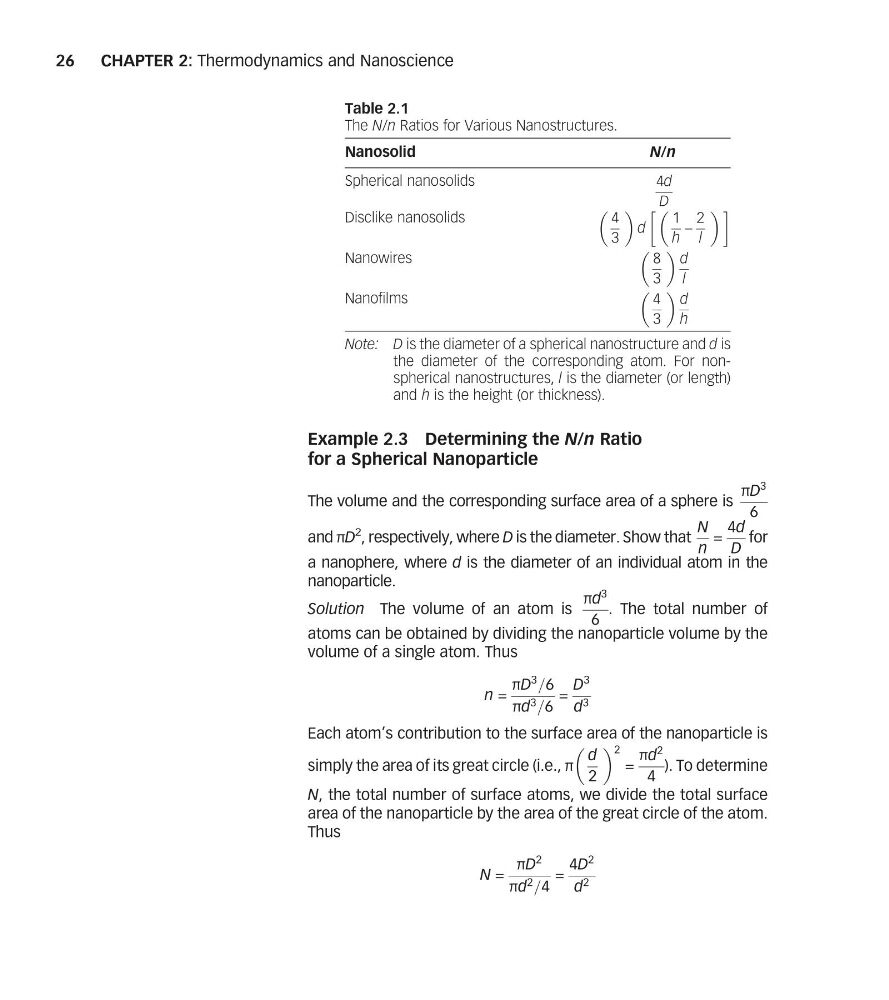
Table 2.1
The N/n Ratios for Various Nanostructures.
Nanosolid
N/n
Spherical nanosolids
4d
D
Disclike nanosolids
4
3
d
1
h
−
2
l
!
Nanowires
8
3
d
l
Nanofilms
4
3
d
h
Note: D is the diameter of a spherical nanostructure and d is
the diameter of the corresponding atom. For nonspherical nanostructures, l is the diameter (or length)
and h is the height (or thickness).
CHAPTER 2: Thermodynamics and Nanoscience
26
for a Spherical Nanoparticle
The volume and the corresponding surface area of a sphere is
πD
3
6
and πD
2
, respectively, where D is the diameter. Show that
N
n
=
4d
D
for
a nanophere, where d is the diameter of an individual atom in the
nanoparticle.
Solution The volume of an atom is
πd
3
6
. The total number of
atoms can be obtained by dividing the nanoparticle volume by the
volume of a single atom. Thus
n =
πD
3
=6
πd 3 =6
=
D
3
d 3
Each atom’s contribution to the surface area of the nanoparticle is
simply the area of its great circle (i.e., π
d
2
2
=
πd
2
4
). To determine
N, the total number of surface atoms, we divide the total surface
area of the nanoparticle by the area of the great circle of the atom.
Thus
N =
πD
2
πd
2
=4
=
4D
2
d
2
Table 2.1
The N/n Ratios for Various Nanostructures.
Nanosolid
N/n
Spherical nanosolids
4d
D
Disclike nanosolids
4
3
d
1
h
−
2
l
!
Nanowires
8
3
d
l
Nanofilms
4
3
d
h
Note: D is the diameter of a spherical nanostructure and d is
the diameter of the corresponding atom. For nonspherical nanostructures, l is the diameter (or length)
and h is the height (or thickness).
CHAPTER 2: Thermodynamics and Nanoscience
26