

As a result, the surface contribution to the total cohesive energy is
1
2
NE o .
Therefore, the total cohesive energy of the nanomaterial can be described
by Equation 2.3:
E total = E 0 n − N
ð
Þ+
1
2
E o N
(2.3)
0
200
400
600
800
1000
1200
0
1
2
3
4
5
6
7
8
9
10
Nanoparticle diameter (nm)
Melting temperature (°C)
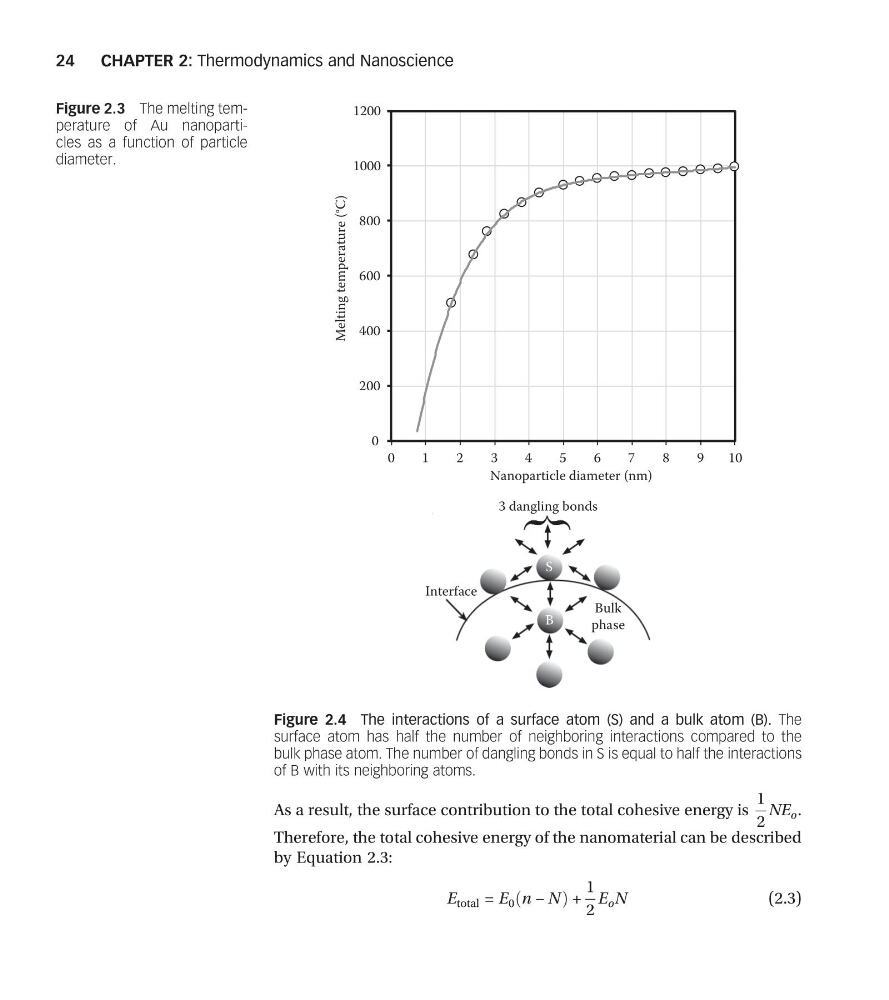
Figure 2.3 The melting temperature of Au nanoparticles as a function of particle
diameter.
3 dangling bonds
Interface
Bulk
phase
S
B
Figure 2.4 The interactions of a surface atom (S) and a bulk atom (B). The
surface atom has half the number of neighboring interactions compared to the
bulk phase atom. The number of dangling bonds in S is equal to half the interactions
of B with its neighboring atoms.
CHAPTER 2: Thermodynamics and Nanoscience
24
1
2
NE o .
Therefore, the total cohesive energy of the nanomaterial can be described
by Equation 2.3:
E total = E 0 n − N
ð
Þ+
1
2
E o N
(2.3)
0
200
400
600
800
1000
1200
0
1
2
3
4
5
6
7
8
9
10
Nanoparticle diameter (nm)
Melting temperature (°C)
Figure 2.3 The melting temperature of Au nanoparticles as a function of particle
diameter.
3 dangling bonds
Interface
Bulk
phase
S
B
Figure 2.4 The interactions of a surface atom (S) and a bulk atom (B). The
surface atom has half the number of neighboring interactions compared to the
bulk phase atom. The number of dangling bonds in S is equal to half the interactions
of B with its neighboring atoms.
CHAPTER 2: Thermodynamics and Nanoscience
24