

We define the relative temperature fluctuation at T as ΔT/T, where ΔT is
the range of temperature that deviates from T. We will consider classical
thermodynamics to be valid, when relative temperature fluctuations are
below 1% (0.01), (Wautelet and Shirinyan, 2009).
Example 2.2 Relative Temperature Fluctuation
and Nanosystems
Silver has a density of 10.5 g/cm
3 and has an atomic mass of
107.86 g/mol, yielding a number density of 6 × 10
30 atoms/m
3
.
Consider a nanomaterial of length L composed of N = 10
30 atoms per
cubic meter. Assuming we accept a relative temperature fluctuation
less than 0.01, determine the minimum size of the nanomaterial for
thermodynamics to be accepted.
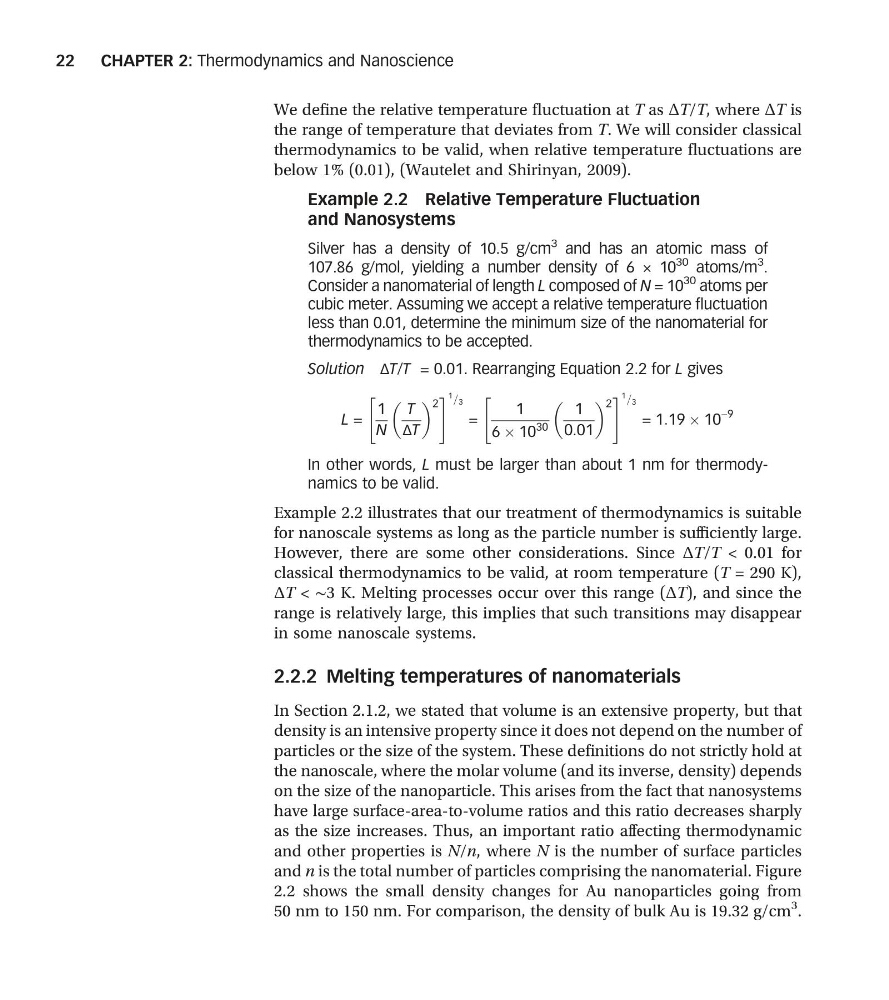
Solution ΔT/T = 0.01. Rearranging Equation 2.2 for L gives
L =
1
N
T
ΔT
2
"
# 1
3
=
=
1
6 Â 10
30
1
0:01
2
"
# 1
3
=
= 1:19 Â 10
−9
In other words, L must be larger than about 1 nm for thermodynamics to be valid.
Example 2.2 illustrates that our treatment of thermodynamics is suitable
for nanoscale systems as long as the particle number is sufficiently large.
However, there are some other considerations. Since ΔT/T < 0.01 for
classical thermodynamics to be valid, at room temperature (T = 290 K),
ΔT < ∼3 K. Melting processes occur over this range (ΔT), and since the
range is relatively large, this implies that such transitions may disappear
in some nanoscale systems.
2.2.2 Melting temperatures of nanomaterials
In Section 2.1.2, we stated that volume is an extensive property, but that
density is an intensive property since it does not depend on the number of
particles or the size of the system. These definitions do not strictly hold at
the nanoscale, where the molar volume (and its inverse, density) depends
on the size of the nanoparticle. This arises from the fact that nanosystems
have large surface-area-to-volume ratios and this ratio decreases sharply
as the size increases. Thus, an important ratio affecting thermodynamic
and other properties is N/n, where N is the number of surface particles
and n is the total number of particles comprising the nanomaterial. Figure
2.2 shows the small density changes for Au nanoparticles going from
50 nm to 150 nm. For comparison, the density of bulk Au is 19.32 g/cm
3
.
CHAPTER 2: Thermodynamics and Nanoscience
22
the range of temperature that deviates from T. We will consider classical
thermodynamics to be valid, when relative temperature fluctuations are
below 1% (0.01), (Wautelet and Shirinyan, 2009).
Example 2.2 Relative Temperature Fluctuation
and Nanosystems
Silver has a density of 10.5 g/cm
3 and has an atomic mass of
107.86 g/mol, yielding a number density of 6 × 10
30 atoms/m
3
.
Consider a nanomaterial of length L composed of N = 10
30 atoms per
cubic meter. Assuming we accept a relative temperature fluctuation
less than 0.01, determine the minimum size of the nanomaterial for
thermodynamics to be accepted.
Solution ΔT/T = 0.01. Rearranging Equation 2.2 for L gives
L =
1
N
T
ΔT
2
"
# 1
3
=
=
1
6 Â 10
30
1
0:01
2
"
# 1
3
=
= 1:19 Â 10
−9
In other words, L must be larger than about 1 nm for thermodynamics to be valid.
Example 2.2 illustrates that our treatment of thermodynamics is suitable
for nanoscale systems as long as the particle number is sufficiently large.
However, there are some other considerations. Since ΔT/T < 0.01 for
classical thermodynamics to be valid, at room temperature (T = 290 K),
ΔT < ∼3 K. Melting processes occur over this range (ΔT), and since the
range is relatively large, this implies that such transitions may disappear
in some nanoscale systems.
2.2.2 Melting temperatures of nanomaterials
In Section 2.1.2, we stated that volume is an extensive property, but that
density is an intensive property since it does not depend on the number of
particles or the size of the system. These definitions do not strictly hold at
the nanoscale, where the molar volume (and its inverse, density) depends
on the size of the nanoparticle. This arises from the fact that nanosystems
have large surface-area-to-volume ratios and this ratio decreases sharply
as the size increases. Thus, an important ratio affecting thermodynamic
and other properties is N/n, where N is the number of surface particles
and n is the total number of particles comprising the nanomaterial. Figure
2.2 shows the small density changes for Au nanoparticles going from
50 nm to 150 nm. For comparison, the density of bulk Au is 19.32 g/cm
3
.
CHAPTER 2: Thermodynamics and Nanoscience
22