

leading to the formation of silica (SiO 2 ) nanoparticles. Under certain
conditions we have the reaction in which silicic acid converts to silica
nanoparticles:
Si OH
ð Þ 4 aq
ð Þ ⇌ SiO 2 aq
ð Þ + 2H 2 O aq
ð Þ
The double arrow indicates the reaction is reversible. When equilibrium
is reached we have constant concentrations of reactants and products
despite the fact that the forward and reverse reactions are still occurring
on the microscopic level. In general chemistry you learned the effect of
concentration of each species in the reaction, and external factors, such as
pressure and temperature, on the position of chemical equilibrium.
In general, a system reaches equilibrium when the system has no effect on
the external environment despite not being isolated from it. For example,
a system may reach mechanical equilibrium once there’s no change in
pressure between the system and its surroundings. The most common
types of equilibria include thermal equilibrium (the system and its surroundings are at the same temperature), chemical equilibrium (the
chemical composition of system does not change with time), and phase
equilibrium (the amount of each phase does not change with time). We
will return to physical and chemical equilibria in Section 2.6.
2.2 TEMPERATURE AND NANOMATERIALS
2.2.1 Thermodynamics and size effects
In classical thermodynamics the system of interest is macroscopic and
composed of a huge number of atoms. Temperature, T, is defined for the
entire system based on its average kinetic energy. The temperature of
individual (or a small group of) atoms and molecules within the system is
not defined. The equations of thermodynamics are generally valid for
systems composed of a large number of particles. What about defining the
temperature of nanomaterials, which may be composed of only hundreds
or thousands of atoms? Is there some limit below which temperature
becomes undefined?
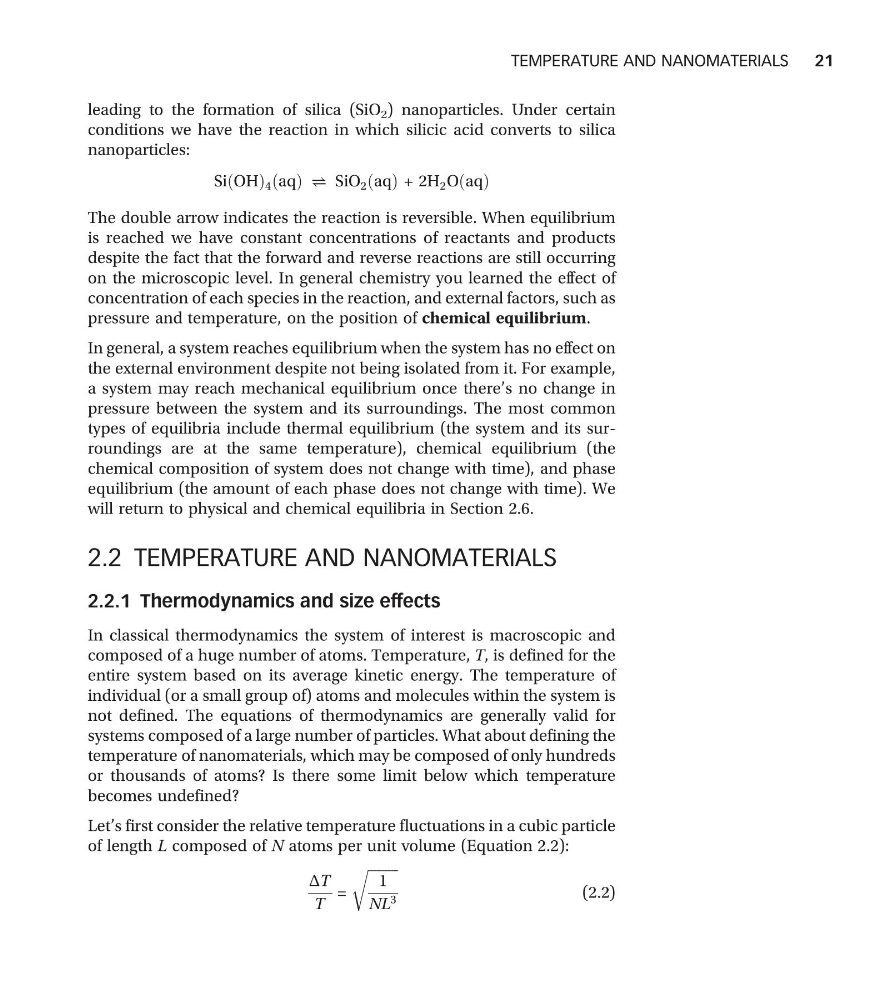
Let’s first consider the relative temperature fluctuations in a cubic particle
of length L composed of N atoms per unit volume (Equation 2.2):
ΔT
T
=
ffiffiffiffiffiffiffiffiffi
1
NL
3
r
(2.2)
TEMPERATURE AND NANOMATERIALS
21
conditions we have the reaction in which silicic acid converts to silica
nanoparticles:
Si OH
ð Þ 4 aq
ð Þ ⇌ SiO 2 aq
ð Þ + 2H 2 O aq
ð Þ
The double arrow indicates the reaction is reversible. When equilibrium
is reached we have constant concentrations of reactants and products
despite the fact that the forward and reverse reactions are still occurring
on the microscopic level. In general chemistry you learned the effect of
concentration of each species in the reaction, and external factors, such as
pressure and temperature, on the position of chemical equilibrium.
In general, a system reaches equilibrium when the system has no effect on
the external environment despite not being isolated from it. For example,
a system may reach mechanical equilibrium once there’s no change in
pressure between the system and its surroundings. The most common
types of equilibria include thermal equilibrium (the system and its surroundings are at the same temperature), chemical equilibrium (the
chemical composition of system does not change with time), and phase
equilibrium (the amount of each phase does not change with time). We
will return to physical and chemical equilibria in Section 2.6.
2.2 TEMPERATURE AND NANOMATERIALS
2.2.1 Thermodynamics and size effects
In classical thermodynamics the system of interest is macroscopic and
composed of a huge number of atoms. Temperature, T, is defined for the
entire system based on its average kinetic energy. The temperature of
individual (or a small group of) atoms and molecules within the system is
not defined. The equations of thermodynamics are generally valid for
systems composed of a large number of particles. What about defining the
temperature of nanomaterials, which may be composed of only hundreds
or thousands of atoms? Is there some limit below which temperature
becomes undefined?
Let’s first consider the relative temperature fluctuations in a cubic particle
of length L composed of N atoms per unit volume (Equation 2.2):
ΔT
T
=
ffiffiffiffiffiffiffiffiffi
1
NL
3
r
(2.2)
TEMPERATURE AND NANOMATERIALS
21