

2.1.3 Reversible and irreversible changes
Changes to matter may be either reversible (proceeding through a series
of tiny changes) or irreversible (proceeding through large, sudden
changes). Let’s consider a process when one phase (e.g., ice) changes to
another phase (e.g., water). Under certain conditions phase changes are
irreversible. The melting of a 200-nm-wide gold solid nanoparticle at
1100°C is an example of an irreversible process. The particle’s melting
point is around 1064
o C, and above this temperature it spontaneously
melts to the liquid phase. An irreversible change is one that proceeds in
one direction and the final state does not revert back to the original.
Examples of these processes include the sublimation of solid iodine at
30°C, the mixing of two gases, and the expansion of a gas into a vacuum.
Returning to our Au nanoparticle, we observe that at the melting point
(1064°C) the two phases (solid and liquid) coexist with constant amounts
of each phase. This is an example of physical equilibrium. At the
molecular level, Au atoms from the solid nanoparticle are constantly
entering the liquid phase, and Au atoms from the liquid are constantly
entering the solid phase. Therefore, at the microscopic level the system is
dynamic and reversible, but at the macroscopic level nothing appears to
be changing. A chemical equilibrium reaction is another type of reversible
change. As an additional example, let’s consider an important reaction
Remove pins
Gas (P i , V i )
Gas (P f , V f )
P ext
P ext
State A
State B
(+q, –w, ΔE)
Δx
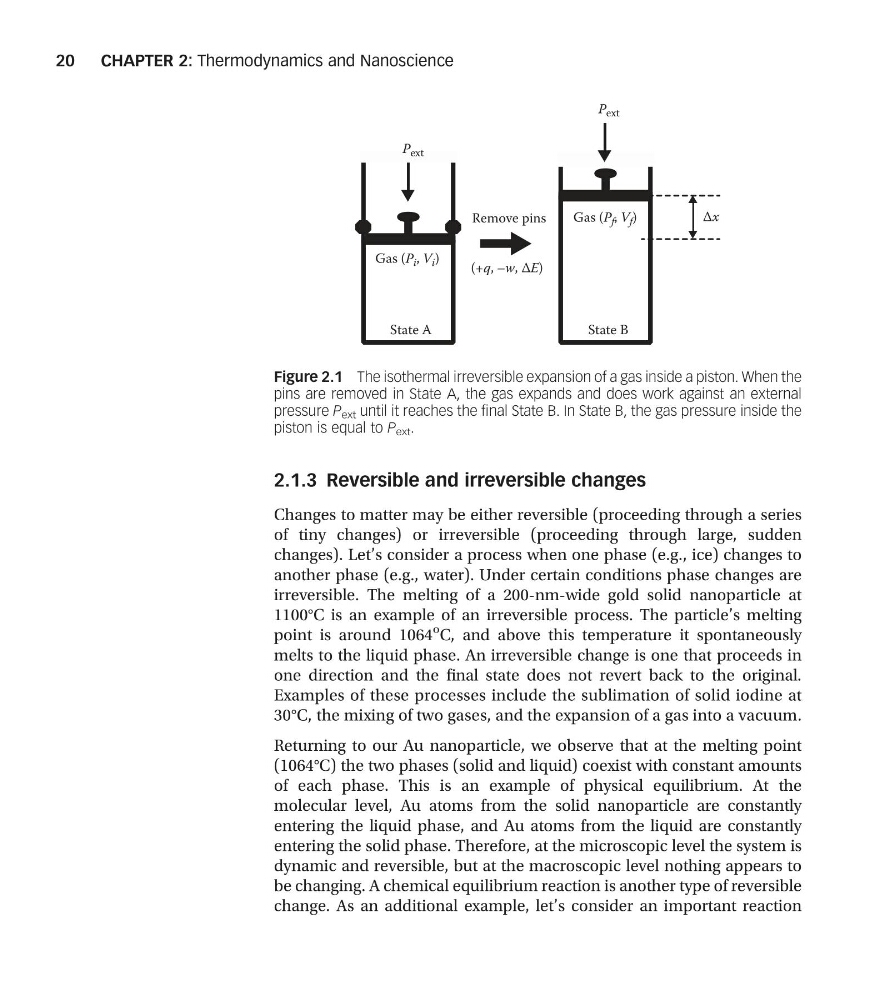
Figure 2.1 The isothermal irreversible expansion of a gas inside a piston. When the
pins are removed in State A, the gas expands and does work against an external
pressure P ext until it reaches the final State B. In State B, the gas pressure inside the
piston is equal to P ext .
CHAPTER 2: Thermodynamics and Nanoscience
20
Changes to matter may be either reversible (proceeding through a series
of tiny changes) or irreversible (proceeding through large, sudden
changes). Let’s consider a process when one phase (e.g., ice) changes to
another phase (e.g., water). Under certain conditions phase changes are
irreversible. The melting of a 200-nm-wide gold solid nanoparticle at
1100°C is an example of an irreversible process. The particle’s melting
point is around 1064
o C, and above this temperature it spontaneously
melts to the liquid phase. An irreversible change is one that proceeds in
one direction and the final state does not revert back to the original.
Examples of these processes include the sublimation of solid iodine at
30°C, the mixing of two gases, and the expansion of a gas into a vacuum.
Returning to our Au nanoparticle, we observe that at the melting point
(1064°C) the two phases (solid and liquid) coexist with constant amounts
of each phase. This is an example of physical equilibrium. At the
molecular level, Au atoms from the solid nanoparticle are constantly
entering the liquid phase, and Au atoms from the liquid are constantly
entering the solid phase. Therefore, at the microscopic level the system is
dynamic and reversible, but at the macroscopic level nothing appears to
be changing. A chemical equilibrium reaction is another type of reversible
change. As an additional example, let’s consider an important reaction
Remove pins
Gas (P i , V i )
Gas (P f , V f )
P ext
P ext
State A
State B
(+q, –w, ΔE)
Δx
Figure 2.1 The isothermal irreversible expansion of a gas inside a piston. When the
pins are removed in State A, the gas expands and does work against an external
pressure P ext until it reaches the final State B. In State B, the gas pressure inside the
piston is equal to P ext .
CHAPTER 2: Thermodynamics and Nanoscience
20