

fused onto the substrate between the barriers, creating a lithographically
patterned array of identical planar-supported membranes.
Arrays of supported membranes can also be fabricated by selectively
destroying regions of a continuous supported bilayer. This is achieved by
high-intensity UV illumination through a photomask under aqueous
conditions (Yee et al., 2004). The UV radiation generates both ozone and
singlet oxygen in highly localized regions. These species react with and
degrade the lipids to form water-soluble components. These patterns of
holes or of corralled bilayers display long-term stability, retaining their
geometric shapes, sizes, and distribution as well as their relative position
on the substrate surface.
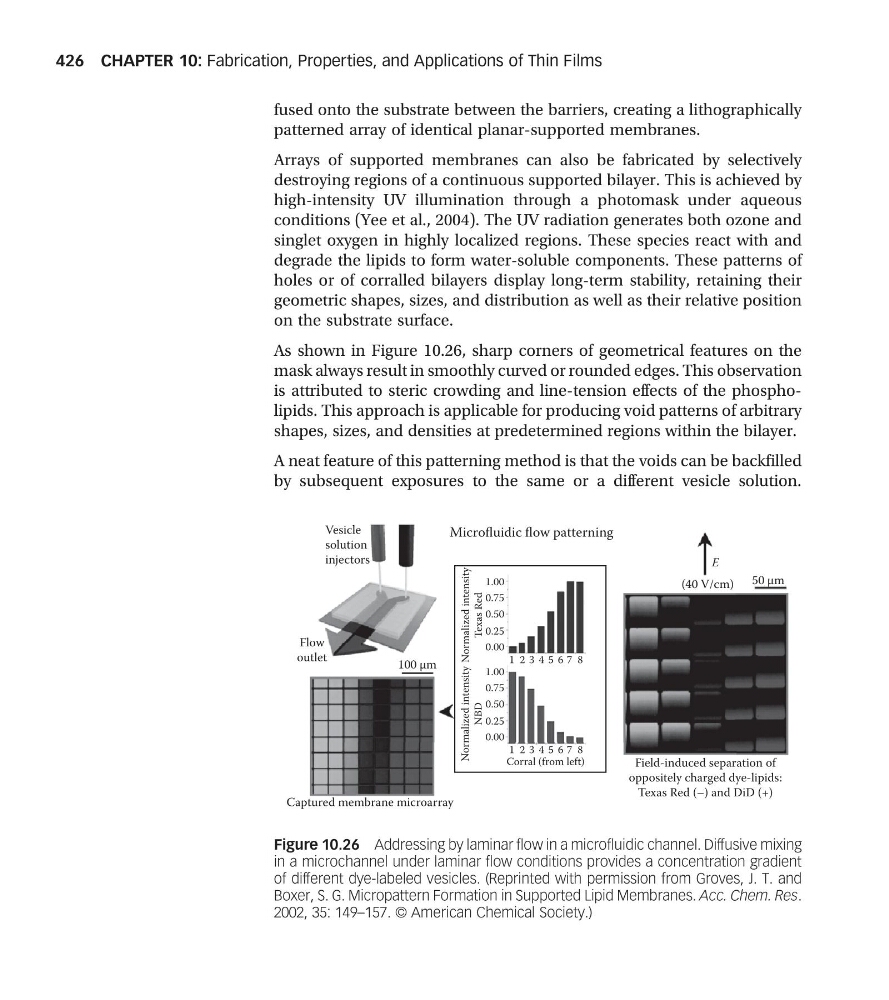
As shown in Figure 10.26, sharp corners of geometrical features on the
mask always result in smoothly curved or rounded edges. This observation
is attributed to steric crowding and line-tension effects of the phospholipids. This approach is applicable for producing void patterns of arbitrary
shapes, sizes, and densities at predetermined regions within the bilayer.
A neat feature of this patterning method is that the voids can be backfilled
by subsequent exposures to the same or a different vesicle solution.
Vesicle
solution
injectors
Flow
outlet
100 μm
(40 V/cm) 50 μm
E
1.00
0.75
Normalized intensity
Texas Red
Normalized intensity
NBD
0.50
0.25
0.00
1 2 3 4 5 6 7 8
1.00
0.75
0.50
0.25
0.00
1 2
Corral (from left)
3 4 5 6 7 8
Captured membrane microarray
Field-induced separation of
oppositely charged dye-lipids:
Texas Red (–) and DiD (+)
Microfluidic flow patterning
Figure 10.26 Addressing by laminar flow in a microfluidic channel. Diffusive mixing
in a microchannel under laminar flow conditions provides a concentration gradient
of different dye-labeled vesicles. (Reprinted with permission from Groves, J. T. and
Boxer, S. G. Micropattern Formation in Supported Lipid Membranes. Acc. Chem. Res.
2002, 35: 149–157. © American Chemical Society.)
CHAPTER 10: Fabrication, Properties, and Applications of Thin Films
426
patterned array of identical planar-supported membranes.
Arrays of supported membranes can also be fabricated by selectively
destroying regions of a continuous supported bilayer. This is achieved by
high-intensity UV illumination through a photomask under aqueous
conditions (Yee et al., 2004). The UV radiation generates both ozone and
singlet oxygen in highly localized regions. These species react with and
degrade the lipids to form water-soluble components. These patterns of
holes or of corralled bilayers display long-term stability, retaining their
geometric shapes, sizes, and distribution as well as their relative position
on the substrate surface.
As shown in Figure 10.26, sharp corners of geometrical features on the
mask always result in smoothly curved or rounded edges. This observation
is attributed to steric crowding and line-tension effects of the phospholipids. This approach is applicable for producing void patterns of arbitrary
shapes, sizes, and densities at predetermined regions within the bilayer.
A neat feature of this patterning method is that the voids can be backfilled
by subsequent exposures to the same or a different vesicle solution.
Vesicle
solution
injectors
Flow
outlet
100 μm
(40 V/cm) 50 μm
E
1.00
0.75
Normalized intensity
Texas Red
Normalized intensity
NBD
0.50
0.25
0.00
1 2 3 4 5 6 7 8
1.00
0.75
0.50
0.25
0.00
1 2
Corral (from left)
3 4 5 6 7 8
Captured membrane microarray
Field-induced separation of
oppositely charged dye-lipids:
Texas Red (–) and DiD (+)
Microfluidic flow patterning
Figure 10.26 Addressing by laminar flow in a microfluidic channel. Diffusive mixing
in a microchannel under laminar flow conditions provides a concentration gradient
of different dye-labeled vesicles. (Reprinted with permission from Groves, J. T. and
Boxer, S. G. Micropattern Formation in Supported Lipid Membranes. Acc. Chem. Res.
2002, 35: 149–157. © American Chemical Society.)
CHAPTER 10: Fabrication, Properties, and Applications of Thin Films
426