

This makes it possible to manipulate membrane compositions and
dynamically probe lipid–lipid diffusive processes. POPC bilayer samples
patterned using the photochemical method shown in Figure 10.24, when
exposed to small unilamellar vesicles, causes the nonfluorescent voids to
be filled with lipids from the secondary vesicles. Depending on the
composition of the secondary vesicles, the pattern can be erased or
retained. If the lipids in the secondary vesicles are the same as the initial
patterned bilayer, the lipids will diffuse and homogenize quickly, thereby
erasing the pattern. If the lipids in the secondary vesicles have significantly different translational mobility, they will retain the backfilled
pattern longer. This suggests the possibility of creating a fluid bilayer
background with patterned microdomains at specific locations.
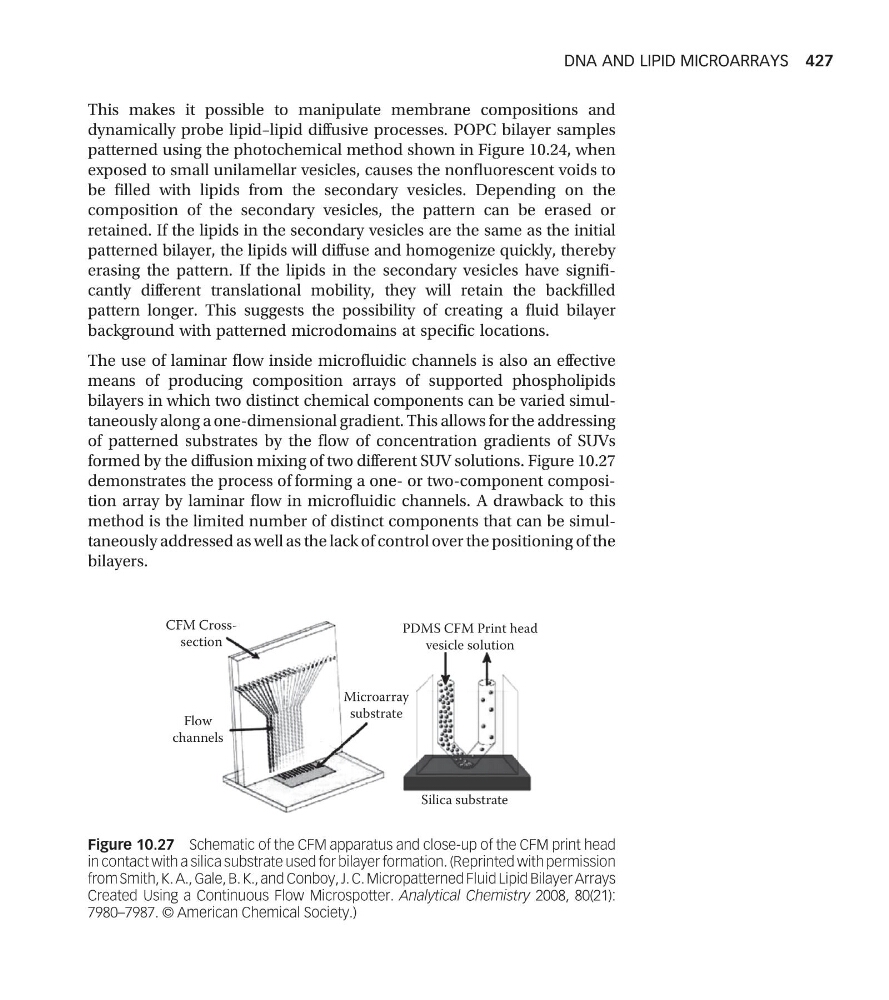
The use of laminar flow inside microfluidic channels is also an effective
means of producing composition arrays of supported phospholipids
bilayers in which two distinct chemical components can be varied simultaneously along a one-dimensional gradient. This allows for the addressing
of patterned substrates by the flow of concentration gradients of SUVs
formed by the diffusion mixing of two different SUV solutions. Figure 10.27
demonstrates the process of forming a one- or two-component composition array by laminar flow in microfluidic channels. A drawback to this
method is the limited number of distinct components that can be simultaneously addressed as well as the lack of control over the positioning of the
bilayers.
CFM Crosssection
PDMS CFM Print head
vesicle solution
Microarray
substrate
Silica substrate
Flow
channels
Figure 10.27 Schematic of the CFM apparatus and close-up of the CFM print head
in contact with a silica substrate used for bilayer formation. (Reprinted with permission
from Smith, K. A., Gale, B. K., and Conboy, J. C. Micropatterned Fluid Lipid Bilayer Arrays
Created Using a Continuous Flow Microspotter. Analytical Chemistry 2008, 80(21):
7980–7987. © American Chemical Society.)
DNA AND LIPID MICROARRAYS 427
dynamically probe lipid–lipid diffusive processes. POPC bilayer samples
patterned using the photochemical method shown in Figure 10.24, when
exposed to small unilamellar vesicles, causes the nonfluorescent voids to
be filled with lipids from the secondary vesicles. Depending on the
composition of the secondary vesicles, the pattern can be erased or
retained. If the lipids in the secondary vesicles are the same as the initial
patterned bilayer, the lipids will diffuse and homogenize quickly, thereby
erasing the pattern. If the lipids in the secondary vesicles have significantly different translational mobility, they will retain the backfilled
pattern longer. This suggests the possibility of creating a fluid bilayer
background with patterned microdomains at specific locations.
The use of laminar flow inside microfluidic channels is also an effective
means of producing composition arrays of supported phospholipids
bilayers in which two distinct chemical components can be varied simultaneously along a one-dimensional gradient. This allows for the addressing
of patterned substrates by the flow of concentration gradients of SUVs
formed by the diffusion mixing of two different SUV solutions. Figure 10.27
demonstrates the process of forming a one- or two-component composition array by laminar flow in microfluidic channels. A drawback to this
method is the limited number of distinct components that can be simultaneously addressed as well as the lack of control over the positioning of the
bilayers.
CFM Crosssection
PDMS CFM Print head
vesicle solution
Microarray
substrate
Silica substrate
Flow
channels
Figure 10.27 Schematic of the CFM apparatus and close-up of the CFM print head
in contact with a silica substrate used for bilayer formation. (Reprinted with permission
from Smith, K. A., Gale, B. K., and Conboy, J. C. Micropatterned Fluid Lipid Bilayer Arrays
Created Using a Continuous Flow Microspotter. Analytical Chemistry 2008, 80(21):
7980–7987. © American Chemical Society.)
DNA AND LIPID MICROARRAYS 427