

Two classes of polymers, polyelectrolytes and lipopolymers, are emerging
as popular choices for cushion material. Polyelectrolyte cushions can be
directly adsorbed from solution to a variety of substrates by means of
layer-by-layer deposition. Lipopolymers consist of a soft hydrophilic
polymer layer presenting lipidlike molecules at their surface that can insert
into a phospholipid membrane and tether it to the polymer spacing.
10.3.4 Fluorescence recovery after photobleaching
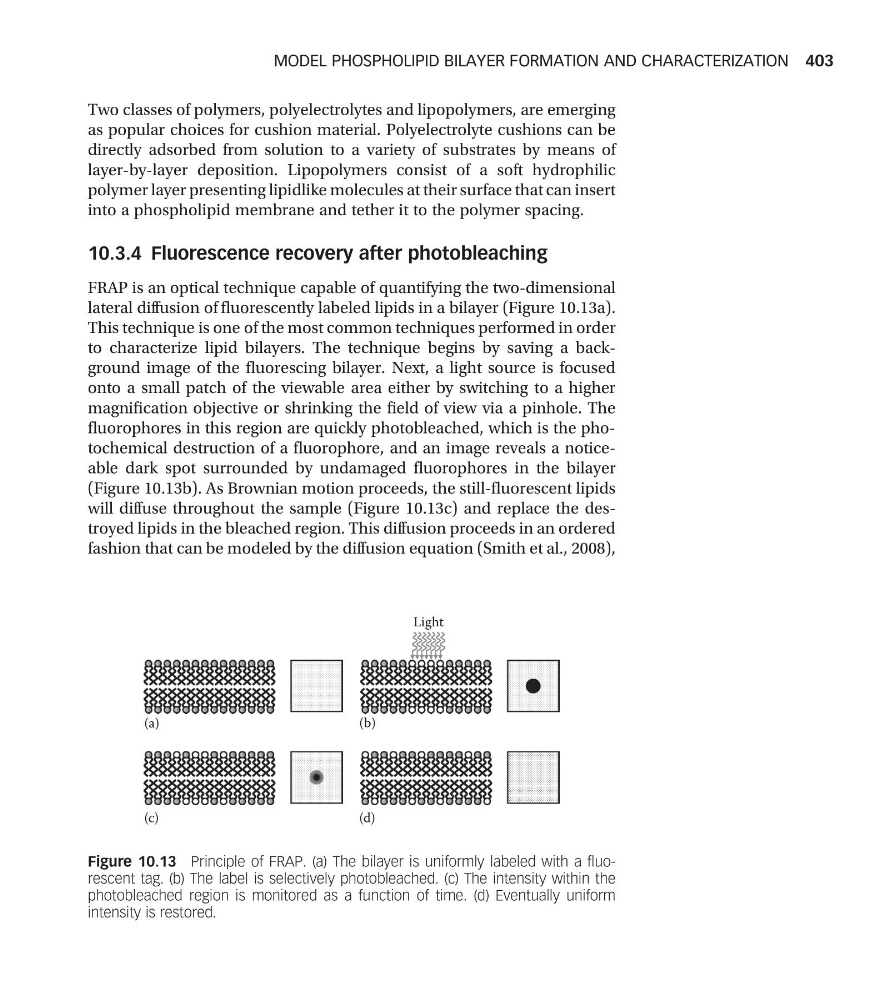
FRAP is an optical technique capable of quantifying the two-dimensional
lateral diffusion of fluorescently labeled lipids in a bilayer (Figure 10.13a).
This technique is one of the most common techniques performed in order
to characterize lipid bilayers. The technique begins by saving a background image of the fluorescing bilayer. Next, a light source is focused
onto a small patch of the viewable area either by switching to a higher
magnification objective or shrinking the field of view via a pinhole. The
fluorophores in this region are quickly photobleached, which is the photochemical destruction of a fluorophore, and an image reveals a noticeable dark spot surrounded by undamaged fluorophores in the bilayer
(Figure 10.13b). As Brownian motion proceeds, the still-fluorescent lipids
will diffuse throughout the sample (Figure 10.13c) and replace the destroyed lipids in the bleached region. This diffusion proceeds in an ordered
fashion that can be modeled by the diffusion equation (Smith et al., 2008),
(a)
Light
(b)
(c)
(d)
Figure 10.13 Principle of FRAP. (a) The bilayer is uniformly labeled with a fluorescent tag. (b) The label is selectively photobleached. (c) The intensity within the
photobleached region is monitored as a function of time. (d) Eventually uniform
intensity is restored.
MODEL PHOSPHOLIPID BILAYER FORMATION AND CHARACTERIZATION 403
as popular choices for cushion material. Polyelectrolyte cushions can be
directly adsorbed from solution to a variety of substrates by means of
layer-by-layer deposition. Lipopolymers consist of a soft hydrophilic
polymer layer presenting lipidlike molecules at their surface that can insert
into a phospholipid membrane and tether it to the polymer spacing.
10.3.4 Fluorescence recovery after photobleaching
FRAP is an optical technique capable of quantifying the two-dimensional
lateral diffusion of fluorescently labeled lipids in a bilayer (Figure 10.13a).
This technique is one of the most common techniques performed in order
to characterize lipid bilayers. The technique begins by saving a background image of the fluorescing bilayer. Next, a light source is focused
onto a small patch of the viewable area either by switching to a higher
magnification objective or shrinking the field of view via a pinhole. The
fluorophores in this region are quickly photobleached, which is the photochemical destruction of a fluorophore, and an image reveals a noticeable dark spot surrounded by undamaged fluorophores in the bilayer
(Figure 10.13b). As Brownian motion proceeds, the still-fluorescent lipids
will diffuse throughout the sample (Figure 10.13c) and replace the destroyed lipids in the bleached region. This diffusion proceeds in an ordered
fashion that can be modeled by the diffusion equation (Smith et al., 2008),
(a)
Light
(b)
(c)
(d)
Figure 10.13 Principle of FRAP. (a) The bilayer is uniformly labeled with a fluorescent tag. (b) The label is selectively photobleached. (c) The intensity within the
photobleached region is monitored as a function of time. (d) Eventually uniform
intensity is restored.
MODEL PHOSPHOLIPID BILAYER FORMATION AND CHARACTERIZATION 403