

In the early stages after adsorption, SUVs may fuse with one another to
form larger unilamellar vesicles. The vesicles then rupture, forming a
supported bilayer in a process that depends on the destabilizing interactions affecting the vesicle, such as the osmotic pressure due to a salt
concentration within the vesicle that differs from the salt concentration
outside the vesicle, or the attraction between the individual lipids and
substrate that causes vesicles to deform from their more stable spherical
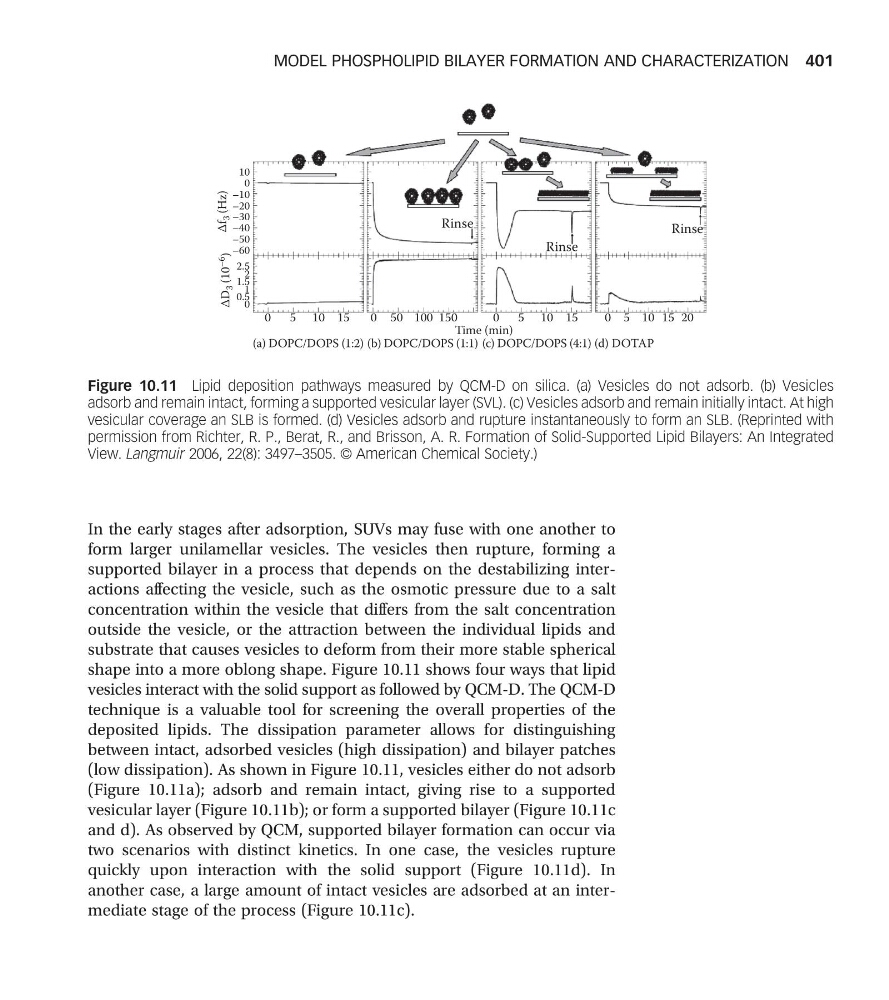
shape into a more oblong shape. Figure 10.11 shows four ways that lipid
vesicles interact with the solid support as followed by QCM-D. The QCM-D
technique is a valuable tool for screening the overall properties of the
deposited lipids. The dissipation parameter allows for distinguishing
between intact, adsorbed vesicles (high dissipation) and bilayer patches
(low dissipation). As shown in Figure 10.11, vesicles either do not adsorb
(Figure 10.11a); adsorb and remain intact, giving rise to a supported
vesicular layer (Figure 10.11b); or form a supported bilayer (Figure 10.11c
and d). As observed by QCM, supported bilayer formation can occur via
two scenarios with distinct kinetics. In one case, the vesicles rupture
quickly upon interaction with the solid support (Figure 10.11d). In
another case, a large amount of intact vesicles are adsorbed at an intermediate stage of the process (Figure 10.11c).
0 50 100 150
Time (min)
Rinse
Rinse
Rinse
1.5
0.5
0
0
5 10 15
(a) DOPC/DOPS (1:2) (b) DOPC/DOPS (1:1) (c) DOPC/DOPS (4:1) (d) DOTAP
0
5 10 15
0 5 10 15 20
2
2.5
ΔD
3 (10
–6
)
Δf
3 (Hz)
–60
–50
–40
–30
–20
–10
0
10
1
Figure 10.11 Lipid deposition pathways measured by QCM-D on silica. (a) Vesicles do not adsorb. (b) Vesicles
adsorb and remain intact, forming a supported vesicular layer (SVL). (c) Vesicles adsorb and remain initially intact. At high
vesicular coverage an SLB is formed. (d) Vesicles adsorb and rupture instantaneously to form an SLB. (Reprinted with
permission from Richter, R. P., Berat, R., and Brisson, A. R. Formation of Solid-Supported Lipid Bilayers: An Integrated
View. Langmuir 2006, 22(8): 3497–3505. © American Chemical Society.)
MODEL PHOSPHOLIPID BILAYER FORMATION AND CHARACTERIZATION 401
form larger unilamellar vesicles. The vesicles then rupture, forming a
supported bilayer in a process that depends on the destabilizing interactions affecting the vesicle, such as the osmotic pressure due to a salt
concentration within the vesicle that differs from the salt concentration
outside the vesicle, or the attraction between the individual lipids and
substrate that causes vesicles to deform from their more stable spherical
shape into a more oblong shape. Figure 10.11 shows four ways that lipid
vesicles interact with the solid support as followed by QCM-D. The QCM-D
technique is a valuable tool for screening the overall properties of the
deposited lipids. The dissipation parameter allows for distinguishing
between intact, adsorbed vesicles (high dissipation) and bilayer patches
(low dissipation). As shown in Figure 10.11, vesicles either do not adsorb
(Figure 10.11a); adsorb and remain intact, giving rise to a supported
vesicular layer (Figure 10.11b); or form a supported bilayer (Figure 10.11c
and d). As observed by QCM, supported bilayer formation can occur via
two scenarios with distinct kinetics. In one case, the vesicles rupture
quickly upon interaction with the solid support (Figure 10.11d). In
another case, a large amount of intact vesicles are adsorbed at an intermediate stage of the process (Figure 10.11c).
0 50 100 150
Time (min)
Rinse
Rinse
Rinse
1.5
0.5
0
0
5 10 15
(a) DOPC/DOPS (1:2) (b) DOPC/DOPS (1:1) (c) DOPC/DOPS (4:1) (d) DOTAP
0
5 10 15
0 5 10 15 20
2
2.5
ΔD
3 (10
–6
)
Δf
3 (Hz)
–60
–50
–40
–30
–20
–10
0
10
1
Figure 10.11 Lipid deposition pathways measured by QCM-D on silica. (a) Vesicles do not adsorb. (b) Vesicles
adsorb and remain intact, forming a supported vesicular layer (SVL). (c) Vesicles adsorb and remain initially intact. At high
vesicular coverage an SLB is formed. (d) Vesicles adsorb and rupture instantaneously to form an SLB. (Reprinted with
permission from Richter, R. P., Berat, R., and Brisson, A. R. Formation of Solid-Supported Lipid Bilayers: An Integrated
View. Langmuir 2006, 22(8): 3497–3505. © American Chemical Society.)
MODEL PHOSPHOLIPID BILAYER FORMATION AND CHARACTERIZATION 401