

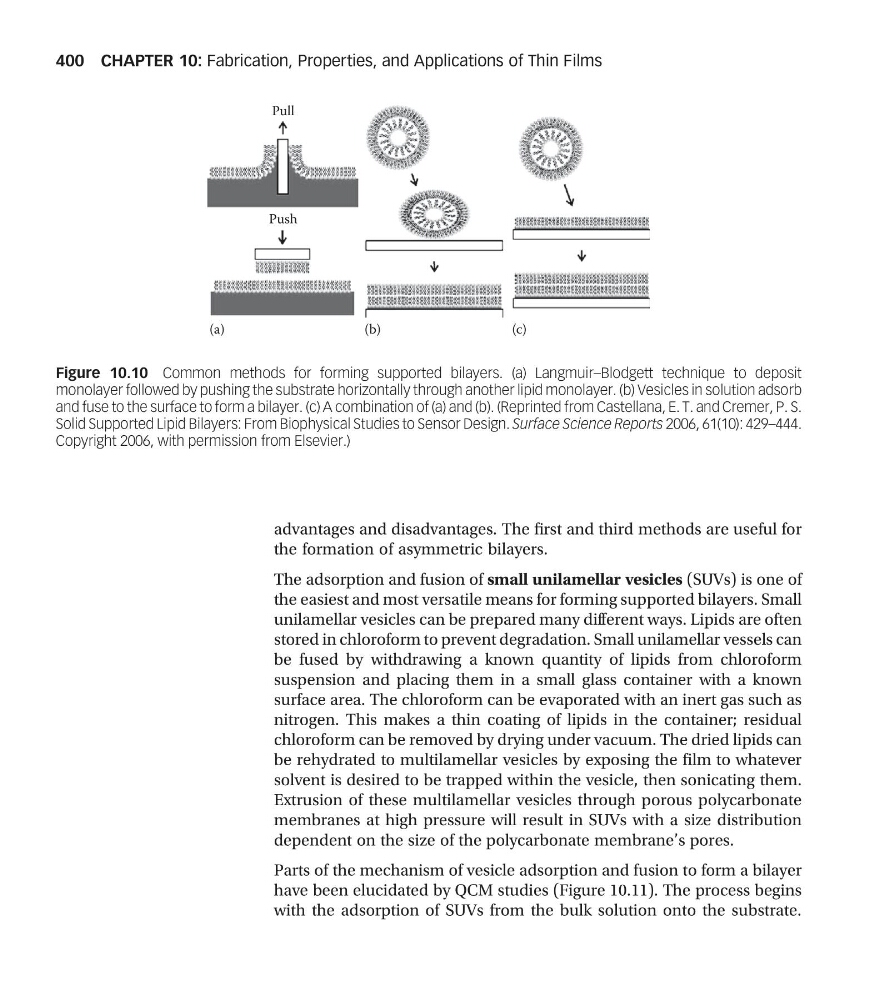
advantages and disadvantages. The first and third methods are useful for
the formation of asymmetric bilayers.
The adsorption and fusion of small unilamellar vesicles (SUVs) is one of
the easiest and most versatile means for forming supported bilayers. Small
unilamellar vesicles can be prepared many different ways. Lipids are often
stored in chloroform to prevent degradation. Small unilamellar vessels can
be fused by withdrawing a known quantity of lipids from chloroform
suspension and placing them in a small glass container with a known
surface area. The chloroform can be evaporated with an inert gas such as
nitrogen. This makes a thin coating of lipids in the container; residual
chloroform can be removed by drying under vacuum. The dried lipids can
be rehydrated to multilamellar vesicles by exposing the film to whatever
solvent is desired to be trapped within the vesicle, then sonicating them.
Extrusion of these multilamellar vesicles through porous polycarbonate
membranes at high pressure will result in SUVs with a size distribution
dependent on the size of the polycarbonate membrane’s pores.
Parts of the mechanism of vesicle adsorption and fusion to form a bilayer
have been elucidated by QCM studies (Figure 10.11). The process begins
with the adsorption of SUVs from the bulk solution onto the substrate.
Pull
Push
(a)
(b)
(c)
Figure 10.10 Common methods for forming supported bilayers. (a) Langmuir–Blodgett technique to deposit
monolayer followed by pushing the substrate horizontally through another lipid monolayer. (b) Vesicles in solution adsorb
and fuse to the surface to form a bilayer. (c) A combination of (a) and (b). (Reprinted from Castellana, E. T. and Cremer, P. S.
Solid Supported Lipid Bilayers: From Biophysical Studies to Sensor Design. Surface Science Reports 2006, 61(10): 429–444.
Copyright 2006, with permission from Elsevier.)
CHAPTER 10: Fabrication, Properties, and Applications of Thin Films
400
the formation of asymmetric bilayers.
The adsorption and fusion of small unilamellar vesicles (SUVs) is one of
the easiest and most versatile means for forming supported bilayers. Small
unilamellar vesicles can be prepared many different ways. Lipids are often
stored in chloroform to prevent degradation. Small unilamellar vessels can
be fused by withdrawing a known quantity of lipids from chloroform
suspension and placing them in a small glass container with a known
surface area. The chloroform can be evaporated with an inert gas such as
nitrogen. This makes a thin coating of lipids in the container; residual
chloroform can be removed by drying under vacuum. The dried lipids can
be rehydrated to multilamellar vesicles by exposing the film to whatever
solvent is desired to be trapped within the vesicle, then sonicating them.
Extrusion of these multilamellar vesicles through porous polycarbonate
membranes at high pressure will result in SUVs with a size distribution
dependent on the size of the polycarbonate membrane’s pores.
Parts of the mechanism of vesicle adsorption and fusion to form a bilayer
have been elucidated by QCM studies (Figure 10.11). The process begins
with the adsorption of SUVs from the bulk solution onto the substrate.
Pull
Push
(a)
(b)
(c)
Figure 10.10 Common methods for forming supported bilayers. (a) Langmuir–Blodgett technique to deposit
monolayer followed by pushing the substrate horizontally through another lipid monolayer. (b) Vesicles in solution adsorb
and fuse to the surface to form a bilayer. (c) A combination of (a) and (b). (Reprinted from Castellana, E. T. and Cremer, P. S.
Solid Supported Lipid Bilayers: From Biophysical Studies to Sensor Design. Surface Science Reports 2006, 61(10): 429–444.
Copyright 2006, with permission from Elsevier.)
CHAPTER 10: Fabrication, Properties, and Applications of Thin Films
400