

for the oppositely charged adsorbent. This approach is generally known
as the layer-by-layer (LbL) technique.
Repetition of this process can be used to make many layered films. To
better understand the overall formation of a multilayer assembly we must
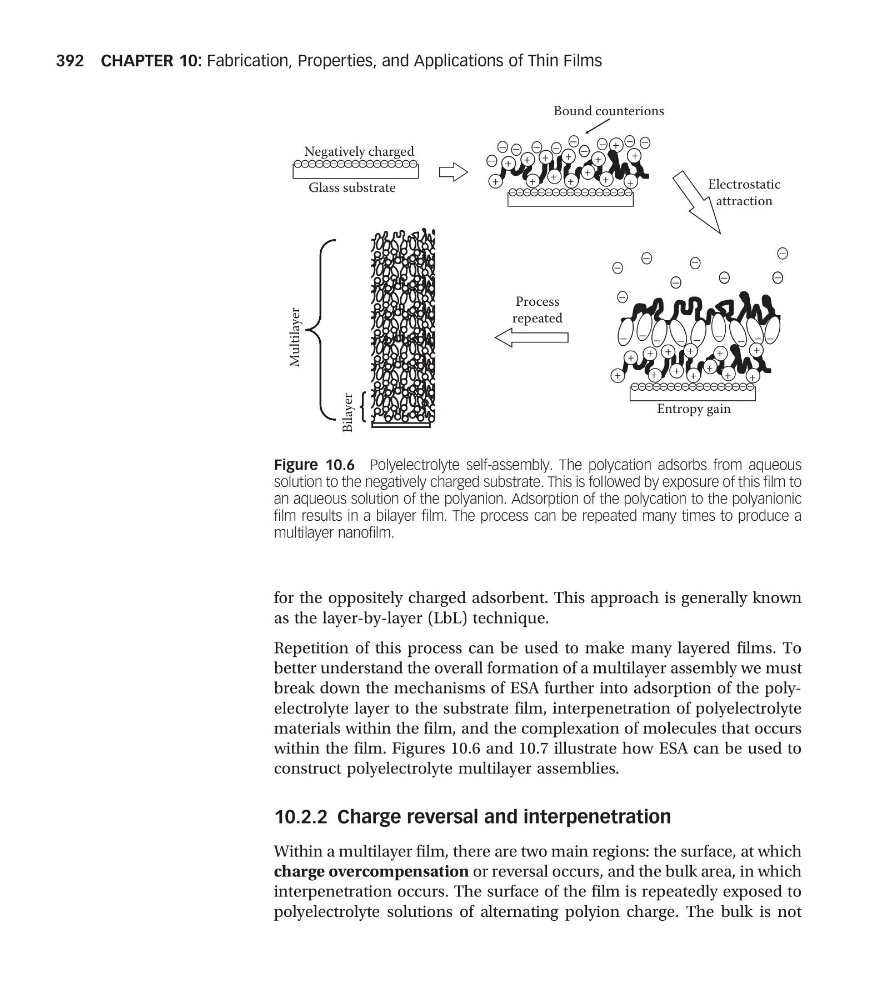
break down the mechanisms of ESA further into adsorption of the polyelectrolyte layer to the substrate film, interpenetration of polyelectrolyte
materials within the film, and the complexation of molecules that occurs
within the film. Figures 10.6 and 10.7 illustrate how ESA can be used to
construct polyelectrolyte multilayer assemblies.
10.2.2 Charge reversal and interpenetration
Within a multilayer film, there are two main regions: the surface, at which
charge overcompensation or reversal occurs, and the bulk area, in which
interpenetration occurs. The surface of the film is repeatedly exposed to
polyelectrolyte solutions of alternating polyion charge. The bulk is not
+ + +
+
+
– – –
–
–
– –
–
–
+
Negatively charged
Bound counterions
+
+ +
+
+
+
+
+
+
+ + +
+
–
Glass substrate
Electrostatic
attraction
–
– – – – – – – – – – – – – – – – –
– – – – – – – – – – – – – – – –
–
–
–
–
-
-
-
-
–
–
- -
-
–
–
Multilayer
+
+ +
+
+
+
+
+
+
+ + +
+
– – – – – – – – – – – – – – – – –
Entropy gain
Process
repeated
–
– – –
– – –
–
–
Bilayer
Figure 10.6 Polyelectrolyte self-assembly. The polycation adsorbs from aqueous
solution to the negatively charged substrate. This is followed by exposure of this film to
an aqueous solution of the polyanion. Adsorption of the polycation to the polyanionic
film results in a bilayer film. The process can be repeated many times to produce a
multilayer nanofilm.
CHAPTER 10: Fabrication, Properties, and Applications of Thin Films
392
as the layer-by-layer (LbL) technique.
Repetition of this process can be used to make many layered films. To
better understand the overall formation of a multilayer assembly we must
break down the mechanisms of ESA further into adsorption of the polyelectrolyte layer to the substrate film, interpenetration of polyelectrolyte
materials within the film, and the complexation of molecules that occurs
within the film. Figures 10.6 and 10.7 illustrate how ESA can be used to
construct polyelectrolyte multilayer assemblies.
10.2.2 Charge reversal and interpenetration
Within a multilayer film, there are two main regions: the surface, at which
charge overcompensation or reversal occurs, and the bulk area, in which
interpenetration occurs. The surface of the film is repeatedly exposed to
polyelectrolyte solutions of alternating polyion charge. The bulk is not
+ + +
+
+
– – –
–
–
– –
–
–
+
Negatively charged
Bound counterions
+
+ +
+
+
+
+
+
+
+ + +
+
–
Glass substrate
Electrostatic
attraction
–
– – – – – – – – – – – – – – – – –
– – – – – – – – – – – – – – – –
–
–
–
–
-
-
-
-
–
–
- -
-
–
–
Multilayer
+
+ +
+
+
+
+
+
+
+ + +
+
– – – – – – – – – – – – – – – – –
Entropy gain
Process
repeated
–
– – –
– – –
–
–
Bilayer
Figure 10.6 Polyelectrolyte self-assembly. The polycation adsorbs from aqueous
solution to the negatively charged substrate. This is followed by exposure of this film to
an aqueous solution of the polyanion. Adsorption of the polycation to the polyanionic
film results in a bilayer film. The process can be repeated many times to produce a
multilayer nanofilm.
CHAPTER 10: Fabrication, Properties, and Applications of Thin Films
392