

exposed to the aqueous environment. This greatly impacts the differences
in chemistry that occurs in these two main regions.
At the surface, charge reversal, or charge overcompensation, helps drive
the formation of layers within the film. Typically, polyelectrolytes are
assumed to take a structure with 1:1 charge stoichiometry in order to
minimize their electrostatic energy. However, in order to drive the formation of multilayers, an overall surface charge must be exposed prior to
the next deposition step in an oppositely charged polyelectrolyte solution.
Charge reversal of the surface enables the electrostatic interactions that
drive the self-assembly process.
The charge-overcompensated region of the terminal layer is matched by
oppositely charged salt counterions in solution (See Chapter 5 for details).
Upon exposure to the next polyionic solution, the counterions are displaced by the polyion. This displacement is driven primarily by entropic
gain from displacement of the counterions. Entropic gain combined with
electrostatic interactions results in a net negative free energy of adsorption
that allows the polyelectrolyte to remain adsorbed to the surface. Further
adsorption of the polyelectrolyte will stop when repulsive interactions
from material already adsorbed prevail. As a result, approximately
reproducible depositions occur in the formation of each subsequent layer.
Once a polyelectrolyte has fully adsorbed to the surface, charge overcompensation occurs again at the terminal layer surface, yielding a
PEI
Fuzzy nanoassemblies
Polyelectrolyte multilayers
Hn SO 2
CO 2
–
H H
N +
n
OH
N N
n
8 nm
(80 Å)
0.8 nm
PAZO
Polycation
Polyanion
(8 Å)
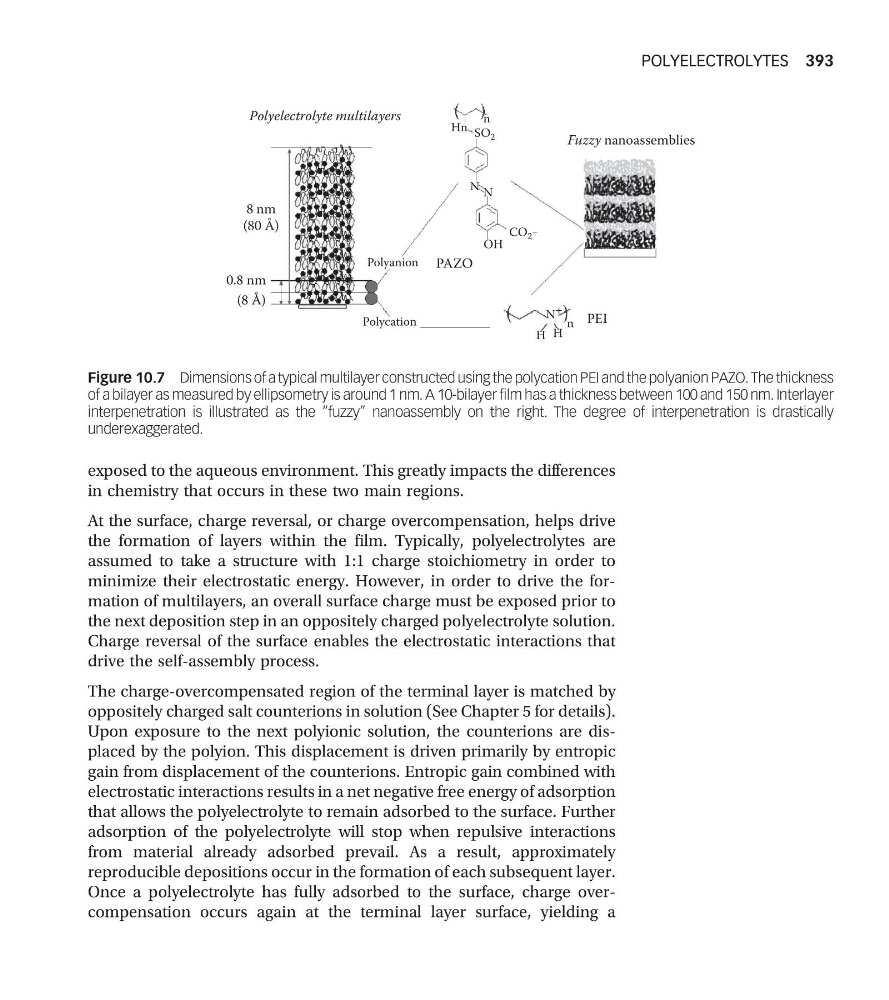
Figure 10.7 Dimensions of a typical multilayer constructed using the polycation PEI and the polyanion PAZO. The thickness
of a bilayer as measured by ellipsometry is around 1 nm. A 10-bilayer film has a thickness between 100 and 150 nm. Interlayer
interpenetration is illustrated as the “fuzzy” nanoassembly on the right. The degree of interpenetration is drastically
underexaggerated.
POLYELECTROLYTES 393
in chemistry that occurs in these two main regions.
At the surface, charge reversal, or charge overcompensation, helps drive
the formation of layers within the film. Typically, polyelectrolytes are
assumed to take a structure with 1:1 charge stoichiometry in order to
minimize their electrostatic energy. However, in order to drive the formation of multilayers, an overall surface charge must be exposed prior to
the next deposition step in an oppositely charged polyelectrolyte solution.
Charge reversal of the surface enables the electrostatic interactions that
drive the self-assembly process.
The charge-overcompensated region of the terminal layer is matched by
oppositely charged salt counterions in solution (See Chapter 5 for details).
Upon exposure to the next polyionic solution, the counterions are displaced by the polyion. This displacement is driven primarily by entropic
gain from displacement of the counterions. Entropic gain combined with
electrostatic interactions results in a net negative free energy of adsorption
that allows the polyelectrolyte to remain adsorbed to the surface. Further
adsorption of the polyelectrolyte will stop when repulsive interactions
from material already adsorbed prevail. As a result, approximately
reproducible depositions occur in the formation of each subsequent layer.
Once a polyelectrolyte has fully adsorbed to the surface, charge overcompensation occurs again at the terminal layer surface, yielding a
PEI
Fuzzy nanoassemblies
Polyelectrolyte multilayers
Hn SO 2
CO 2
–
H H
N +
n
OH
N N
n
8 nm
(80 Å)
0.8 nm
PAZO
Polycation
Polyanion
(8 Å)
Figure 10.7 Dimensions of a typical multilayer constructed using the polycation PEI and the polyanion PAZO. The thickness
of a bilayer as measured by ellipsometry is around 1 nm. A 10-bilayer film has a thickness between 100 and 150 nm. Interlayer
interpenetration is illustrated as the “fuzzy” nanoassembly on the right. The degree of interpenetration is drastically
underexaggerated.
POLYELECTROLYTES 393