

9.6.1 Carbon nanotube structure
Carbon nanotubes are a member of the fullerene family of carbon
structures; they may contain hexagonal, pentagonal, and sometimes
heptagonal rings of pure carbon. It may be helpful to imagine a flat
“sheet” of such rings that can be rolled up to make a single-walled
nanotube. Regardless of the number of carbons within a ring, each shares
a bond with three adjacent carbons. This makes every carbon within the
tube sp
2 hybridized. Carbon nanotubes are often capped with a carbon
hemisphere that is also composed of sp
2 hybridized carbons in rings.
Carbon nanotubes can come in single-walled or multiwalled form.
The multiwalled nanotube structure can be thought of as concentric
single-walled nanotubes encompassing one another.
Because differing carbon nanotubes may consist of similar sp
2 hybridized
carbons, one might assume they all will have similar properties. This is an
incorrect assumption. Differences in how the carbon atoms are structurally organized play a significant role in determining the properties of
the carbon nanotube as a whole. For example, one way of organizing the
carbons can make the nanotube metallic and conducting, whereas
another organization scheme will make it a semiconductor. Because of
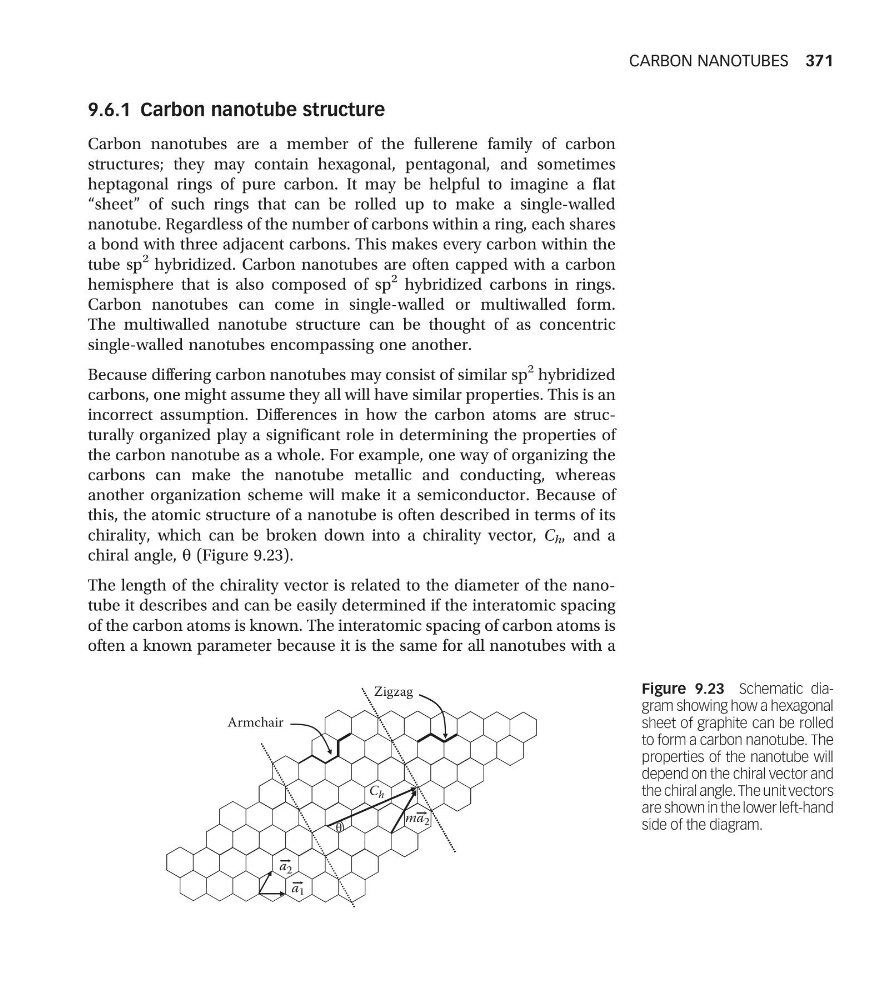
this, the atomic structure of a nanotube is often described in terms of its
chirality, which can be broken down into a chirality vector, C h , and a
chiral angle, q (Figure 9.23).
The length of the chirality vector is related to the diameter of the nanotube it describes and can be easily determined if the interatomic spacing
of the carbon atoms is known. The interatomic spacing of carbon atoms is
often a known parameter because it is the same for all nanotubes with a
Zigzag
Armchair
C h
a 2
a 1
ma 2
θ
Figure 9.23 Schematic diagram showing how a hexagonal
sheet of graphite can be rolled
to form a carbon nanotube. The
properties of the nanotube will
depend on the chiral vector and
the chiral angle. The unit vectors
are shown in the lower left-hand
side of the diagram.
CARBON NANOTUBES 371
Carbon nanotubes are a member of the fullerene family of carbon
structures; they may contain hexagonal, pentagonal, and sometimes
heptagonal rings of pure carbon. It may be helpful to imagine a flat
“sheet” of such rings that can be rolled up to make a single-walled
nanotube. Regardless of the number of carbons within a ring, each shares
a bond with three adjacent carbons. This makes every carbon within the
tube sp
2 hybridized. Carbon nanotubes are often capped with a carbon
hemisphere that is also composed of sp
2 hybridized carbons in rings.
Carbon nanotubes can come in single-walled or multiwalled form.
The multiwalled nanotube structure can be thought of as concentric
single-walled nanotubes encompassing one another.
Because differing carbon nanotubes may consist of similar sp
2 hybridized
carbons, one might assume they all will have similar properties. This is an
incorrect assumption. Differences in how the carbon atoms are structurally organized play a significant role in determining the properties of
the carbon nanotube as a whole. For example, one way of organizing the
carbons can make the nanotube metallic and conducting, whereas
another organization scheme will make it a semiconductor. Because of
this, the atomic structure of a nanotube is often described in terms of its
chirality, which can be broken down into a chirality vector, C h , and a
chiral angle, q (Figure 9.23).
The length of the chirality vector is related to the diameter of the nanotube it describes and can be easily determined if the interatomic spacing
of the carbon atoms is known. The interatomic spacing of carbon atoms is
often a known parameter because it is the same for all nanotubes with a
Zigzag
Armchair
C h
a 2
a 1
ma 2
θ
Figure 9.23 Schematic diagram showing how a hexagonal
sheet of graphite can be rolled
to form a carbon nanotube. The
properties of the nanotube will
depend on the chiral vector and
the chiral angle. The unit vectors
are shown in the lower left-hand
side of the diagram.
CARBON NANOTUBES 371