

nanowire synthetic techniques. These new devices will allow nanowires
to be seen in higher magnification and clarity, allowing for more accurate
analysis of experimental results. Studies will continue to be done on
synthesized nanowires to help define the nanoparticle’s unique properties so it can be better applied to products in the industry, including
batteries, computers, and chemical composites.
9.6 CARBON NANOTUBES
Carbon nanotubes are another important class of a 1D nanomaterial.
They are constructs of carbon that have diameters on the order of a few
nanometers and lengths that can be significantly longer. Carbon
nanotubes are extremely strong; the tensile strength of a single-walled
carbon nanotube is many times stronger than steel. They also have
unique electrical and optical properties and are efficient conductors of
heat. These properties have made the study of carbon nanotubes surge in
recent years (Dai, 2002).
50 nm
(a)
(b)
(c)
(d)
500 nm
10 nm
100 nm
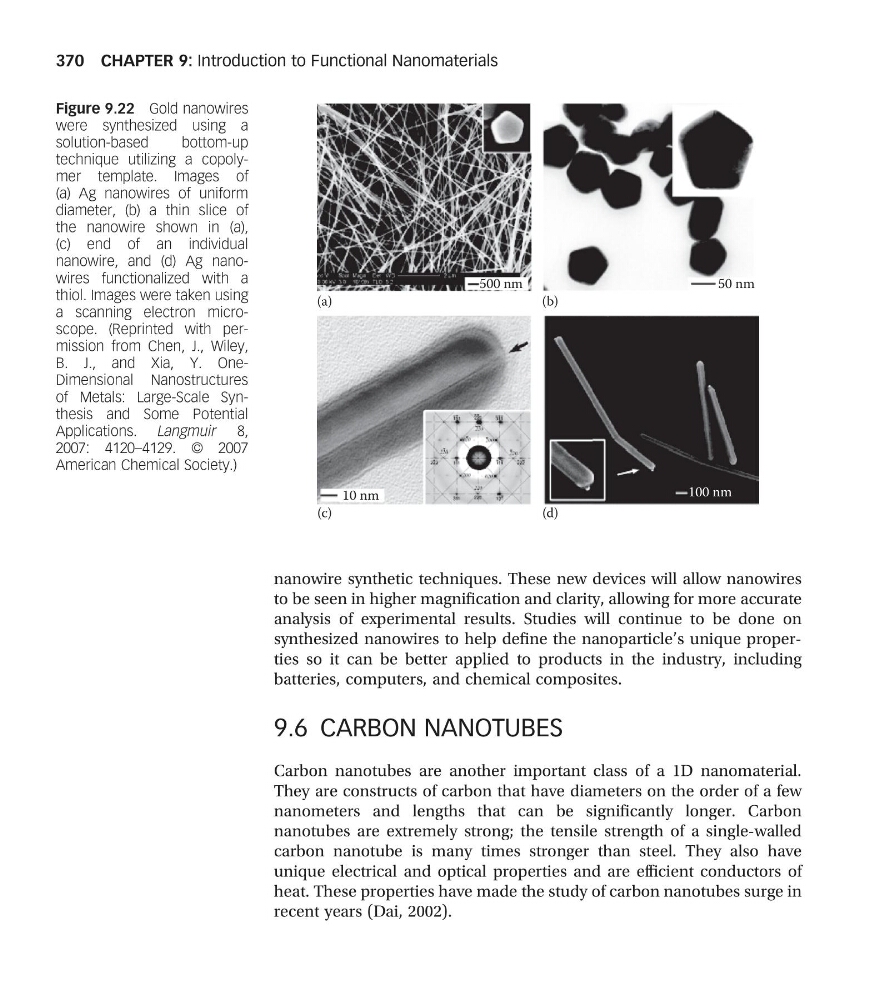
Figure 9.22 Gold nanowires
were synthesized using a
solution-based
bottom-up
technique utilizing a copolymer template. Images of
(a) Ag nanowires of uniform
diameter, (b) a thin slice of
the nanowire shown in (a),
(c) end of an individual
nanowire, and (d) Ag nanowires functionalized with a
thiol. Images were taken using
a scanning electron microscope. (Reprinted with permission from Chen, J., Wiley,
B. J., and Xia, Y. OneDimensional Nanostructures
of Metals: Large-Scale Synthesis and Some Potential
Applications. Langmuir 8,
2007: 4120–4129. © 2007
American Chemical Society.)
CHAPTER 9: Introduction to Functional Nanomaterials
370
to be seen in higher magnification and clarity, allowing for more accurate
analysis of experimental results. Studies will continue to be done on
synthesized nanowires to help define the nanoparticle’s unique properties so it can be better applied to products in the industry, including
batteries, computers, and chemical composites.
9.6 CARBON NANOTUBES
Carbon nanotubes are another important class of a 1D nanomaterial.
They are constructs of carbon that have diameters on the order of a few
nanometers and lengths that can be significantly longer. Carbon
nanotubes are extremely strong; the tensile strength of a single-walled
carbon nanotube is many times stronger than steel. They also have
unique electrical and optical properties and are efficient conductors of
heat. These properties have made the study of carbon nanotubes surge in
recent years (Dai, 2002).
50 nm
(a)
(b)
(c)
(d)
500 nm
10 nm
100 nm
Figure 9.22 Gold nanowires
were synthesized using a
solution-based
bottom-up
technique utilizing a copolymer template. Images of
(a) Ag nanowires of uniform
diameter, (b) a thin slice of
the nanowire shown in (a),
(c) end of an individual
nanowire, and (d) Ag nanowires functionalized with a
thiol. Images were taken using
a scanning electron microscope. (Reprinted with permission from Chen, J., Wiley,
B. J., and Xia, Y. OneDimensional Nanostructures
of Metals: Large-Scale Synthesis and Some Potential
Applications. Langmuir 8,
2007: 4120–4129. © 2007
American Chemical Society.)
CHAPTER 9: Introduction to Functional Nanomaterials
370