

similar lattice or unrolled “sheet” of rings. An equation for describing the
chiral vector is given in Equation 9.25 (Thostenson et al., 2001):
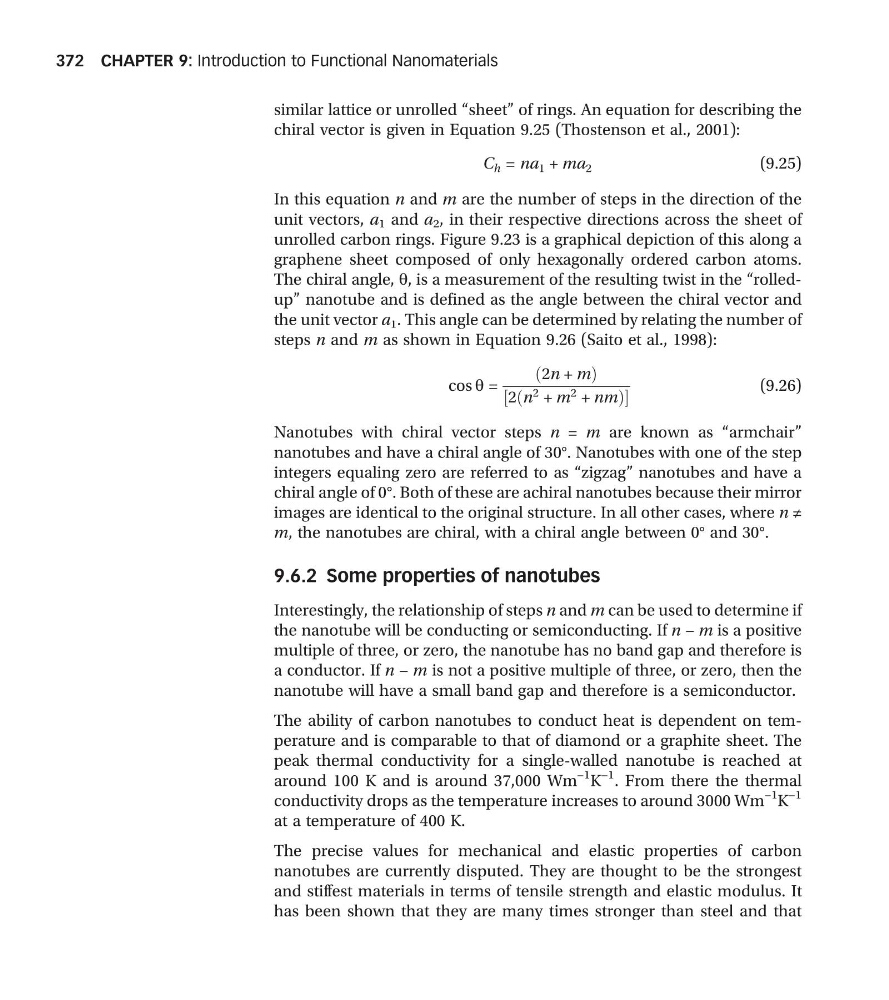
C h = na 1 + ma 2
(9.25)
In this equation n and m are the number of steps in the direction of the
unit vectors, a 1 and a 2 , in their respective directions across the sheet of
unrolled carbon rings. Figure 9.23 is a graphical depiction of this along a
graphene sheet composed of only hexagonally ordered carbon atoms.
The chiral angle, q, is a measurement of the resulting twist in the “rolledup” nanotube and is defined as the angle between the chiral vector and
the unit vector a 1 . This angle can be determined by relating the number of
steps n and m as shown in Equation 9.26 (Saito et al., 1998):
cos q =
2n + m
ð
Þ
2 n 2 + m 2 + nm
ð
Þ
½
(9.26)
Nanotubes with chiral vector steps n = m are known as “armchair”
nanotubes and have a chiral angle of 30°. Nanotubes with one of the step
integers equaling zero are referred to as “zigzag” nanotubes and have a
chiral angle of 0°. Both of these are achiral nanotubes because their mirror
images are identical to the original structure. In all other cases, where n ≠
m, the nanotubes are chiral, with a chiral angle between 0° and 30°.
9.6.2 Some properties of nanotubes
Interestingly, the relationship of steps n and m can be used to determine if
the nanotube will be conducting or semiconducting. If n − m is a positive
multiple of three, or zero, the nanotube has no band gap and therefore is
a conductor. If n − m is not a positive multiple of three, or zero, then the
nanotube will have a small band gap and therefore is a semiconductor.
The ability of carbon nanotubes to conduct heat is dependent on temperature and is comparable to that of diamond or a graphite sheet. The
peak thermal conductivity for a single-walled nanotube is reached at
around 100 K and is around 37,000 Wm
−1 K
−1 . From there the thermal
conductivity drops as the temperature increases to around 3000 Wm
−1 K
−1
at a temperature of 400 K.
The precise values for mechanical and elastic properties of carbon
nanotubes are currently disputed. They are thought to be the strongest
and stiffest materials in terms of tensile strength and elastic modulus. It
has been shown that they are many times stronger than steel and that
CHAPTER 9: Introduction to Functional Nanomaterials
372
chiral vector is given in Equation 9.25 (Thostenson et al., 2001):
C h = na 1 + ma 2
(9.25)
In this equation n and m are the number of steps in the direction of the
unit vectors, a 1 and a 2 , in their respective directions across the sheet of
unrolled carbon rings. Figure 9.23 is a graphical depiction of this along a
graphene sheet composed of only hexagonally ordered carbon atoms.
The chiral angle, q, is a measurement of the resulting twist in the “rolledup” nanotube and is defined as the angle between the chiral vector and
the unit vector a 1 . This angle can be determined by relating the number of
steps n and m as shown in Equation 9.26 (Saito et al., 1998):
cos q =
2n + m
ð
Þ
2 n 2 + m 2 + nm
ð
Þ
½
(9.26)
Nanotubes with chiral vector steps n = m are known as “armchair”
nanotubes and have a chiral angle of 30°. Nanotubes with one of the step
integers equaling zero are referred to as “zigzag” nanotubes and have a
chiral angle of 0°. Both of these are achiral nanotubes because their mirror
images are identical to the original structure. In all other cases, where n ≠
m, the nanotubes are chiral, with a chiral angle between 0° and 30°.
9.6.2 Some properties of nanotubes
Interestingly, the relationship of steps n and m can be used to determine if
the nanotube will be conducting or semiconducting. If n − m is a positive
multiple of three, or zero, the nanotube has no band gap and therefore is
a conductor. If n − m is not a positive multiple of three, or zero, then the
nanotube will have a small band gap and therefore is a semiconductor.
The ability of carbon nanotubes to conduct heat is dependent on temperature and is comparable to that of diamond or a graphite sheet. The
peak thermal conductivity for a single-walled nanotube is reached at
around 100 K and is around 37,000 Wm
−1 K
−1 . From there the thermal
conductivity drops as the temperature increases to around 3000 Wm
−1 K
−1
at a temperature of 400 K.
The precise values for mechanical and elastic properties of carbon
nanotubes are currently disputed. They are thought to be the strongest
and stiffest materials in terms of tensile strength and elastic modulus. It
has been shown that they are many times stronger than steel and that
CHAPTER 9: Introduction to Functional Nanomaterials
372