

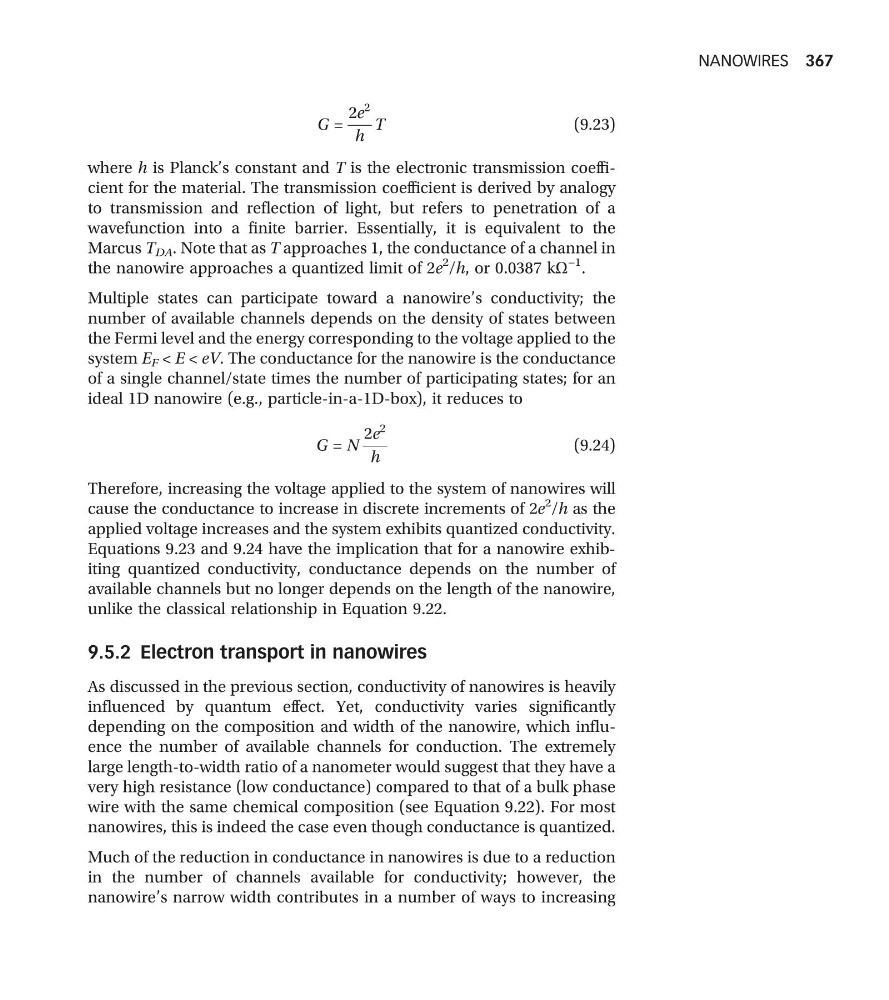
G =
2e
2
h
T
(9.23)
where h is Planck’s constant and T is the electronic transmission coefficient for the material. The transmission coefficient is derived by analogy
to transmission and reflection of light, but refers to penetration of a
wavefunction into a finite barrier. Essentially, it is equivalent to the
Marcus T DA . Note that as T approaches 1, the conductance of a channel in
the nanowire approaches a quantized limit of 2e
2
/h, or 0.0387 kΩ
−1 .
Multiple states can participate toward a nanowire’s conductivity; the
number of available channels depends on the density of states between
the Fermi level and the energy corresponding to the voltage applied to the
system E F < E < eV. The conductance for the nanowire is the conductance
of a single channel/state times the number of participating states; for an
ideal 1D nanowire (e.g., particle-in-a-1D-box), it reduces to
G = N
2e
2
h
(9.24)
Therefore, increasing the voltage applied to the system of nanowires will
cause the conductance to increase in discrete increments of 2e
2
/h as the
applied voltage increases and the system exhibits quantized conductivity.
Equations 9.23 and 9.24 have the implication that for a nanowire exhibiting quantized conductivity, conductance depends on the number of
available channels but no longer depends on the length of the nanowire,
unlike the classical relationship in Equation 9.22.
9.5.2 Electron transport in nanowires
As discussed in the previous section, conductivity of nanowires is heavily
influenced by quantum effect. Yet, conductivity varies significantly
depending on the composition and width of the nanowire, which influence the number of available channels for conduction. The extremely
large length-to-width ratio of a nanometer would suggest that they have a
very high resistance (low conductance) compared to that of a bulk phase
wire with the same chemical composition (see Equation 9.22). For most
nanowires, this is indeed the case even though conductance is quantized.
Much of the reduction in conductance in nanowires is due to a reduction
in the number of channels available for conductivity; however, the
nanowire’s narrow width contributes in a number of ways to increasing
NANOWIRES 367
2e
2
h
T
(9.23)
where h is Planck’s constant and T is the electronic transmission coefficient for the material. The transmission coefficient is derived by analogy
to transmission and reflection of light, but refers to penetration of a
wavefunction into a finite barrier. Essentially, it is equivalent to the
Marcus T DA . Note that as T approaches 1, the conductance of a channel in
the nanowire approaches a quantized limit of 2e
2
/h, or 0.0387 kΩ
−1 .
Multiple states can participate toward a nanowire’s conductivity; the
number of available channels depends on the density of states between
the Fermi level and the energy corresponding to the voltage applied to the
system E F < E < eV. The conductance for the nanowire is the conductance
of a single channel/state times the number of participating states; for an
ideal 1D nanowire (e.g., particle-in-a-1D-box), it reduces to
G = N
2e
2
h
(9.24)
Therefore, increasing the voltage applied to the system of nanowires will
cause the conductance to increase in discrete increments of 2e
2
/h as the
applied voltage increases and the system exhibits quantized conductivity.
Equations 9.23 and 9.24 have the implication that for a nanowire exhibiting quantized conductivity, conductance depends on the number of
available channels but no longer depends on the length of the nanowire,
unlike the classical relationship in Equation 9.22.
9.5.2 Electron transport in nanowires
As discussed in the previous section, conductivity of nanowires is heavily
influenced by quantum effect. Yet, conductivity varies significantly
depending on the composition and width of the nanowire, which influence the number of available channels for conduction. The extremely
large length-to-width ratio of a nanometer would suggest that they have a
very high resistance (low conductance) compared to that of a bulk phase
wire with the same chemical composition (see Equation 9.22). For most
nanowires, this is indeed the case even though conductance is quantized.
Much of the reduction in conductance in nanowires is due to a reduction
in the number of channels available for conductivity; however, the
nanowire’s narrow width contributes in a number of ways to increasing
NANOWIRES 367