

resistance. For one, decreased width increases the relative effect of the
wire’s surface molecules. The atoms or molecules at the surface of the
wire are much less tightly bound than atoms or molecules found in
the interior of the wire. As well, surface molecules are in contact with far
fewer of the wire’s molecules than those found in the interior of the wire.
The overall consequence is that molecules found at the surface of a wire
have greater difficulty propagating electrons to other wire molecules.
Therefore, high surface-area-to-volume ratios tend to increase the resistance. The basic concept of width effects on resistance is related to what is
known as the mean-free path.
Mean-free path relates to the distance an electron travels between subsequent collisions with other moving particles. Unlike for chemical
reactions, where collisions are necessary for a reaction to proceed, collisions are not favorable for electron transport through nanowires since
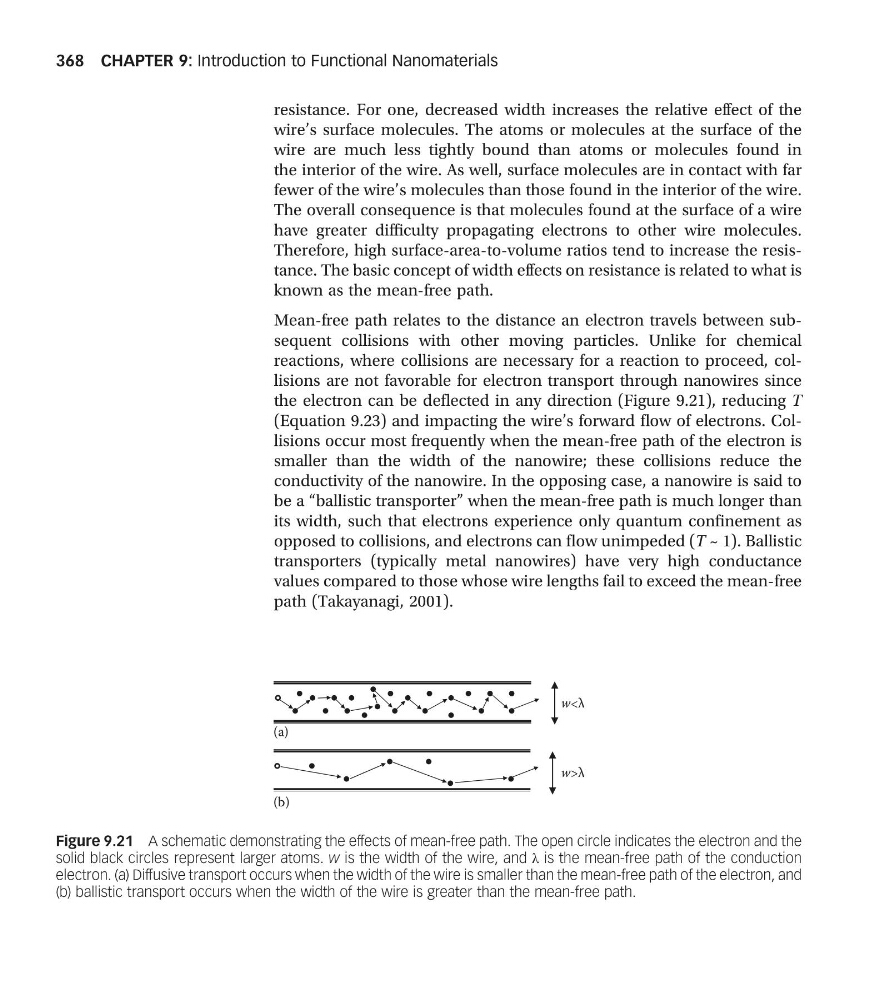
the electron can be deflected in any direction (Figure 9.21), reducing T
(Equation 9.23) and impacting the wire’s forward flow of electrons. Collisions occur most frequently when the mean-free path of the electron is
smaller than the width of the nanowire; these collisions reduce the
conductivity of the nanowire. In the opposing case, a nanowire is said to
be a “ballistic transporter” when the mean-free path is much longer than
its width, such that electrons experience only quantum confinement as
opposed to collisions, and electrons can flow unimpeded (T ~ 1). Ballistic
transporters (typically metal nanowires) have very high conductance
values compared to those whose wire lengths fail to exceed the mean-free
path (Takayanagi, 2001).
w<λ
w>λ
(a)
(b)
Figure 9.21 A schematic demonstrating the effects of mean-free path. The open circle indicates the electron and the
solid black circles represent larger atoms. w is the width of the wire, and λ is the mean-free path of the conduction
electron. (a) Diffusive transport occurs when the width of the wire is smaller than the mean-free path of the electron, and
(b) ballistic transport occurs when the width of the wire is greater than the mean-free path.
CHAPTER 9: Introduction to Functional Nanomaterials
368
wire’s surface molecules. The atoms or molecules at the surface of the
wire are much less tightly bound than atoms or molecules found in
the interior of the wire. As well, surface molecules are in contact with far
fewer of the wire’s molecules than those found in the interior of the wire.
The overall consequence is that molecules found at the surface of a wire
have greater difficulty propagating electrons to other wire molecules.
Therefore, high surface-area-to-volume ratios tend to increase the resistance. The basic concept of width effects on resistance is related to what is
known as the mean-free path.
Mean-free path relates to the distance an electron travels between subsequent collisions with other moving particles. Unlike for chemical
reactions, where collisions are necessary for a reaction to proceed, collisions are not favorable for electron transport through nanowires since
the electron can be deflected in any direction (Figure 9.21), reducing T
(Equation 9.23) and impacting the wire’s forward flow of electrons. Collisions occur most frequently when the mean-free path of the electron is
smaller than the width of the nanowire; these collisions reduce the
conductivity of the nanowire. In the opposing case, a nanowire is said to
be a “ballistic transporter” when the mean-free path is much longer than
its width, such that electrons experience only quantum confinement as
opposed to collisions, and electrons can flow unimpeded (T ~ 1). Ballistic
transporters (typically metal nanowires) have very high conductance
values compared to those whose wire lengths fail to exceed the mean-free
path (Takayanagi, 2001).
w<λ
w>λ
(a)
(b)
Figure 9.21 A schematic demonstrating the effects of mean-free path. The open circle indicates the electron and the
solid black circles represent larger atoms. w is the width of the wire, and λ is the mean-free path of the conduction
electron. (a) Diffusive transport occurs when the width of the wire is smaller than the mean-free path of the electron, and
(b) ballistic transport occurs when the width of the wire is greater than the mean-free path.
CHAPTER 9: Introduction to Functional Nanomaterials
368