

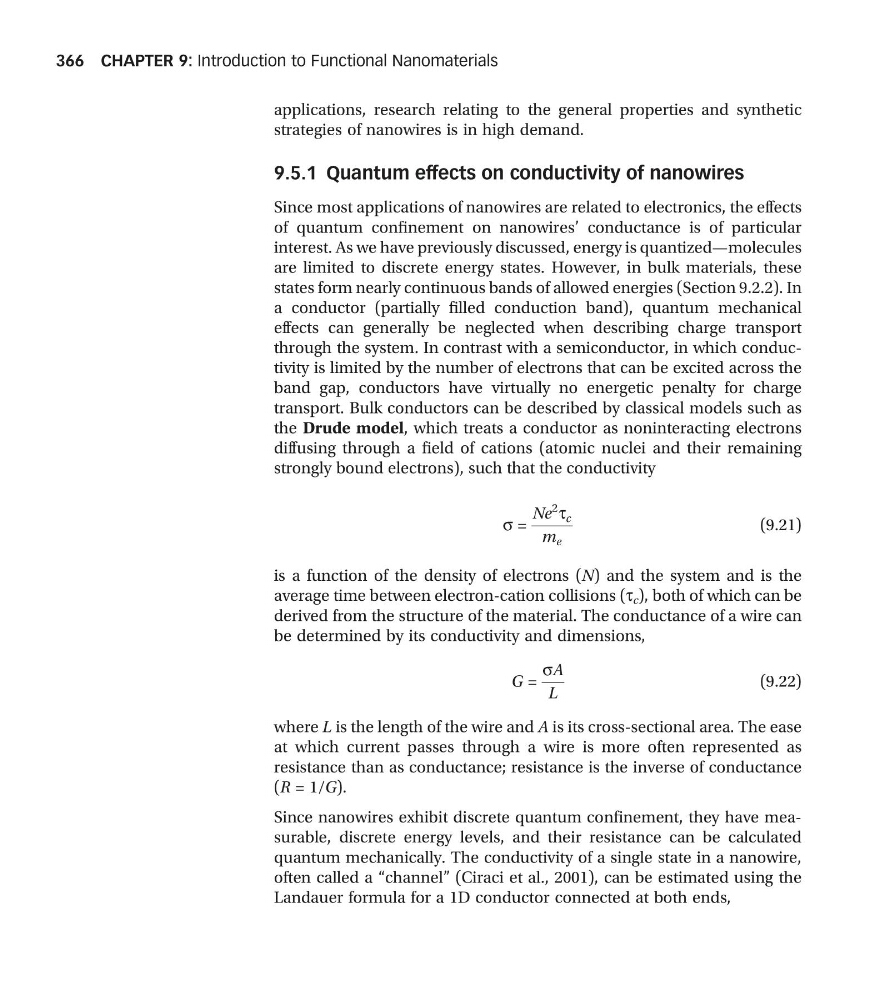
applications, research relating to the general properties and synthetic
strategies of nanowires is in high demand.
9.5.1 Quantum effects on conductivity of nanowires
Since most applications of nanowires are related to electronics, the effects
of quantum confinement on nanowires’ conductance is of particular
interest. As we have previously discussed, energy is quantized—molecules
are limited to discrete energy states. However, in bulk materials, these
states form nearly continuous bands of allowed energies (Section 9.2.2). In
a conductor (partially filled conduction band), quantum mechanical
effects can generally be neglected when describing charge transport
through the system. In contrast with a semiconductor, in which conductivity is limited by the number of electrons that can be excited across the
band gap, conductors have virtually no energetic penalty for charge
transport. Bulk conductors can be described by classical models such as
the Drude model, which treats a conductor as noninteracting electrons
diffusing through a field of cations (atomic nuclei and their remaining
strongly bound electrons), such that the conductivity
s =
Ne
2 t c
m e
(9.21)
is a function of the density of electrons (N) and the system and is the
average time between electron-cation collisions (t c ), both of which can be
derived from the structure of the material. The conductance of a wire can
be determined by its conductivity and dimensions,
G =
sA
L
(9.22)
where L is the length of the wire and A is its cross-sectional area. The ease
at which current passes through a wire is more often represented as
resistance than as conductance; resistance is the inverse of conductance
(R = 1/G).
Since nanowires exhibit discrete quantum confinement, they have measurable, discrete energy levels, and their resistance can be calculated
quantum mechanically. The conductivity of a single state in a nanowire,
often called a “channel” (Ciraci et al., 2001), can be estimated using the
Landauer formula for a 1D conductor connected at both ends,
CHAPTER 9: Introduction to Functional Nanomaterials
366
strategies of nanowires is in high demand.
9.5.1 Quantum effects on conductivity of nanowires
Since most applications of nanowires are related to electronics, the effects
of quantum confinement on nanowires’ conductance is of particular
interest. As we have previously discussed, energy is quantized—molecules
are limited to discrete energy states. However, in bulk materials, these
states form nearly continuous bands of allowed energies (Section 9.2.2). In
a conductor (partially filled conduction band), quantum mechanical
effects can generally be neglected when describing charge transport
through the system. In contrast with a semiconductor, in which conductivity is limited by the number of electrons that can be excited across the
band gap, conductors have virtually no energetic penalty for charge
transport. Bulk conductors can be described by classical models such as
the Drude model, which treats a conductor as noninteracting electrons
diffusing through a field of cations (atomic nuclei and their remaining
strongly bound electrons), such that the conductivity
s =
Ne
2 t c
m e
(9.21)
is a function of the density of electrons (N) and the system and is the
average time between electron-cation collisions (t c ), both of which can be
derived from the structure of the material. The conductance of a wire can
be determined by its conductivity and dimensions,
G =
sA
L
(9.22)
where L is the length of the wire and A is its cross-sectional area. The ease
at which current passes through a wire is more often represented as
resistance than as conductance; resistance is the inverse of conductance
(R = 1/G).
Since nanowires exhibit discrete quantum confinement, they have measurable, discrete energy levels, and their resistance can be calculated
quantum mechanically. The conductivity of a single state in a nanowire,
often called a “channel” (Ciraci et al., 2001), can be estimated using the
Landauer formula for a 1D conductor connected at both ends,
CHAPTER 9: Introduction to Functional Nanomaterials
366