

the fluorescence exhibited by the quantum dots. Analysis by mass spectroscopy reveals the identity of the ligand.
9.4.4 Photodynamic therapy
Another interesting use of quantum dots in biological systems is as a
therapeutic agent. A quantum dot can be coated with a dye and either
directly injected into a target region such as a tumor or conjugated with
an antibody such that it can recognize and bind to its target (Zhang et al.,
2007). If light at a wavelength that excites the quantum dot is shone on the
organism, the quantum dot is excited and transfers that excitation to the
dye via methods such as those discussed in Section 9.3. The dye can then
transfer energy and/or electrons to the medium, forming reactive oxygen
species (ROS, also known as free radicals) that destroy the target cell.
Such an approach is promising for treating cancerous tumors while
avoiding damage to healthy tissue (Lucky et al., 2015). A schematic of
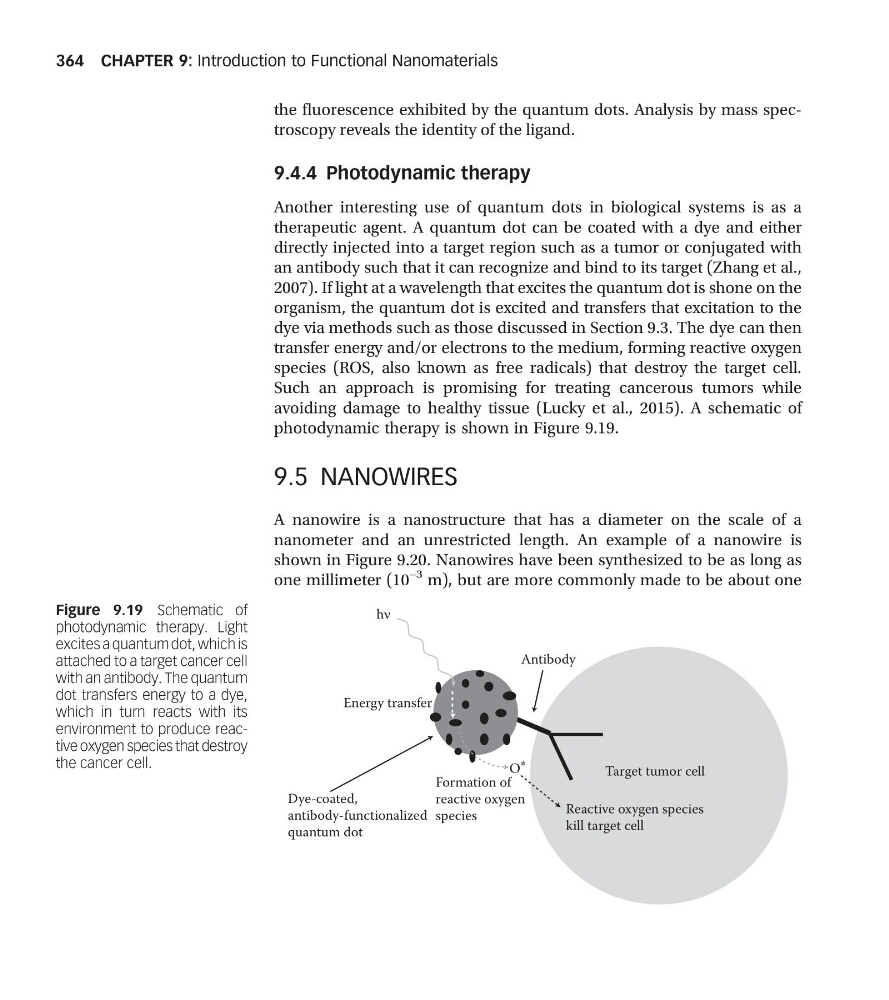
photodynamic therapy is shown in Figure 9.19.
9.5 NANOWIRES
A nanowire is a nanostructure that has a diameter on the scale of a
nanometer and an unrestricted length. An example of a nanowire is
shown in Figure 9.20. Nanowires have been synthesized to be as long as
one millimeter (10
−3 m), but are more commonly made to be about one
Target tumor cell
Antibody
O *
Reactive oxygen species
kill target cell
hν
Energy transfer
Dye-coated,
antibody-functionalized
quantum dot
Formation of
reactive oxygen
species
Figure 9.19 Schematic of
photodynamic therapy. Light
excites a quantum dot, which is
attached to a target cancer cell
with an antibody. The quantum
dot transfers energy to a dye,
which in turn reacts with its
environment to produce reactive oxygen species that destroy
the cancer cell.
CHAPTER 9: Introduction to Functional Nanomaterials
364
9.4.4 Photodynamic therapy
Another interesting use of quantum dots in biological systems is as a
therapeutic agent. A quantum dot can be coated with a dye and either
directly injected into a target region such as a tumor or conjugated with
an antibody such that it can recognize and bind to its target (Zhang et al.,
2007). If light at a wavelength that excites the quantum dot is shone on the
organism, the quantum dot is excited and transfers that excitation to the
dye via methods such as those discussed in Section 9.3. The dye can then
transfer energy and/or electrons to the medium, forming reactive oxygen
species (ROS, also known as free radicals) that destroy the target cell.
Such an approach is promising for treating cancerous tumors while
avoiding damage to healthy tissue (Lucky et al., 2015). A schematic of
photodynamic therapy is shown in Figure 9.19.
9.5 NANOWIRES
A nanowire is a nanostructure that has a diameter on the scale of a
nanometer and an unrestricted length. An example of a nanowire is
shown in Figure 9.20. Nanowires have been synthesized to be as long as
one millimeter (10
−3 m), but are more commonly made to be about one
Target tumor cell
Antibody
O *
Reactive oxygen species
kill target cell
hν
Energy transfer
Dye-coated,
antibody-functionalized
quantum dot
Formation of
reactive oxygen
species
Figure 9.19 Schematic of
photodynamic therapy. Light
excites a quantum dot, which is
attached to a target cancer cell
with an antibody. The quantum
dot transfers energy to a dye,
which in turn reacts with its
environment to produce reactive oxygen species that destroy
the cancer cell.
CHAPTER 9: Introduction to Functional Nanomaterials
364