

through absorption by an acceptor or through fluorescence. This is
another possible mechanism for how energy is able to be transported
through a medium.
9.4 QUANTUM DOTS
In the previous sections in this chapter, we have considered basic physics
needed to understand charge and excitation transfer in functional
nanomaterials with several examples of systems and devices. We will now
begin a brief tour through a wide variety of functional nanomaterials,
starting with zero-dimensional systems and working our way up in
dimensionality.
Quantum dots are inorganic semiconductor nanoparticles, typically 2–
10 nm in size. The excitons (electron-hole pairs) within quantum dots are
confined along all three dimensions, such that they are 0-dimensional
nanomaterials. In contrast, nanowires are confined in two dimensions
(1D nanomaterials), and quantum wells are confined along one dimension (2D nanomaterials). As the confining dimensions of a nanomaterial
decrease toward a limit, the energy gap starts to change with it. This
change in the energy gap can be quantified using models such as the
particle-in-a-sphere model, which we discussed in Chapter 4. The small
size of quantum dots confines electrons to a region that gives them optical
and electronic properties in between those of bulk semiconductors and
discrete molecules (Nirmal, 1999). Each dot is a mesoscopic entity with
individual properties, differentiating it from a colloidal particle.
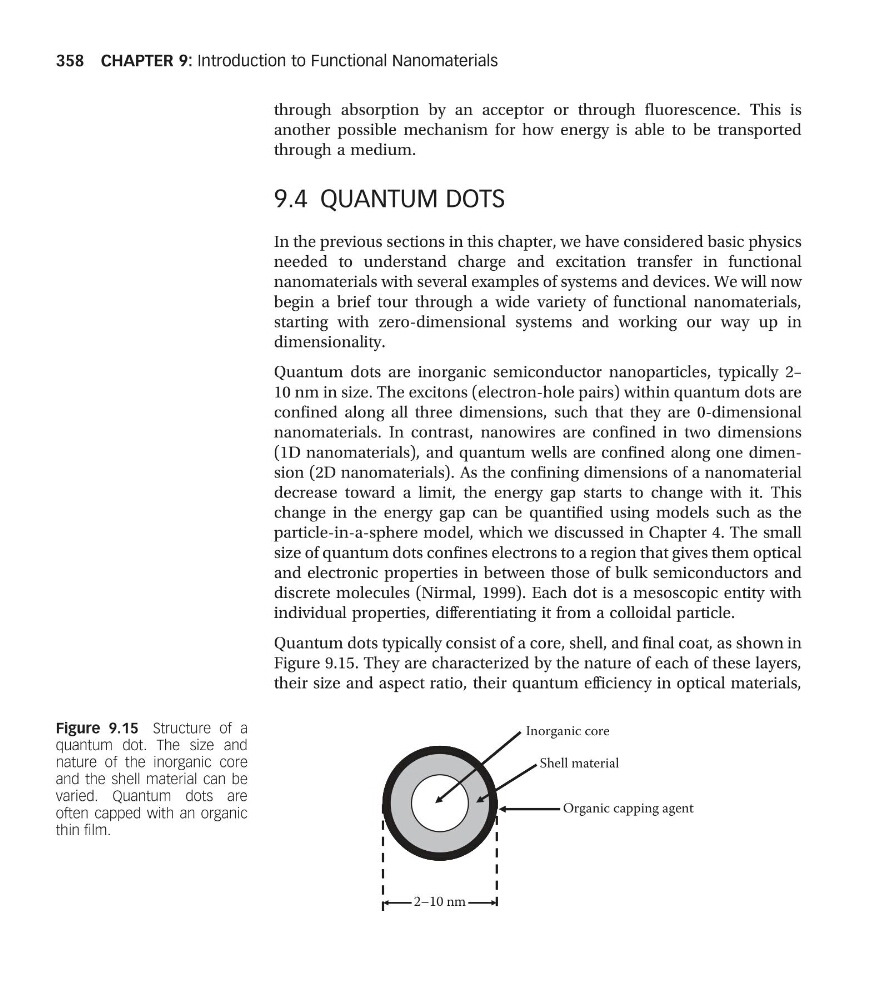
Quantum dots typically consist of a core, shell, and final coat, as shown in
Figure 9.15. They are characterized by the nature of each of these layers,
their size and aspect ratio, their quantum efficiency in optical materials,
Inorganic core
Shell material
Organic capping agent
2–10 nm
Figure 9.15 Structure of a
quantum dot. The size and
nature of the inorganic core
and the shell material can be
varied. Quantum dots are
often capped with an organic
thin film.
CHAPTER 9: Introduction to Functional Nanomaterials
358
another possible mechanism for how energy is able to be transported
through a medium.
9.4 QUANTUM DOTS
In the previous sections in this chapter, we have considered basic physics
needed to understand charge and excitation transfer in functional
nanomaterials with several examples of systems and devices. We will now
begin a brief tour through a wide variety of functional nanomaterials,
starting with zero-dimensional systems and working our way up in
dimensionality.
Quantum dots are inorganic semiconductor nanoparticles, typically 2–
10 nm in size. The excitons (electron-hole pairs) within quantum dots are
confined along all three dimensions, such that they are 0-dimensional
nanomaterials. In contrast, nanowires are confined in two dimensions
(1D nanomaterials), and quantum wells are confined along one dimension (2D nanomaterials). As the confining dimensions of a nanomaterial
decrease toward a limit, the energy gap starts to change with it. This
change in the energy gap can be quantified using models such as the
particle-in-a-sphere model, which we discussed in Chapter 4. The small
size of quantum dots confines electrons to a region that gives them optical
and electronic properties in between those of bulk semiconductors and
discrete molecules (Nirmal, 1999). Each dot is a mesoscopic entity with
individual properties, differentiating it from a colloidal particle.
Quantum dots typically consist of a core, shell, and final coat, as shown in
Figure 9.15. They are characterized by the nature of each of these layers,
their size and aspect ratio, their quantum efficiency in optical materials,
Inorganic core
Shell material
Organic capping agent
2–10 nm
Figure 9.15 Structure of a
quantum dot. The size and
nature of the inorganic core
and the shell material can be
varied. Quantum dots are
often capped with an organic
thin film.
CHAPTER 9: Introduction to Functional Nanomaterials
358