

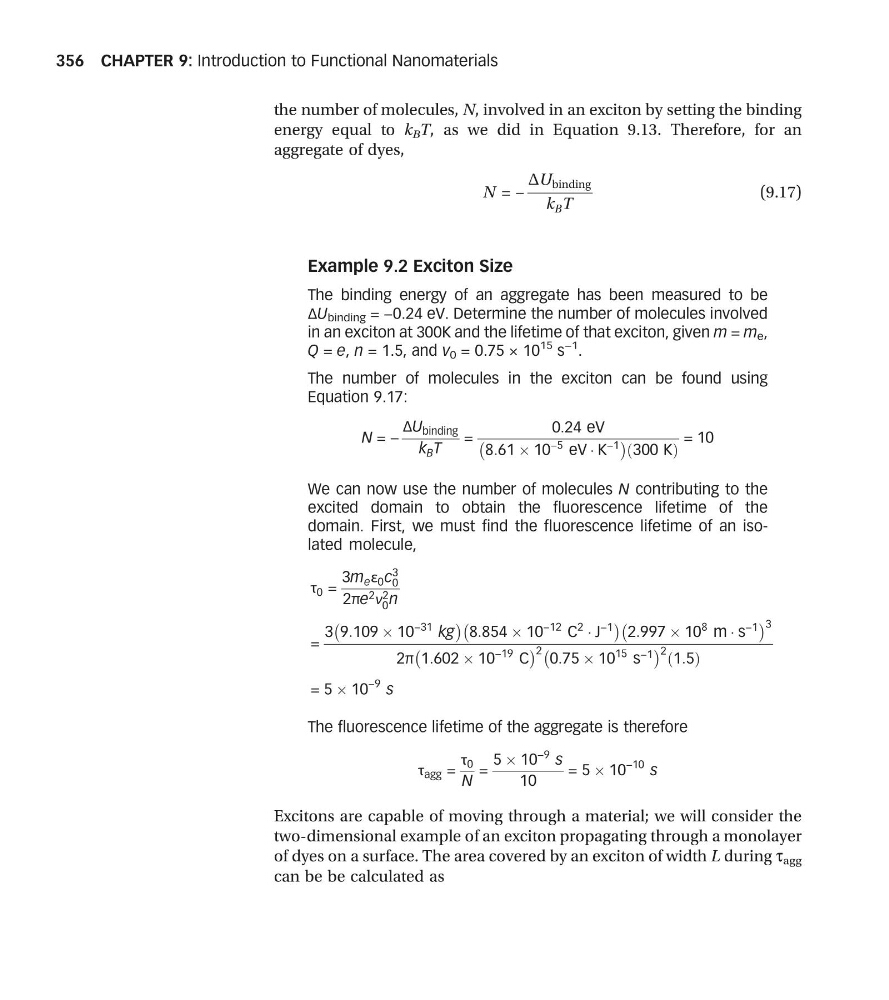
the number of molecules, N, involved in an exciton by setting the binding
energy equal to k B T, as we did in Equation 9.13. Therefore, for an
aggregate of dyes,
N = −
ΔU binding
k B T
(9.17)
Example 9.2 Exciton Size
The binding energy of an aggregate has been measured to be
ΔU binding = −0.24 eV. Determine the number of molecules involved
in an exciton at 300K and the lifetime of that exciton, given m = m e ,
Q = e, n = 1.5, and v 0 = 0.75 × 10
15 s
−1
.
The number of molecules in the exciton can be found using
Equation 9.17:
N = −
ΔU binding
k B T
=
0:24 eV
8:61 Â 10
−5 eV Á K
−1
À
Á
300 K
ð
Þ
= 10
We can now use the number of molecules N contributing to the
excited domain to obtain the fluorescence lifetime of the
domain. First, we must find the fluorescence lifetime of an isolated molecule,
τ 0 =
3m e ε 0 c
3
0
2πe 2 ν 2
0 n
=
3 9:109 Â 10
−31 kg
À
Á
8:854 Â 10
−12 C
2
Á J
−1
À
Á
2:997 Â 10
8 m Á s
−1
À
Á 3
2π 1:602 Â 10
−19 C
À
Á 2 0:75 Â 10
15 s
−1
À
Á 2 1:5
ð Þ
= 5 Â 10
−9 s
The fluorescence lifetime of the aggregate is therefore
τ agg =
τ 0
N
=
5 Â 10
−9 s
10
= 5 Â 10
−10 s
Excitons are capable of moving through a material; we will consider the
two-dimensional example of an exciton propagating through a monolayer
of dyes on a surface. The area covered by an exciton of width L during t agg
can be be calculated as
CHAPTER 9: Introduction to Functional Nanomaterials
356
energy equal to k B T, as we did in Equation 9.13. Therefore, for an
aggregate of dyes,
N = −
ΔU binding
k B T
(9.17)
Example 9.2 Exciton Size
The binding energy of an aggregate has been measured to be
ΔU binding = −0.24 eV. Determine the number of molecules involved
in an exciton at 300K and the lifetime of that exciton, given m = m e ,
Q = e, n = 1.5, and v 0 = 0.75 × 10
15 s
−1
.
The number of molecules in the exciton can be found using
Equation 9.17:
N = −
ΔU binding
k B T
=
0:24 eV
8:61 Â 10
−5 eV Á K
−1
À
Á
300 K
ð
Þ
= 10
We can now use the number of molecules N contributing to the
excited domain to obtain the fluorescence lifetime of the
domain. First, we must find the fluorescence lifetime of an isolated molecule,
τ 0 =
3m e ε 0 c
3
0
2πe 2 ν 2
0 n
=
3 9:109 Â 10
−31 kg
À
Á
8:854 Â 10
−12 C
2
Á J
−1
À
Á
2:997 Â 10
8 m Á s
−1
À
Á 3
2π 1:602 Â 10
−19 C
À
Á 2 0:75 Â 10
15 s
−1
À
Á 2 1:5
ð Þ
= 5 Â 10
−9 s
The fluorescence lifetime of the aggregate is therefore
τ agg =
τ 0
N
=
5 Â 10
−9 s
10
= 5 Â 10
−10 s
Excitons are capable of moving through a material; we will consider the
two-dimensional example of an exciton propagating through a monolayer
of dyes on a surface. The area covered by an exciton of width L during t agg
can be be calculated as
CHAPTER 9: Introduction to Functional Nanomaterials
356