

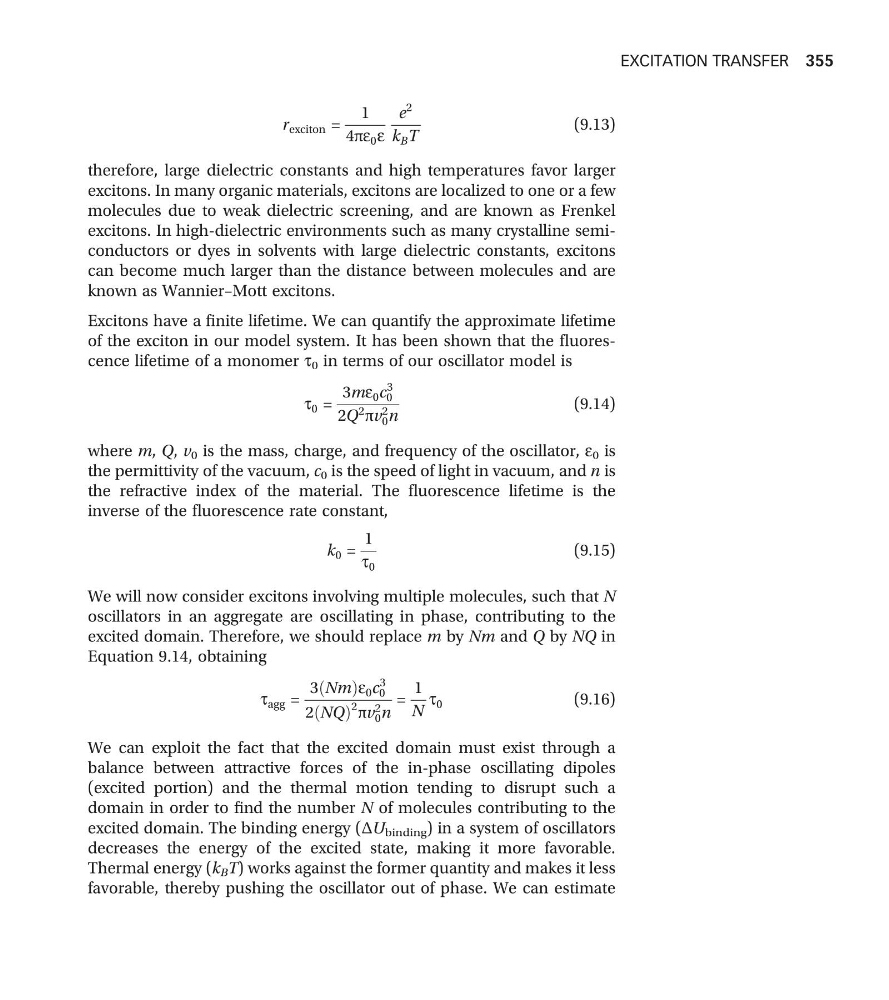
r exciton =
1
4πe 0 e
e
2
k B T
(9.13)
therefore, large dielectric constants and high temperatures favor larger
excitons. In many organic materials, excitons are localized to one or a few
molecules due to weak dielectric screening, and are known as Frenkel
excitons. In high-dielectric environments such as many crystalline semiconductors or dyes in solvents with large dielectric constants, excitons
can become much larger than the distance between molecules and are
known as Wannier–Mott excitons.
Excitons have a finite lifetime. We can quantify the approximate lifetime
of the exciton in our model system. It has been shown that the fluorescence lifetime of a monomer t 0 in terms of our oscillator model is
t 0 =
3me 0 c
3
0
2Q
2
πv
2
0 n
(9.14)
where m, Q, v 0 is the mass, charge, and frequency of the oscillator, e 0 is
the permittivity of the vacuum, c 0 is the speed of light in vacuum, and n is
the refractive index of the material. The fluorescence lifetime is the
inverse of the fluorescence rate constant,
k 0 =
1
t 0
(9.15)
We will now consider excitons involving multiple molecules, such that N
oscillators in an aggregate are oscillating in phase, contributing to the
excited domain. Therefore, we should replace m by Nm and Q by NQ in
Equation 9.14, obtaining
t agg =
3 Nm
ð
Þe 0 c
3
0
2 NQ
ð Þ
2
πv
2
0 n
=
1
N
t 0
(9.16)
We can exploit the fact that the excited domain must exist through a
balance between attractive forces of the in-phase oscillating dipoles
(excited portion) and the thermal motion tending to disrupt such a
domain in order to find the number N of molecules contributing to the
excited domain. The binding energy (ΔU binding ) in a system of oscillators
decreases the energy of the excited state, making it more favorable.
Thermal energy (k B T) works against the former quantity and makes it less
favorable, thereby pushing the oscillator out of phase. We can estimate
EXCITATION TRANSFER 355
1
4πe 0 e
e
2
k B T
(9.13)
therefore, large dielectric constants and high temperatures favor larger
excitons. In many organic materials, excitons are localized to one or a few
molecules due to weak dielectric screening, and are known as Frenkel
excitons. In high-dielectric environments such as many crystalline semiconductors or dyes in solvents with large dielectric constants, excitons
can become much larger than the distance between molecules and are
known as Wannier–Mott excitons.
Excitons have a finite lifetime. We can quantify the approximate lifetime
of the exciton in our model system. It has been shown that the fluorescence lifetime of a monomer t 0 in terms of our oscillator model is
t 0 =
3me 0 c
3
0
2Q
2
πv
2
0 n
(9.14)
where m, Q, v 0 is the mass, charge, and frequency of the oscillator, e 0 is
the permittivity of the vacuum, c 0 is the speed of light in vacuum, and n is
the refractive index of the material. The fluorescence lifetime is the
inverse of the fluorescence rate constant,
k 0 =
1
t 0
(9.15)
We will now consider excitons involving multiple molecules, such that N
oscillators in an aggregate are oscillating in phase, contributing to the
excited domain. Therefore, we should replace m by Nm and Q by NQ in
Equation 9.14, obtaining
t agg =
3 Nm
ð
Þe 0 c
3
0
2 NQ
ð Þ
2
πv
2
0 n
=
1
N
t 0
(9.16)
We can exploit the fact that the excited domain must exist through a
balance between attractive forces of the in-phase oscillating dipoles
(excited portion) and the thermal motion tending to disrupt such a
domain in order to find the number N of molecules contributing to the
excited domain. The binding energy (ΔU binding ) in a system of oscillators
decreases the energy of the excited state, making it more favorable.
Thermal energy (k B T) works against the former quantity and makes it less
favorable, thereby pushing the oscillator out of phase. We can estimate
EXCITATION TRANSFER 355