

absorbing at shorter wavelengths, is shifted to even shorter wavelengths
(higher energy), and the acceptor dye, absorbing light at longer wavelengths, is shifted to longer wavelengths (lower energy). In order to explain
the cause of this difference, we can approximate the behavior of the dye
molecules by oscillating charges exposed to the oscillating electric field of
the incident light. When considering our system as a whole, we must
account for the interactions among the electrons to determine the energy
required to excite the system. As incident light reaches the system and
excites electrons, each π-electron system can either oscillate in phase or
out of phase with its neighbors. In-phase oscillation produces a strong
absorption band because both oscillating charges are accelerated by the
electric field of the excitation, increasing the magnitude of the transition
dipole. In out-of-phase oscillation, a weak absorption band is realized
because one charge is accelerated while its neighbor feels an opposing
electric field and is decelerated, reducing the magnitude of the transition
dipole.
In an aggregate layer such as our example donor–acceptor system, the
oscillator that we use to represent a dye molecule will be strongly coupled
to all the other dye molecules (oscillators) in the layer due to the tight
packing in the system. Namely, the π-electrons of each molecule to be
excited are in close contact with all the other electrons and their oscillations are in phase. This means that as incident light is exposed to the
dye interface, an in-phase oscillation among all the layers’ oscillators
occurs and an excited domain forms, having absorbed the energy from
the incident photons. We refer to this excited domain as an exciton.
Essentially, excitons consist of excited electrons that are electrostatically
bound to vacant orbitals (holes) but can diffuse through a system and can
transfer energy between each other when their oscillations couple. The
size of an exciton depends on the dielectric constant of its environment,
and the binding energy between each electron and its corresponding hole
is given by Coulomb’s law (Chapter 5), as
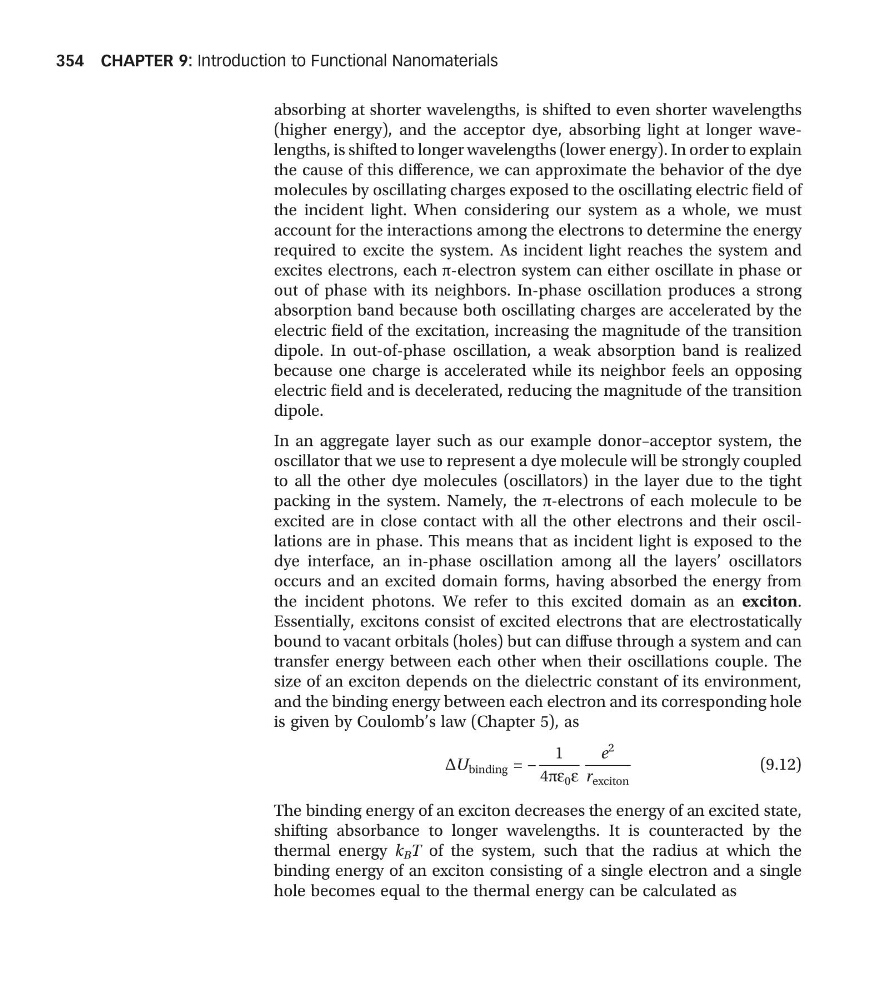
ΔU binding = −
1
4πe 0 e
e
2
r exciton
(9.12)
The binding energy of an exciton decreases the energy of an excited state,
shifting absorbance to longer wavelengths. It is counteracted by the
thermal energy k B T of the system, such that the radius at which the
binding energy of an exciton consisting of a single electron and a single
hole becomes equal to the thermal energy can be calculated as
CHAPTER 9: Introduction to Functional Nanomaterials
354
(higher energy), and the acceptor dye, absorbing light at longer wavelengths, is shifted to longer wavelengths (lower energy). In order to explain
the cause of this difference, we can approximate the behavior of the dye
molecules by oscillating charges exposed to the oscillating electric field of
the incident light. When considering our system as a whole, we must
account for the interactions among the electrons to determine the energy
required to excite the system. As incident light reaches the system and
excites electrons, each π-electron system can either oscillate in phase or
out of phase with its neighbors. In-phase oscillation produces a strong
absorption band because both oscillating charges are accelerated by the
electric field of the excitation, increasing the magnitude of the transition
dipole. In out-of-phase oscillation, a weak absorption band is realized
because one charge is accelerated while its neighbor feels an opposing
electric field and is decelerated, reducing the magnitude of the transition
dipole.
In an aggregate layer such as our example donor–acceptor system, the
oscillator that we use to represent a dye molecule will be strongly coupled
to all the other dye molecules (oscillators) in the layer due to the tight
packing in the system. Namely, the π-electrons of each molecule to be
excited are in close contact with all the other electrons and their oscillations are in phase. This means that as incident light is exposed to the
dye interface, an in-phase oscillation among all the layers’ oscillators
occurs and an excited domain forms, having absorbed the energy from
the incident photons. We refer to this excited domain as an exciton.
Essentially, excitons consist of excited electrons that are electrostatically
bound to vacant orbitals (holes) but can diffuse through a system and can
transfer energy between each other when their oscillations couple. The
size of an exciton depends on the dielectric constant of its environment,
and the binding energy between each electron and its corresponding hole
is given by Coulomb’s law (Chapter 5), as
ΔU binding = −
1
4πe 0 e
e
2
r exciton
(9.12)
The binding energy of an exciton decreases the energy of an excited state,
shifting absorbance to longer wavelengths. It is counteracted by the
thermal energy k B T of the system, such that the radius at which the
binding energy of an exciton consisting of a single electron and a single
hole becomes equal to the thermal energy can be calculated as
CHAPTER 9: Introduction to Functional Nanomaterials
354