

system losing heat. In materials exhibiting anti-Stokes shift behavior,
photon energy is absorbed; however, before reverting to ground state, the
exciton—an electrostatically coupled donor and acceptor—is also
vibrationally excited via an intermolecular vibrational mode known as a
phonon. This extra energy absorption creates a higher-energy photon
emission. However, loss of this vibration energy creates a loss of heat in
the material; it cools as it photorelaxes.
9.3.3 Resonant energy transfer
If a dye or nanoparticle emits light at a wavelength that can be absorbed
by another dye or nanoparticle, energy can be transferred between the
two systems via the emitted photon. This is called the trivial mechanism
of excitation transfer, as it is unrelated to the specifics of the system.
However, other methods of energy transfer exist that are related to
electrostatic coupling between the donor and acceptor molecules. One
common energy transfer mechanism that is important for several fluorescence spectroscopy techniques is Förster transfer, which involves
coupling between the transition dipoles of two molecules or
nanosystems. In Förster transfer, the oscillating electrons in the donor
produces a transition dipole that induces an oscillating dipole in the
acceptor, transferring energy between the donor and acceptor. The rate
constant for this transfer process is proportional to the square of the
transition dipoles,
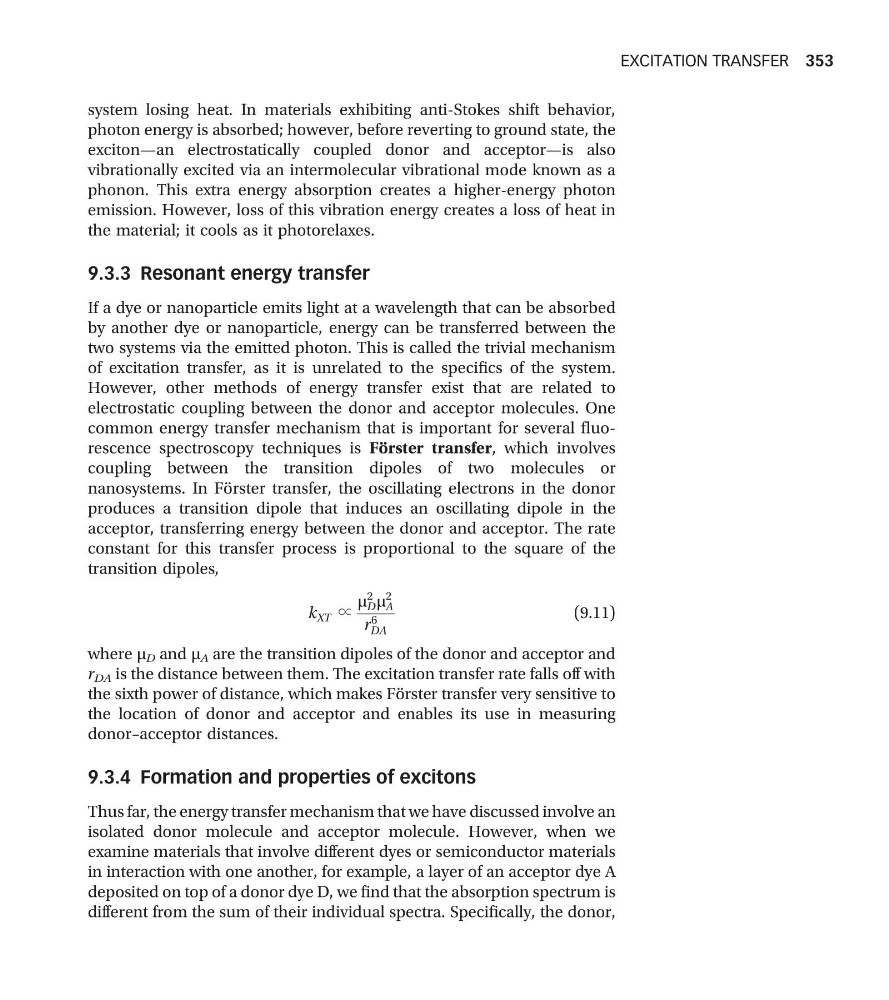
k XT ∝
μ
2
D μ
2
A
r
6
DA
(9.11)
where μ D and μ A are the transition dipoles of the donor and acceptor and
r DA is the distance between them. The excitation transfer rate falls off with
the sixth power of distance, which makes Förster transfer very sensitive to
the location of donor and acceptor and enables its use in measuring
donor–acceptor distances.
9.3.4 Formation and properties of excitons
Thus far, the energy transfer mechanism that we have discussed involve an
isolated donor molecule and acceptor molecule. However, when we
examine materials that involve different dyes or semiconductor materials
in interaction with one another, for example, a layer of an acceptor dye A
deposited on top of a donor dye D, we find that the absorption spectrum is
different from the sum of their individual spectra. Specifically, the donor,
EXCITATION TRANSFER 353
photon energy is absorbed; however, before reverting to ground state, the
exciton—an electrostatically coupled donor and acceptor—is also
vibrationally excited via an intermolecular vibrational mode known as a
phonon. This extra energy absorption creates a higher-energy photon
emission. However, loss of this vibration energy creates a loss of heat in
the material; it cools as it photorelaxes.
9.3.3 Resonant energy transfer
If a dye or nanoparticle emits light at a wavelength that can be absorbed
by another dye or nanoparticle, energy can be transferred between the
two systems via the emitted photon. This is called the trivial mechanism
of excitation transfer, as it is unrelated to the specifics of the system.
However, other methods of energy transfer exist that are related to
electrostatic coupling between the donor and acceptor molecules. One
common energy transfer mechanism that is important for several fluorescence spectroscopy techniques is Förster transfer, which involves
coupling between the transition dipoles of two molecules or
nanosystems. In Förster transfer, the oscillating electrons in the donor
produces a transition dipole that induces an oscillating dipole in the
acceptor, transferring energy between the donor and acceptor. The rate
constant for this transfer process is proportional to the square of the
transition dipoles,
k XT ∝
μ
2
D μ
2
A
r
6
DA
(9.11)
where μ D and μ A are the transition dipoles of the donor and acceptor and
r DA is the distance between them. The excitation transfer rate falls off with
the sixth power of distance, which makes Förster transfer very sensitive to
the location of donor and acceptor and enables its use in measuring
donor–acceptor distances.
9.3.4 Formation and properties of excitons
Thus far, the energy transfer mechanism that we have discussed involve an
isolated donor molecule and acceptor molecule. However, when we
examine materials that involve different dyes or semiconductor materials
in interaction with one another, for example, a layer of an acceptor dye A
deposited on top of a donor dye D, we find that the absorption spectrum is
different from the sum of their individual spectra. Specifically, the donor,
EXCITATION TRANSFER 353