

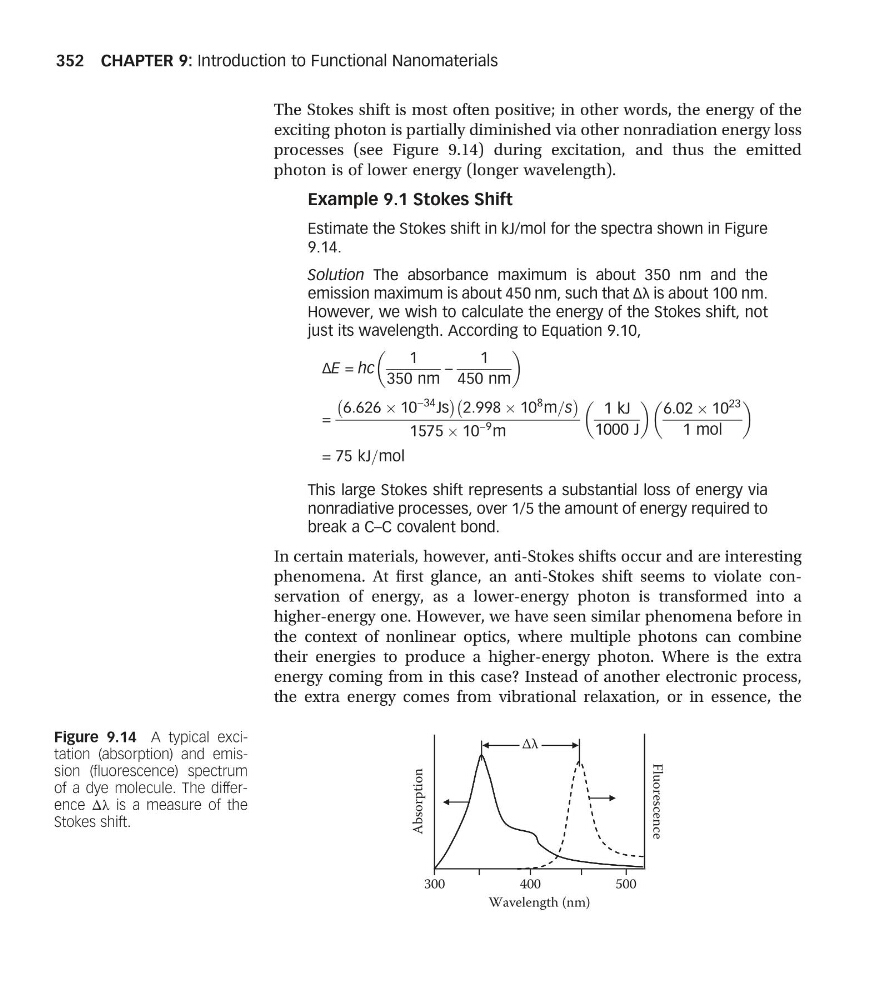
The Stokes shift is most often positive; in other words, the energy of the
exciting photon is partially diminished via other nonradiation energy loss
processes (see Figure 9.14) during excitation, and thus the emitted
photon is of lower energy (longer wavelength).
Example 9.1 Stokes Shift
Estimate the Stokes shift in kJ/mol for the spectra shown in Figure
9.14.
Solution The absorbance maximum is about 350 nm and the
emission maximum is about 450 nm, such that Δλ is about 100 nm.
However, we wish to calculate the energy of the Stokes shift, not
just its wavelength. According to Equation 9.10,
ΔE = hc
1
350 nm
−
1
450 nm
=
6:626 Â 10
−34 Js
À
Á
2:998 Â 10
8 m=s
À
Á
1575 Â 10
−9 m
1 kJ
1000 J
6:02 Â 10
23
1 mol
= 75 kJ=mol
This large Stokes shift represents a substantial loss of energy via
nonradiative processes, over 1/5 the amount of energy required to
break a C–C covalent bond.
In certain materials, however, anti-Stokes shifts occur and are interesting
phenomena. At first glance, an anti-Stokes shift seems to violate conservation of energy, as a lower-energy photon is transformed into a
higher-energy one. However, we have seen similar phenomena before in
the context of nonlinear optics, where multiple photons can combine
their energies to produce a higher-energy photon. Where is the extra
energy coming from in this case? Instead of another electronic process,
the extra energy comes from vibrational relaxation, or in essence, the
Fluorescence
Δλ
Absorption
300
400
500
Wavelength (nm)
Figure 9.14 A typical excitation (absorption) and emission (fluorescence) spectrum
of a dye molecule. The difference Δλ is a measure of the
Stokes shift.
CHAPTER 9: Introduction to Functional Nanomaterials
352
exciting photon is partially diminished via other nonradiation energy loss
processes (see Figure 9.14) during excitation, and thus the emitted
photon is of lower energy (longer wavelength).
Example 9.1 Stokes Shift
Estimate the Stokes shift in kJ/mol for the spectra shown in Figure
9.14.
Solution The absorbance maximum is about 350 nm and the
emission maximum is about 450 nm, such that Δλ is about 100 nm.
However, we wish to calculate the energy of the Stokes shift, not
just its wavelength. According to Equation 9.10,
ΔE = hc
1
350 nm
−
1
450 nm
=
6:626 Â 10
−34 Js
À
Á
2:998 Â 10
8 m=s
À
Á
1575 Â 10
−9 m
1 kJ
1000 J
6:02 Â 10
23
1 mol
= 75 kJ=mol
This large Stokes shift represents a substantial loss of energy via
nonradiative processes, over 1/5 the amount of energy required to
break a C–C covalent bond.
In certain materials, however, anti-Stokes shifts occur and are interesting
phenomena. At first glance, an anti-Stokes shift seems to violate conservation of energy, as a lower-energy photon is transformed into a
higher-energy one. However, we have seen similar phenomena before in
the context of nonlinear optics, where multiple photons can combine
their energies to produce a higher-energy photon. Where is the extra
energy coming from in this case? Instead of another electronic process,
the extra energy comes from vibrational relaxation, or in essence, the
Fluorescence
Δλ
Absorption
300
400
500
Wavelength (nm)
Figure 9.14 A typical excitation (absorption) and emission (fluorescence) spectrum
of a dye molecule. The difference Δλ is a measure of the
Stokes shift.
CHAPTER 9: Introduction to Functional Nanomaterials
352