

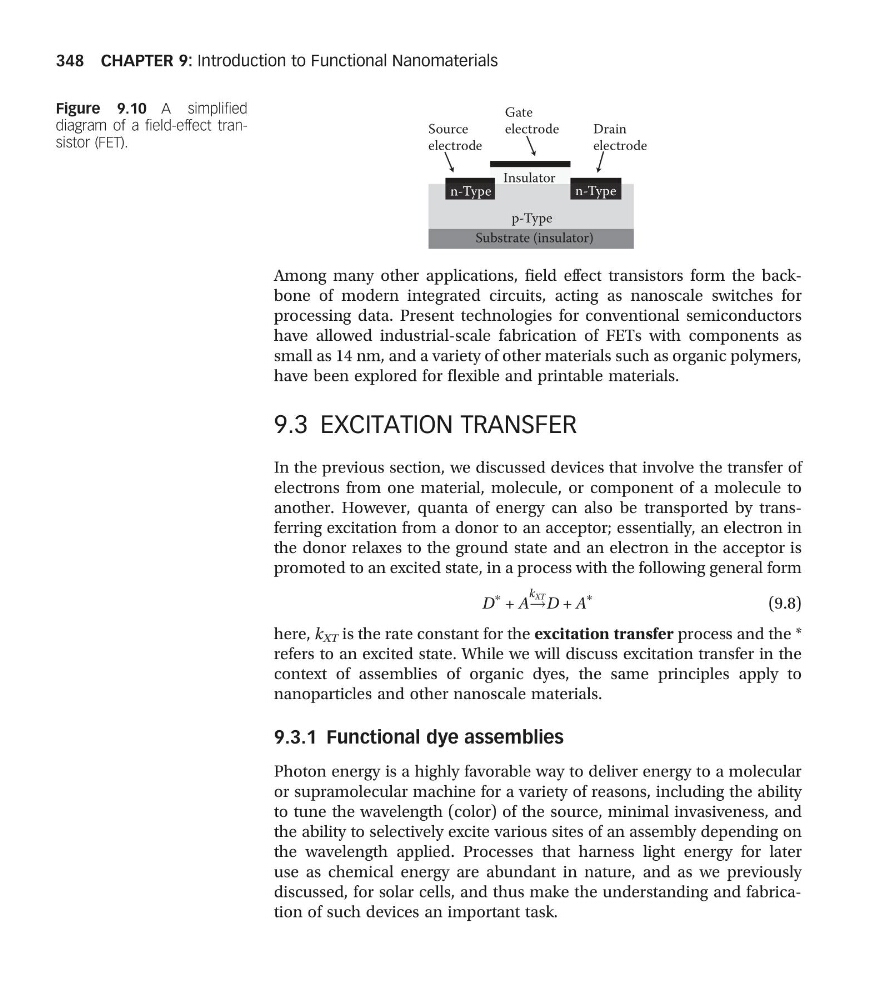
Among many other applications, field effect transistors form the backbone of modern integrated circuits, acting as nanoscale switches for
processing data. Present technologies for conventional semiconductors
have allowed industrial-scale fabrication of FETs with components as
small as 14 nm, and a variety of other materials such as organic polymers,
have been explored for flexible and printable materials.
9.3 EXCITATION TRANSFER
In the previous section, we discussed devices that involve the transfer of
electrons from one material, molecule, or component of a molecule to
another. However, quanta of energy can also be transported by transferring excitation from a donor to an acceptor; essentially, an electron in
the donor relaxes to the ground state and an electron in the acceptor is
promoted to an excited state, in a process with the following general form
D
∗ + A!
k XT D + A
∗
(9.8)
here, k XT is the rate constant for the excitation transfer process and the *
refers to an excited state. While we will discuss excitation transfer in the
context of assemblies of organic dyes, the same principles apply to
nanoparticles and other nanoscale materials.
9.3.1 Functional dye assemblies
Photon energy is a highly favorable way to deliver energy to a molecular
or supramolecular machine for a variety of reasons, including the ability
to tune the wavelength (color) of the source, minimal invasiveness, and
the ability to selectively excite various sites of an assembly depending on
the wavelength applied. Processes that harness light energy for later
use as chemical energy are abundant in nature, and as we previously
discussed, for solar cells, and thus make the understanding and fabrication of such devices an important task.
Insulator
p-Type
n-Type
n-Type
Source
electrode
Drain
electrode
Gate
electrode
Substrate (insulator)
Figure 9.10 A simplified
diagram of a field-effect transistor (FET).
CHAPTER 9: Introduction to Functional Nanomaterials
348
processing data. Present technologies for conventional semiconductors
have allowed industrial-scale fabrication of FETs with components as
small as 14 nm, and a variety of other materials such as organic polymers,
have been explored for flexible and printable materials.
9.3 EXCITATION TRANSFER
In the previous section, we discussed devices that involve the transfer of
electrons from one material, molecule, or component of a molecule to
another. However, quanta of energy can also be transported by transferring excitation from a donor to an acceptor; essentially, an electron in
the donor relaxes to the ground state and an electron in the acceptor is
promoted to an excited state, in a process with the following general form
D
∗ + A!
k XT D + A
∗
(9.8)
here, k XT is the rate constant for the excitation transfer process and the *
refers to an excited state. While we will discuss excitation transfer in the
context of assemblies of organic dyes, the same principles apply to
nanoparticles and other nanoscale materials.
9.3.1 Functional dye assemblies
Photon energy is a highly favorable way to deliver energy to a molecular
or supramolecular machine for a variety of reasons, including the ability
to tune the wavelength (color) of the source, minimal invasiveness, and
the ability to selectively excite various sites of an assembly depending on
the wavelength applied. Processes that harness light energy for later
use as chemical energy are abundant in nature, and as we previously
discussed, for solar cells, and thus make the understanding and fabrication of such devices an important task.
Insulator
p-Type
n-Type
n-Type
Source
electrode
Drain
electrode
Gate
electrode
Substrate (insulator)
Figure 9.10 A simplified
diagram of a field-effect transistor (FET).
CHAPTER 9: Introduction to Functional Nanomaterials
348