

compared to conventional semiconductor fabrication processes. A
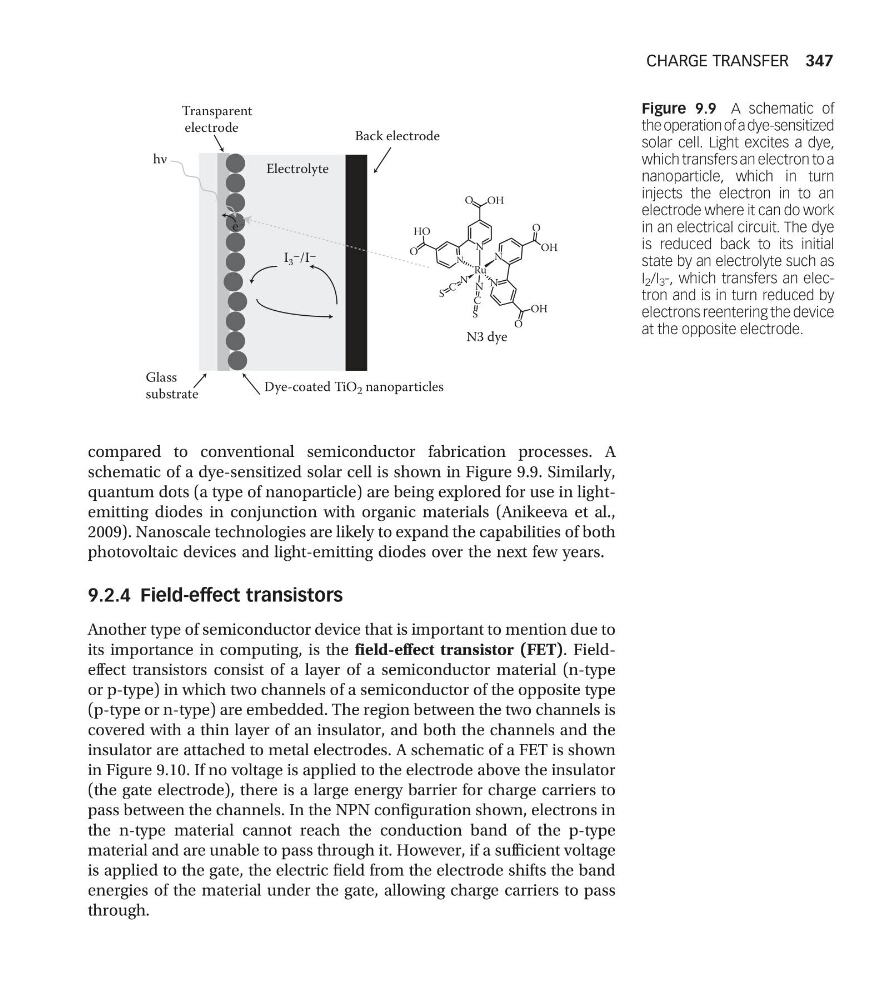
schematic of a dye-sensitized solar cell is shown in Figure 9.9. Similarly,
quantum dots (a type of nanoparticle) are being explored for use in lightemitting diodes in conjunction with organic materials (Anikeeva et al.,
2009). Nanoscale technologies are likely to expand the capabilities of both
photovoltaic devices and light-emitting diodes over the next few years.
9.2.4 Field-effect transistors
Another type of semiconductor device that is important to mention due to
its importance in computing, is the field-effect transistor (FET). Fieldeffect transistors consist of a layer of a semiconductor material (n-type
or p-type) in which two channels of a semiconductor of the opposite type
(p-type or n-type) are embedded. The region between the two channels is
covered with a thin layer of an insulator, and both the channels and the
insulator are attached to metal electrodes. A schematic of a FET is shown
in Figure 9.10. If no voltage is applied to the electrode above the insulator
(the gate electrode), there is a large energy barrier for charge carriers to
pass between the channels. In the NPN configuration shown, electrons in
the n-type material cannot reach the conduction band of the p-type
material and are unable to pass through it. However, if a sufficient voltage
is applied to the gate, the electric field from the electrode shifts the band
energies of the material under the gate, allowing charge carriers to pass
through.
I 3
– /I –
Electrolyte
Back electrode
Transparent
electrode
Glass
substrate
Dye-coated TiO 2 nanoparticles
N3 dye
e –
hν
OH
OH
OH
O
O
O
HO
O
N
N
N
N
N
C
C
S
S
N
Ru
Figure 9.9 A schematic of
the operation of a dye-sensitized
solar cell. Light excites a dye,
which transfers an electron to a
nanoparticle, which in turn
injects the electron in to an
electrode where it can do work
in an electrical circuit. The dye
is reduced back to its initial
state by an electrolyte such as
I 2 /I 3 -, which transfers an electron and is in turn reduced by
electrons reentering the device
at the opposite electrode.
CHARGE TRANSFER 347
schematic of a dye-sensitized solar cell is shown in Figure 9.9. Similarly,
quantum dots (a type of nanoparticle) are being explored for use in lightemitting diodes in conjunction with organic materials (Anikeeva et al.,
2009). Nanoscale technologies are likely to expand the capabilities of both
photovoltaic devices and light-emitting diodes over the next few years.
9.2.4 Field-effect transistors
Another type of semiconductor device that is important to mention due to
its importance in computing, is the field-effect transistor (FET). Fieldeffect transistors consist of a layer of a semiconductor material (n-type
or p-type) in which two channels of a semiconductor of the opposite type
(p-type or n-type) are embedded. The region between the two channels is
covered with a thin layer of an insulator, and both the channels and the
insulator are attached to metal electrodes. A schematic of a FET is shown
in Figure 9.10. If no voltage is applied to the electrode above the insulator
(the gate electrode), there is a large energy barrier for charge carriers to
pass between the channels. In the NPN configuration shown, electrons in
the n-type material cannot reach the conduction band of the p-type
material and are unable to pass through it. However, if a sufficient voltage
is applied to the gate, the electric field from the electrode shifts the band
energies of the material under the gate, allowing charge carriers to pass
through.
I 3
– /I –
Electrolyte
Back electrode
Transparent
electrode
Glass
substrate
Dye-coated TiO 2 nanoparticles
N3 dye
e –
hν
OH
OH
OH
O
O
O
HO
O
N
N
N
N
N
C
C
S
S
N
Ru
Figure 9.9 A schematic of
the operation of a dye-sensitized
solar cell. Light excites a dye,
which transfers an electron to a
nanoparticle, which in turn
injects the electron in to an
electrode where it can do work
in an electrical circuit. The dye
is reduced back to its initial
state by an electrolyte such as
I 2 /I 3 -, which transfers an electron and is in turn reduced by
electrons reentering the device
at the opposite electrode.
CHARGE TRANSFER 347