

drop down to the valence band, recombining with holes in the p-type
material and emitting light at a wavelength corresponding to the energy of
the band gap, forming a light-emitting diode, or LED. LEDs are essentially solar cells running in reverse. Of course, for practical devices, the
materials are optimized for their intended application (e.g., preventing
recombination of charge carriers in solar cells while encouraging it in
LEDs, or tuning a solar cell to absorb a wavelength range that generates
maximum power vs. tuning a LED to generate a desired color). These
optimizations can be performed by selecting from a wide variety of
materials, dopants, and additional layers of materials outside the P–N
junction.
Both photovoltaic cells and light-emitting diodes have been active areas
of nanotechnology research. Blends of organic polymers and fullerenes
can be used to make thin and flexible photovoltaic cells (Mazzio and
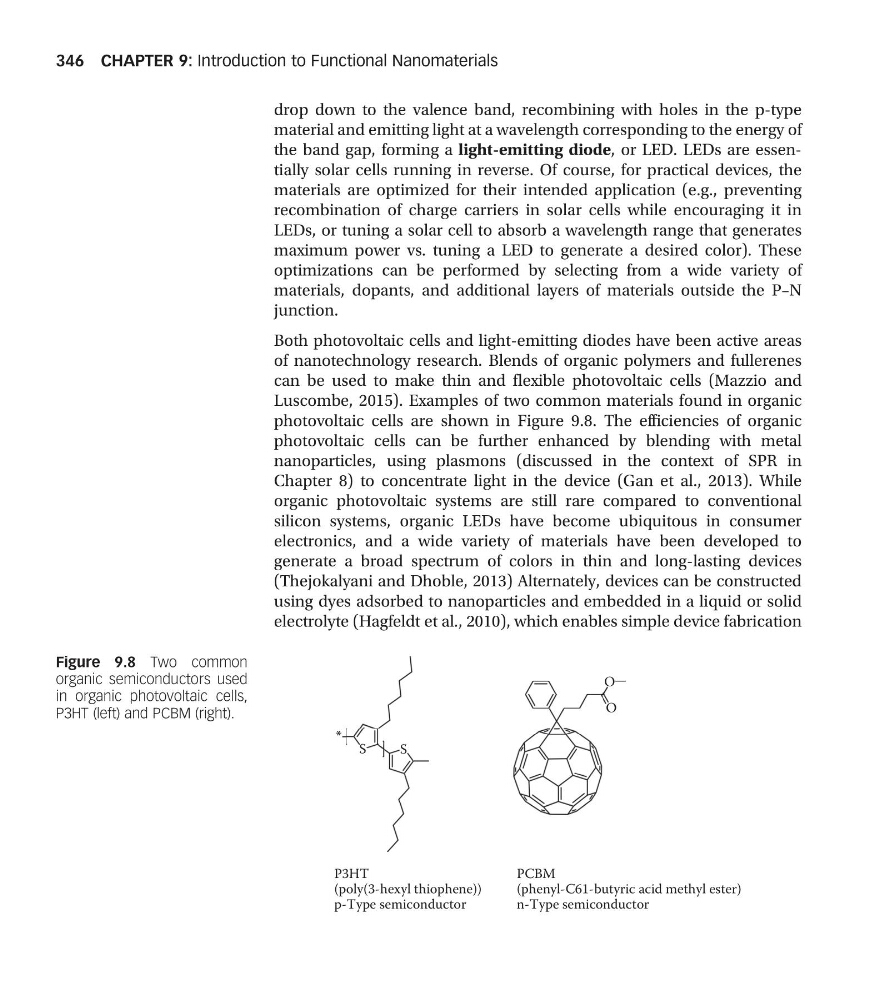
Luscombe, 2015). Examples of two common materials found in organic
photovoltaic cells are shown in Figure 9.8. The efficiencies of organic
photovoltaic cells can be further enhanced by blending with metal
nanoparticles, using plasmons (discussed in the context of SPR in
Chapter 8) to concentrate light in the device (Gan et al., 2013). While
organic photovoltaic systems are still rare compared to conventional
silicon systems, organic LEDs have become ubiquitous in consumer
electronics, and a wide variety of materials have been developed to
generate a broad spectrum of colors in thin and long-lasting devices
(Thejokalyani and Dhoble, 2013) Alternately, devices can be constructed
using dyes adsorbed to nanoparticles and embedded in a liquid or solid
electrolyte (Hagfeldt et al., 2010), which enables simple device fabrication
P3HT
(poly(3-hexyl thiophene))
p-Type semiconductor
PCBM
(phenyl-C61-butyric acid methyl ester)
n-Type semiconductor
S
S
*
O
O
Figure 9.8 Two common
organic semiconductors used
in organic photovoltaic cells,
P3HT (left) and PCBM (right).
CHAPTER 9: Introduction to Functional Nanomaterials
346
material and emitting light at a wavelength corresponding to the energy of
the band gap, forming a light-emitting diode, or LED. LEDs are essentially solar cells running in reverse. Of course, for practical devices, the
materials are optimized for their intended application (e.g., preventing
recombination of charge carriers in solar cells while encouraging it in
LEDs, or tuning a solar cell to absorb a wavelength range that generates
maximum power vs. tuning a LED to generate a desired color). These
optimizations can be performed by selecting from a wide variety of
materials, dopants, and additional layers of materials outside the P–N
junction.
Both photovoltaic cells and light-emitting diodes have been active areas
of nanotechnology research. Blends of organic polymers and fullerenes
can be used to make thin and flexible photovoltaic cells (Mazzio and
Luscombe, 2015). Examples of two common materials found in organic
photovoltaic cells are shown in Figure 9.8. The efficiencies of organic
photovoltaic cells can be further enhanced by blending with metal
nanoparticles, using plasmons (discussed in the context of SPR in
Chapter 8) to concentrate light in the device (Gan et al., 2013). While
organic photovoltaic systems are still rare compared to conventional
silicon systems, organic LEDs have become ubiquitous in consumer
electronics, and a wide variety of materials have been developed to
generate a broad spectrum of colors in thin and long-lasting devices
(Thejokalyani and Dhoble, 2013) Alternately, devices can be constructed
using dyes adsorbed to nanoparticles and embedded in a liquid or solid
electrolyte (Hagfeldt et al., 2010), which enables simple device fabrication
P3HT
(poly(3-hexyl thiophene))
p-Type semiconductor
PCBM
(phenyl-C61-butyric acid methyl ester)
n-Type semiconductor
S
S
*
O
O
Figure 9.8 Two common
organic semiconductors used
in organic photovoltaic cells,
P3HT (left) and PCBM (right).
CHAPTER 9: Introduction to Functional Nanomaterials
346