

Fermi levels of the anode (positive electrode) and cathode (negative
electrode). More fundamentally, it is limited by the longest wavelength of
light absorbed; for example, a solar cell with a band gap of 2 eV (620 nm)
could produce no more than 2V. The current produced by a solar cell is
proportional to the number of photons absorbed; maximum current is
produced when the solar cell is connected to itself without powering any
load (short-circuit current). The power generated is equal to the product
of voltage and current, or proportional to V oc and I sc ,
P = IV = FF Á V OC I SC
(9.7)
where FF is a constant of proportionality known as the fill factor. The
efficiency of photovoltaic cells is far less than 100% as not all photons are
absorbed and some charge carriers recombine in the device, losing
energy by reemitting light or nonradiative processes (Chapter 6). At
present, the best efficiency available in conventional crystalline silicon
solar cells with the most advanced cells, which use multiple junctions and
concentrate light with lenses or mirrors, is about 40% efficient (National
Renewable Energy Laboratory, 2017).
What happens if a P–N junction with a band gap in the visible range is
connected such that a power source injects electrons into the n-type
material? In this situation, the electrons will migrate to the junction and
Anode
Cathode
p-doped
n-doped
hν
e –
h +
Anode
Cathode
p-doped n-doped
hν
e –
h +
Photovoltaic cell
Light-emitting diode
Load
hν
Anode
Cathode
e –
Source
hν
Anode
Cathode
e –
VB
CB
VB
CB
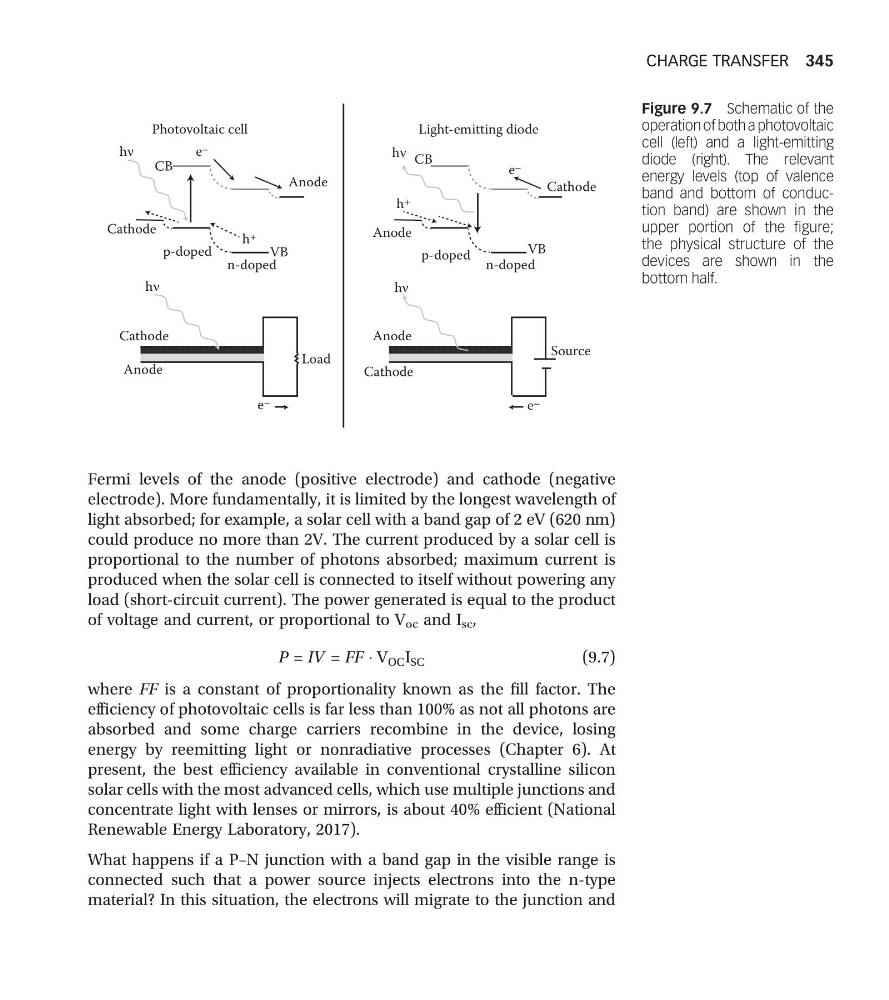
Figure 9.7 Schematic of the
operation of both a photovoltaic
cell (left) and a light-emitting
diode (right). The relevant
energy levels (top of valence
band and bottom of conduction band) are shown in the
upper portion of the figure;
the physical structure of the
devices are shown in the
bottom half.
CHARGE TRANSFER 345
electrode). More fundamentally, it is limited by the longest wavelength of
light absorbed; for example, a solar cell with a band gap of 2 eV (620 nm)
could produce no more than 2V. The current produced by a solar cell is
proportional to the number of photons absorbed; maximum current is
produced when the solar cell is connected to itself without powering any
load (short-circuit current). The power generated is equal to the product
of voltage and current, or proportional to V oc and I sc ,
P = IV = FF Á V OC I SC
(9.7)
where FF is a constant of proportionality known as the fill factor. The
efficiency of photovoltaic cells is far less than 100% as not all photons are
absorbed and some charge carriers recombine in the device, losing
energy by reemitting light or nonradiative processes (Chapter 6). At
present, the best efficiency available in conventional crystalline silicon
solar cells with the most advanced cells, which use multiple junctions and
concentrate light with lenses or mirrors, is about 40% efficient (National
Renewable Energy Laboratory, 2017).
What happens if a P–N junction with a band gap in the visible range is
connected such that a power source injects electrons into the n-type
material? In this situation, the electrons will migrate to the junction and
Anode
Cathode
p-doped
n-doped
hν
e –
h +
Anode
Cathode
p-doped n-doped
hν
e –
h +
Photovoltaic cell
Light-emitting diode
Load
hν
Anode
Cathode
e –
Source
hν
Anode
Cathode
e –
VB
CB
VB
CB
Figure 9.7 Schematic of the
operation of both a photovoltaic
cell (left) and a light-emitting
diode (right). The relevant
energy levels (top of valence
band and bottom of conduction band) are shown in the
upper portion of the figure;
the physical structure of the
devices are shown in the
bottom half.
CHARGE TRANSFER 345