

energy of the highest-energy state containing an electron is called the
Fermi level (E F ).
However, orbitals within bands are not necessarily evenly spaced in
energy. The number of orbitals at each energy is known as the density of
states, or g(E). For example, for electrons confined in a 3D box, the
density of states is given by
g(E) 3D = 4πV
2m e
h
2
3=2 ffiffiffi
E
p
(9.5)
where V is the volume in which the electrons are confined. Densities of
states for complex systems can also be determined using spectroscopic
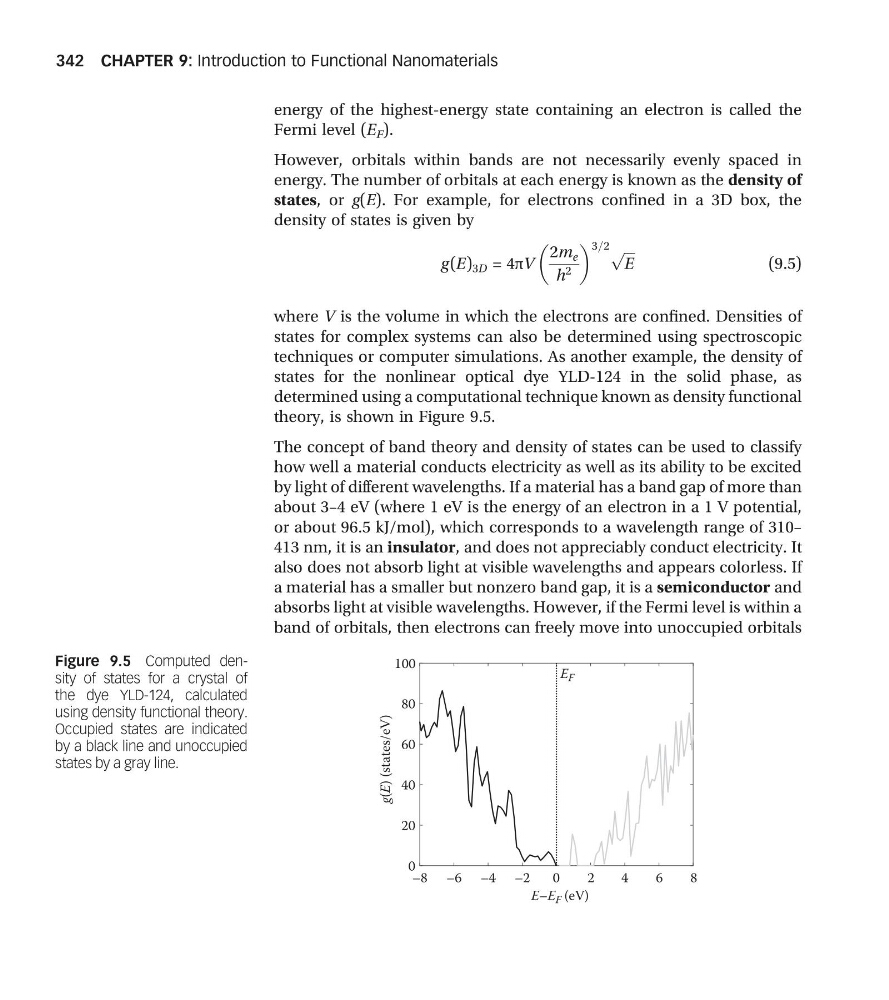
techniques or computer simulations. As another example, the density of
states for the nonlinear optical dye YLD-124 in the solid phase, as
determined using a computational technique known as density functional
theory, is shown in Figure 9.5.
The concept of band theory and density of states can be used to classify
how well a material conducts electricity as well as its ability to be excited
by light of different wavelengths. If a material has a band gap of more than
about 3–4 eV (where 1 eV is the energy of an electron in a 1 V potential,
or about 96.5 kJ/mol), which corresponds to a wavelength range of 310–
413 nm, it is an insulator, and does not appreciably conduct electricity. It
also does not absorb light at visible wavelengths and appears colorless. If
a material has a smaller but nonzero band gap, it is a semiconductor and
absorbs light at visible wavelengths. However, if the Fermi level is within a
band of orbitals, then electrons can freely move into unoccupied orbitals
–8 –6 –4 –2
0
E–E F (eV)
0
20
40
60
80
100
g(E) (states/eV)
E F
2
4
6
8
Figure 9.5 Computed density of states for a crystal of
the dye YLD-124, calculated
using density functional theory.
Occupied states are indicated
by a black line and unoccupied
states by a gray line.
CHAPTER 9: Introduction to Functional Nanomaterials
342
Fermi level (E F ).
However, orbitals within bands are not necessarily evenly spaced in
energy. The number of orbitals at each energy is known as the density of
states, or g(E). For example, for electrons confined in a 3D box, the
density of states is given by
g(E) 3D = 4πV
2m e
h
2
3=2 ffiffiffi
E
p
(9.5)
where V is the volume in which the electrons are confined. Densities of
states for complex systems can also be determined using spectroscopic
techniques or computer simulations. As another example, the density of
states for the nonlinear optical dye YLD-124 in the solid phase, as
determined using a computational technique known as density functional
theory, is shown in Figure 9.5.
The concept of band theory and density of states can be used to classify
how well a material conducts electricity as well as its ability to be excited
by light of different wavelengths. If a material has a band gap of more than
about 3–4 eV (where 1 eV is the energy of an electron in a 1 V potential,
or about 96.5 kJ/mol), which corresponds to a wavelength range of 310–
413 nm, it is an insulator, and does not appreciably conduct electricity. It
also does not absorb light at visible wavelengths and appears colorless. If
a material has a smaller but nonzero band gap, it is a semiconductor and
absorbs light at visible wavelengths. However, if the Fermi level is within a
band of orbitals, then electrons can freely move into unoccupied orbitals
–8 –6 –4 –2
0
E–E F (eV)
0
20
40
60
80
100
g(E) (states/eV)
E F
2
4
6
8
Figure 9.5 Computed density of states for a crystal of
the dye YLD-124, calculated
using density functional theory.
Occupied states are indicated
by a black line and unoccupied
states by a gray line.
CHAPTER 9: Introduction to Functional Nanomaterials
342