

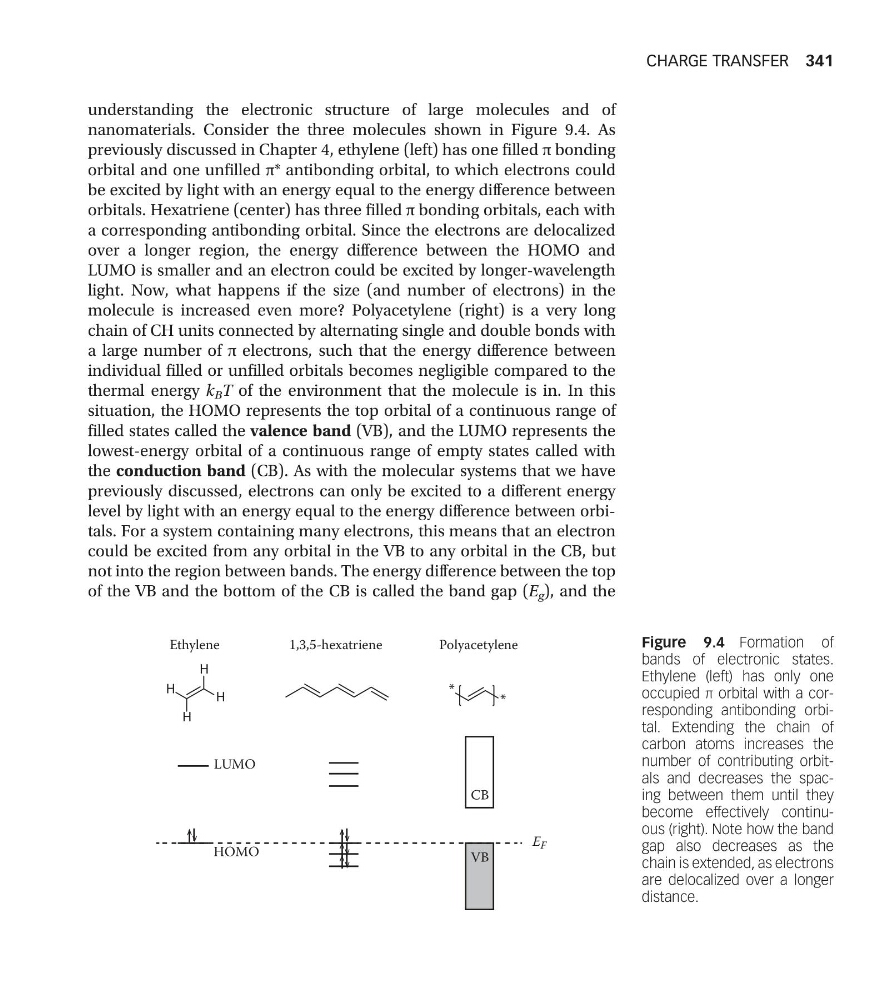
understanding the electronic structure of large molecules and of
nanomaterials. Consider the three molecules shown in Figure 9.4. As
previously discussed in Chapter 4, ethylene (left) has one filled π bonding
orbital and one unfilled π* antibonding orbital, to which electrons could
be excited by light with an energy equal to the energy difference between
orbitals. Hexatriene (center) has three filled π bonding orbitals, each with
a corresponding antibonding orbital. Since the electrons are delocalized
over a longer region, the energy difference between the HOMO and
LUMO is smaller and an electron could be excited by longer-wavelength
light. Now, what happens if the size (and number of electrons) in the
molecule is increased even more? Polyacetylene (right) is a very long
chain of CH units connected by alternating single and double bonds with
a large number of π electrons, such that the energy difference between
individual filled or unfilled orbitals becomes negligible compared to the
thermal energy k B T of the environment that the molecule is in. In this
situation, the HOMO represents the top orbital of a continuous range of
filled states called the valence band (VB), and the LUMO represents the
lowest-energy orbital of a continuous range of empty states called with
the conduction band (CB). As with the molecular systems that we have
previously discussed, electrons can only be excited to a different energy
level by light with an energy equal to the energy difference between orbitals. For a system containing many electrons, this means that an electron
could be excited from any orbital in the VB to any orbital in the CB, but
not into the region between bands. The energy difference between the top
of the VB and the bottom of the CB is called the band gap (E g ), and the
Ethylene
1,3,5-hexatriene
Polyacetylene
VB
CB
E F
HOMO
LUMO
H
H
H
*
H
*
Figure 9.4 Formation of
bands of electronic states.
Ethylene (left) has only one
occupied π orbital with a corresponding antibonding orbital. Extending the chain of
carbon atoms increases the
number of contributing orbitals and decreases the spacing between them until they
become effectively continuous (right). Note how the band
gap also decreases as the
chain is extended, as electrons
are delocalized over a longer
distance.
CHARGE TRANSFER 341
nanomaterials. Consider the three molecules shown in Figure 9.4. As
previously discussed in Chapter 4, ethylene (left) has one filled π bonding
orbital and one unfilled π* antibonding orbital, to which electrons could
be excited by light with an energy equal to the energy difference between
orbitals. Hexatriene (center) has three filled π bonding orbitals, each with
a corresponding antibonding orbital. Since the electrons are delocalized
over a longer region, the energy difference between the HOMO and
LUMO is smaller and an electron could be excited by longer-wavelength
light. Now, what happens if the size (and number of electrons) in the
molecule is increased even more? Polyacetylene (right) is a very long
chain of CH units connected by alternating single and double bonds with
a large number of π electrons, such that the energy difference between
individual filled or unfilled orbitals becomes negligible compared to the
thermal energy k B T of the environment that the molecule is in. In this
situation, the HOMO represents the top orbital of a continuous range of
filled states called the valence band (VB), and the LUMO represents the
lowest-energy orbital of a continuous range of empty states called with
the conduction band (CB). As with the molecular systems that we have
previously discussed, electrons can only be excited to a different energy
level by light with an energy equal to the energy difference between orbitals. For a system containing many electrons, this means that an electron
could be excited from any orbital in the VB to any orbital in the CB, but
not into the region between bands. The energy difference between the top
of the VB and the bottom of the CB is called the band gap (E g ), and the
Ethylene
1,3,5-hexatriene
Polyacetylene
VB
CB
E F
HOMO
LUMO
H
H
H
*
H
*
Figure 9.4 Formation of
bands of electronic states.
Ethylene (left) has only one
occupied π orbital with a corresponding antibonding orbital. Extending the chain of
carbon atoms increases the
number of contributing orbitals and decreases the spacing between them until they
become effectively continuous (right). Note how the band
gap also decreases as the
chain is extended, as electrons
are delocalized over a longer
distance.
CHARGE TRANSFER 341