

within a molecule, h is Planck’s constant, and k B is Boltzmann’s constant (R/
N A ). While Equation 9.3 may appear complex, it shows a systematic relationship between the structure and energetics of a donor and acceptor and a
crucial process for materials. The solvent reorganization energy l consists
of two components. The first component is the change in bond energies
known as the inner-sphere component, which can be calculated from a
change in vibrational frequencies. The second component represents the
difference in electrostatic interactions between the donor and acceptor and
is called the outer-sphere component. It can be represented as
l outer = e
2
1
2r D
+
1
2r A
−
1
r DA
1
n
2 −
1
e
(9.4)
where e is the fundamental unit of electric charge, r D is the radius of the
electron donor, r A is the radius of the electron acceptor, r DA is the distance
between the donor and acceptor, n is the refractive index of the medium,
and e is the static dielectric constant of the medium. For most systems, the
outer-sphere (electrostatic) component has a much larger contribution
than the inner-sphere component.
Marcus theory provides a useful framework for predicting rates of electron
transfer between molecules and/or nanostructures when the energetics of
the states involved are understood. Understanding the energetics of these
states in extended systems requires generalizing our understanding of
molecular electronic structure from molecules to larger systems such as
nanoparticles, nanowires, or surfaces. These systems have many states
that are close in energy to each other, forming continuous bands separated by gaps, which can be described using band theory.
9.2.2 Band theory
Band theory is the generalization of molecular orbitals to larger systems.
While often used in the context of bulk inorganic solids, it is also useful for
Reaction coordinate
ΔG rxn
λ
Products
ΔG ‡
TS
(‡)
Reactants
G
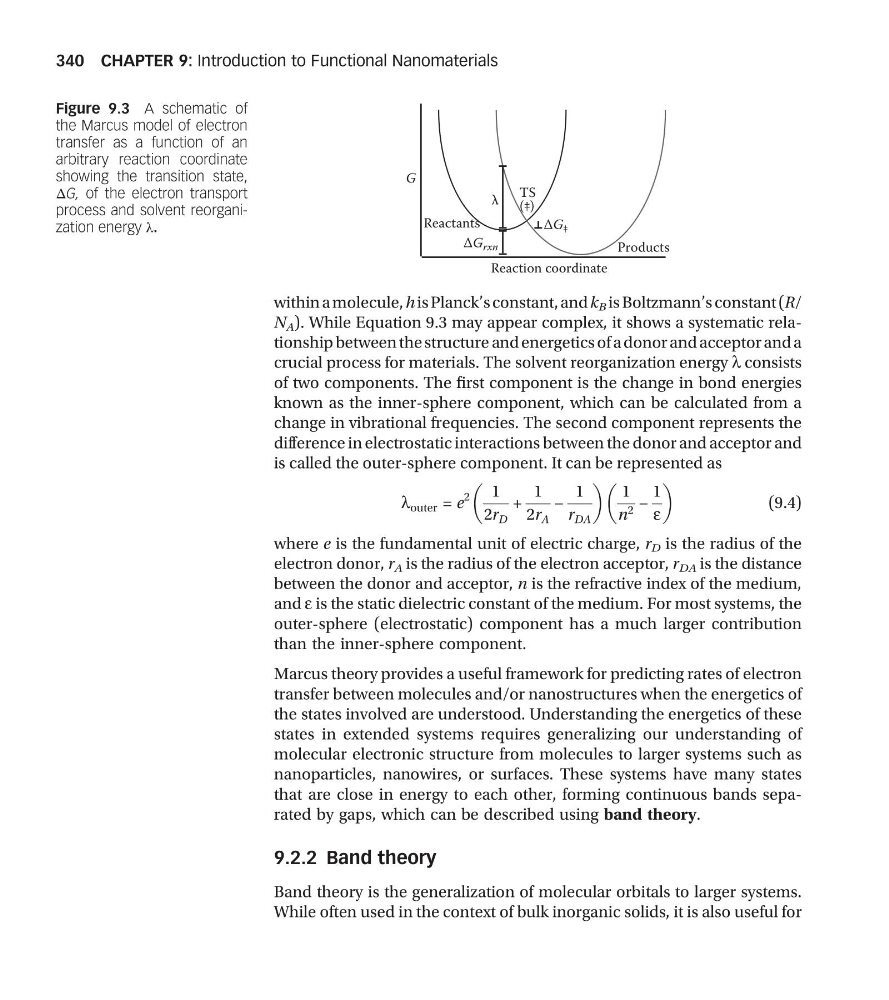
Figure 9.3 A schematic of
the Marcus model of electron
transfer as a function of an
arbitrary reaction coordinate
showing the transition state,
ΔG, of the electron transport
process and solvent reorganization energy λ.
CHAPTER 9: Introduction to Functional Nanomaterials
340
N A ). While Equation 9.3 may appear complex, it shows a systematic relationship between the structure and energetics of a donor and acceptor and a
crucial process for materials. The solvent reorganization energy l consists
of two components. The first component is the change in bond energies
known as the inner-sphere component, which can be calculated from a
change in vibrational frequencies. The second component represents the
difference in electrostatic interactions between the donor and acceptor and
is called the outer-sphere component. It can be represented as
l outer = e
2
1
2r D
+
1
2r A
−
1
r DA
1
n
2 −
1
e
(9.4)
where e is the fundamental unit of electric charge, r D is the radius of the
electron donor, r A is the radius of the electron acceptor, r DA is the distance
between the donor and acceptor, n is the refractive index of the medium,
and e is the static dielectric constant of the medium. For most systems, the
outer-sphere (electrostatic) component has a much larger contribution
than the inner-sphere component.
Marcus theory provides a useful framework for predicting rates of electron
transfer between molecules and/or nanostructures when the energetics of
the states involved are understood. Understanding the energetics of these
states in extended systems requires generalizing our understanding of
molecular electronic structure from molecules to larger systems such as
nanoparticles, nanowires, or surfaces. These systems have many states
that are close in energy to each other, forming continuous bands separated by gaps, which can be described using band theory.
9.2.2 Band theory
Band theory is the generalization of molecular orbitals to larger systems.
While often used in the context of bulk inorganic solids, it is also useful for
Reaction coordinate
ΔG rxn
λ
Products
ΔG ‡
TS
(‡)
Reactants
G
Figure 9.3 A schematic of
the Marcus model of electron
transfer as a function of an
arbitrary reaction coordinate
showing the transition state,
ΔG, of the electron transport
process and solvent reorganization energy λ.
CHAPTER 9: Introduction to Functional Nanomaterials
340