

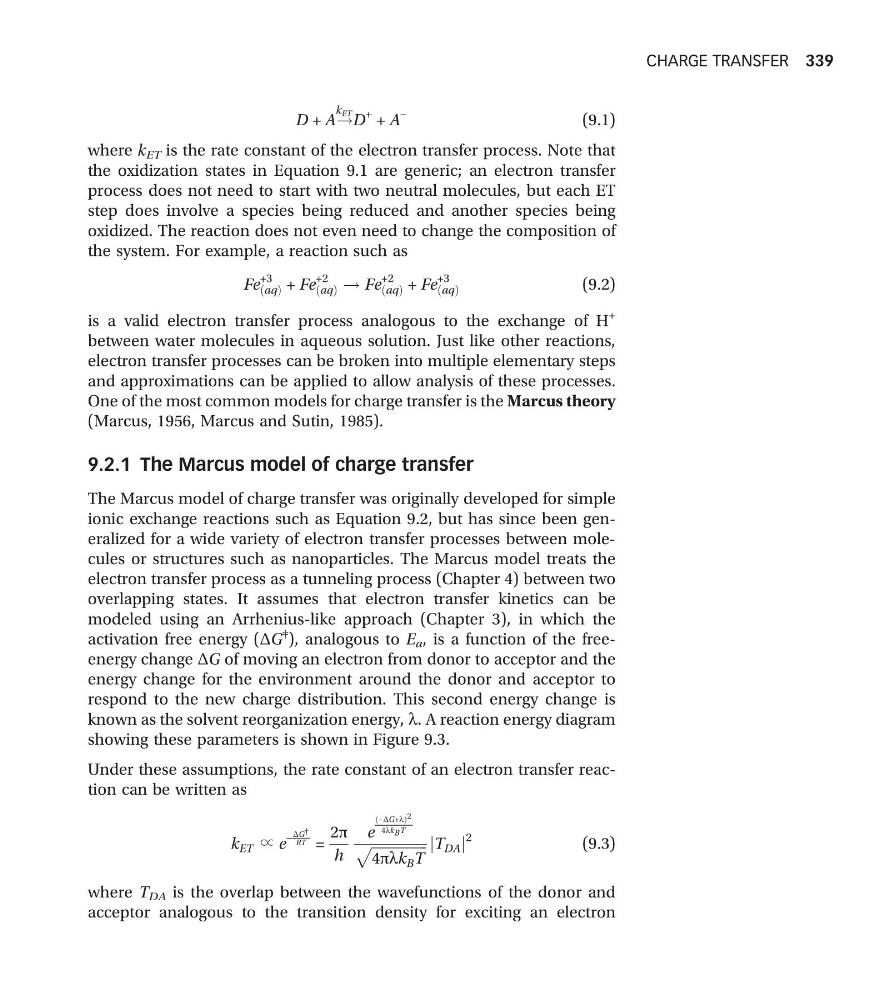
D + A!
k ET D
+ + A
−
(9.1)
where k ET is the rate constant of the electron transfer process. Note that
the oxidization states in Equation 9.1 are generic; an electron transfer
process does not need to start with two neutral molecules, but each ET
step does involve a species being reduced and another species being
oxidized. The reaction does not even need to change the composition of
the system. For example, a reaction such as
Fe
+3
ðaqÞ + Fe
+2
ðaqÞ ! Fe
+2
ðaqÞ + Fe
+3
ðaqÞ
(9.2)
is a valid electron transfer process analogous to the exchange of H
+
between water molecules in aqueous solution. Just like other reactions,
electron transfer processes can be broken into multiple elementary steps
and approximations can be applied to allow analysis of these processes.
One of the most common models for charge transfer is the Marcus theory
(Marcus, 1956, Marcus and Sutin, 1985).
9.2.1 The Marcus model of charge transfer
The Marcus model of charge transfer was originally developed for simple
ionic exchange reactions such as Equation 9.2, but has since been generalized for a wide variety of electron transfer processes between molecules or structures such as nanoparticles. The Marcus model treats the
electron transfer process as a tunneling process (Chapter 4) between two
overlapping states. It assumes that electron transfer kinetics can be
modeled using an Arrhenius-like approach (Chapter 3), in which the
activation free energy (ΔG
‡
), analogous to E a , is a function of the freeenergy change ΔG of moving an electron from donor to acceptor and the
energy change for the environment around the donor and acceptor to
respond to the new charge distribution. This second energy change is
known as the solvent reorganization energy, l. A reaction energy diagram
showing these parameters is shown in Figure 9.3.
Under these assumptions, the rate constant of an electron transfer reaction can be written as
k ET ∝ e
−
ΔG †
RT =
2π
h
e
−ΔG+l
ð
Þ 2
4lk B T
ffiffiffiffiffiffiffiffiffiffiffiffiffiffiffi ffi
4πlk B T
p
T DA
j
j
2
(9.3)
where T DA is the overlap between the wavefunctions of the donor and
acceptor analogous to the transition density for exciting an electron
CHARGE TRANSFER 339
k ET D
+ + A
−
(9.1)
where k ET is the rate constant of the electron transfer process. Note that
the oxidization states in Equation 9.1 are generic; an electron transfer
process does not need to start with two neutral molecules, but each ET
step does involve a species being reduced and another species being
oxidized. The reaction does not even need to change the composition of
the system. For example, a reaction such as
Fe
+3
ðaqÞ + Fe
+2
ðaqÞ ! Fe
+2
ðaqÞ + Fe
+3
ðaqÞ
(9.2)
is a valid electron transfer process analogous to the exchange of H
+
between water molecules in aqueous solution. Just like other reactions,
electron transfer processes can be broken into multiple elementary steps
and approximations can be applied to allow analysis of these processes.
One of the most common models for charge transfer is the Marcus theory
(Marcus, 1956, Marcus and Sutin, 1985).
9.2.1 The Marcus model of charge transfer
The Marcus model of charge transfer was originally developed for simple
ionic exchange reactions such as Equation 9.2, but has since been generalized for a wide variety of electron transfer processes between molecules or structures such as nanoparticles. The Marcus model treats the
electron transfer process as a tunneling process (Chapter 4) between two
overlapping states. It assumes that electron transfer kinetics can be
modeled using an Arrhenius-like approach (Chapter 3), in which the
activation free energy (ΔG
‡
), analogous to E a , is a function of the freeenergy change ΔG of moving an electron from donor to acceptor and the
energy change for the environment around the donor and acceptor to
respond to the new charge distribution. This second energy change is
known as the solvent reorganization energy, l. A reaction energy diagram
showing these parameters is shown in Figure 9.3.
Under these assumptions, the rate constant of an electron transfer reaction can be written as
k ET ∝ e
−
ΔG †
RT =
2π
h
e
−ΔG+l
ð
Þ 2
4lk B T
ffiffiffiffiffiffiffiffiffiffiffiffiffiffiffi ffi
4πlk B T
p
T DA
j
j
2
(9.3)
where T DA is the overlap between the wavefunctions of the donor and
acceptor analogous to the transition density for exciting an electron
CHARGE TRANSFER 339