

materials are beyond the scope of this chapter, although many excellent
review articles exist, such as Huang et al., 2016.
9.2 CHARGE TRANSFER
Charge transfer is the movement of an electron from one molecule to
another, or one portion of a molecule to another. The source of the
electron is called an electron donor (D) and the component receiving an
electron is called an electron acceptor (A). The general form of such a
process can be written as
Meso-(R,S-R,S) isomer
N
N
C 6 H 13
C 6 H 13
C 6 H 13
C 6 H 13
(R)
(S)
(S)
(R)
Stereo center
Helix
inversion
(vibrational
excitation)
C 6 H 13
(S)
Double−bond
isomerization
(electronic
excitation)
Double-bond
isomerization
Helix
inversion
Helix
inversion
Double-bond
isomerization
STM tip
Excitation
Movement
Side view
(a)
(b)
(c)
(d)
(e)
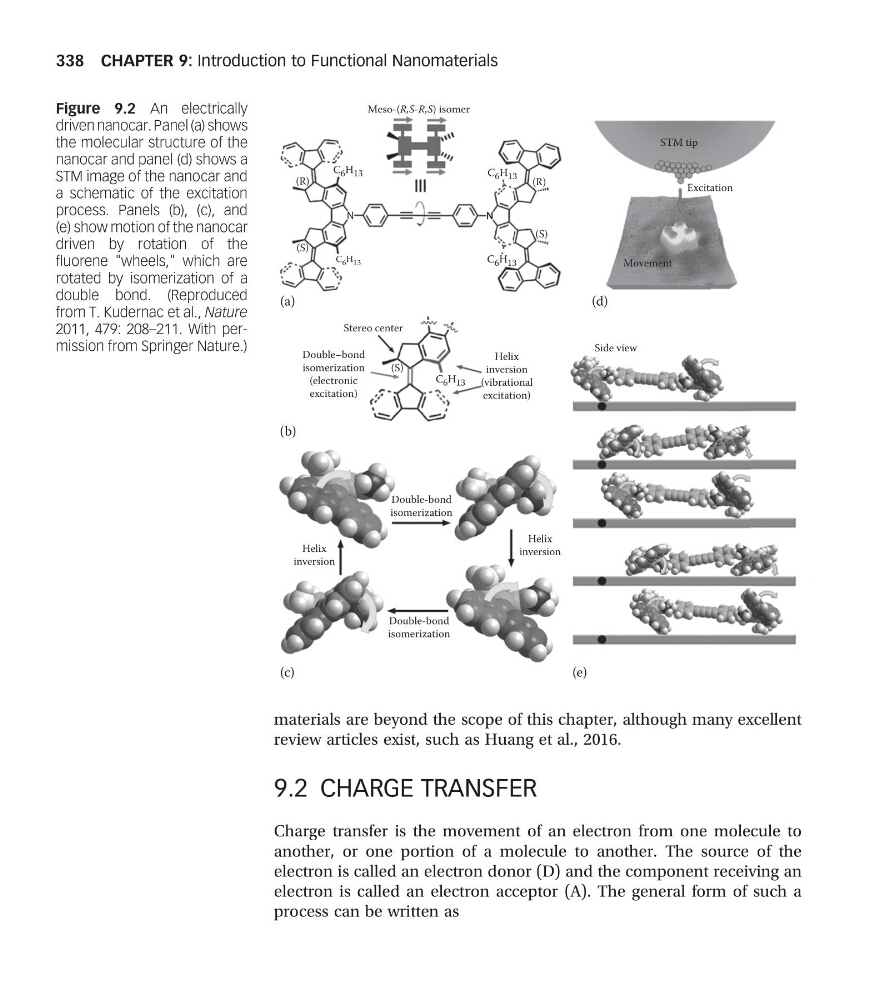
Figure 9.2 An electrically
driven nanocar. Panel (a) shows
the molecular structure of the
nanocar and panel (d) shows a
STM image of the nanocar and
a schematic of the excitation
process. Panels (b), (c), and
(e) show motion of the nanocar
driven by rotation of the
fluorene "wheels," which are
rotated by isomerization of a
double bond. (Reproduced
from T. Kudernac et al., Nature
2011, 479: 208–211. With permission from Springer Nature.)
CHAPTER 9: Introduction to Functional Nanomaterials
338
review articles exist, such as Huang et al., 2016.
9.2 CHARGE TRANSFER
Charge transfer is the movement of an electron from one molecule to
another, or one portion of a molecule to another. The source of the
electron is called an electron donor (D) and the component receiving an
electron is called an electron acceptor (A). The general form of such a
process can be written as
Meso-(R,S-R,S) isomer
N
N
C 6 H 13
C 6 H 13
C 6 H 13
C 6 H 13
(R)
(S)
(S)
(R)
Stereo center
Helix
inversion
(vibrational
excitation)
C 6 H 13
(S)
Double−bond
isomerization
(electronic
excitation)
Double-bond
isomerization
Helix
inversion
Helix
inversion
Double-bond
isomerization
STM tip
Excitation
Movement
Side view
(a)
(b)
(c)
(d)
(e)
Figure 9.2 An electrically
driven nanocar. Panel (a) shows
the molecular structure of the
nanocar and panel (d) shows a
STM image of the nanocar and
a schematic of the excitation
process. Panels (b), (c), and
(e) show motion of the nanocar
driven by rotation of the
fluorene "wheels," which are
rotated by isomerization of a
double bond. (Reproduced
from T. Kudernac et al., Nature
2011, 479: 208–211. With permission from Springer Nature.)
CHAPTER 9: Introduction to Functional Nanomaterials
338