

and the material is a conductor. Conductors can absorb (or, alternately,
reflect, depending on the relationship between the real and imaginary
components of the refractive index) light at all wavelengths. Simplified
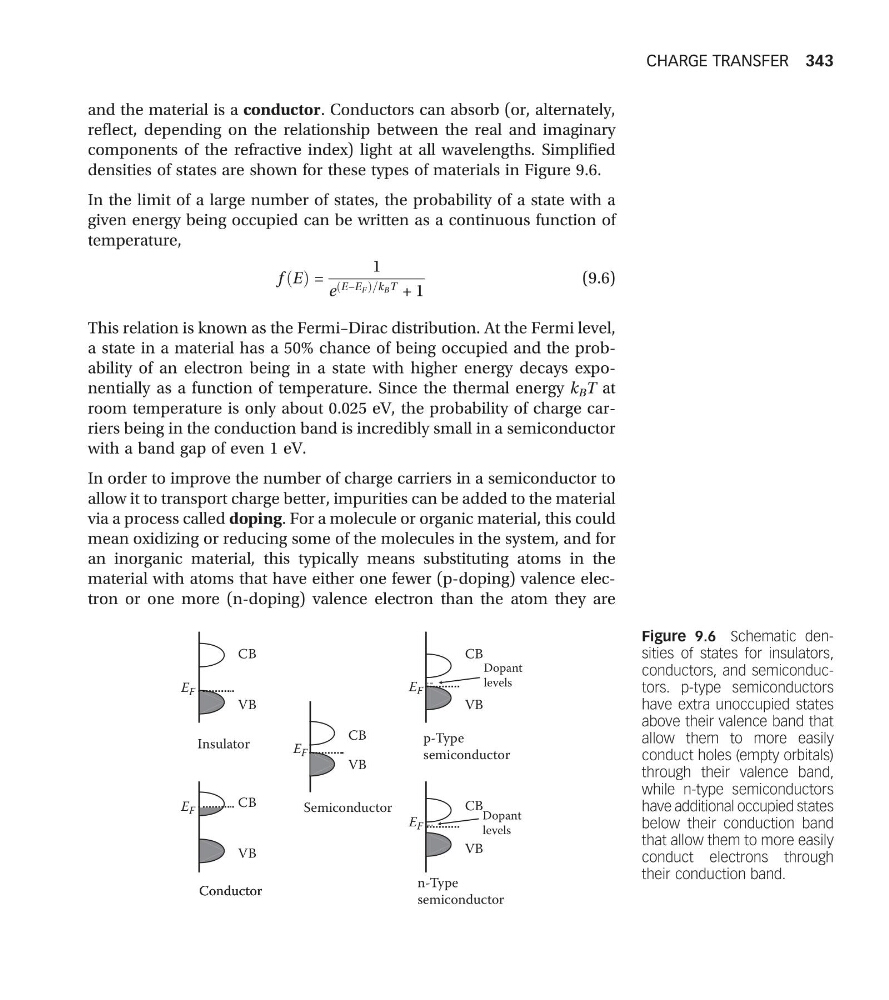
densities of states are shown for these types of materials in Figure 9.6.
In the limit of a large number of states, the probability of a state with a
given energy being occupied can be written as a continuous function of
temperature,
f E
ð Þ =
1
e
E−E F
ð
Þ=k B T + 1
(9.6)
This relation is known as the Fermi–Dirac distribution. At the Fermi level,
a state in a material has a 50% chance of being occupied and the probability of an electron being in a state with higher energy decays exponentially as a function of temperature. Since the thermal energy k B T at
room temperature is only about 0.025 eV, the probability of charge carriers being in the conduction band is incredibly small in a semiconductor
with a band gap of even 1 eV.
In order to improve the number of charge carriers in a semiconductor to
allow it to transport charge better, impurities can be added to the material
via a process called doping. For a molecule or organic material, this could
mean oxidizing or reducing some of the molecules in the system, and for
an inorganic material, this typically means substituting atoms in the
material with atoms that have either one fewer (p-doping) valence electron or one more (n-doping) valence electron than the atom they are
VB
CB
VB
CB
VB
CB
VB
CB
CB
E F
E F
E F
E F
E F
Conductor
Insulator
Conductor
Semiconductor
p-Type
semiconductor
n-Type
semiconductor
VB
Dopant
levels
Dopant
levels
Figure 9.6 Schematic densities of states for insulators,
conductors, and semiconductors. p-type semiconductors
have extra unoccupied states
above their valence band that
allow them to more easily
conduct holes (empty orbitals)
through their valence band,
while n-type semiconductors
have additional occupied states
below their conduction band
that allow them to more easily
conduct electrons through
their conduction band.
CHARGE TRANSFER 343
reflect, depending on the relationship between the real and imaginary
components of the refractive index) light at all wavelengths. Simplified
densities of states are shown for these types of materials in Figure 9.6.
In the limit of a large number of states, the probability of a state with a
given energy being occupied can be written as a continuous function of
temperature,
f E
ð Þ =
1
e
E−E F
ð
Þ=k B T + 1
(9.6)
This relation is known as the Fermi–Dirac distribution. At the Fermi level,
a state in a material has a 50% chance of being occupied and the probability of an electron being in a state with higher energy decays exponentially as a function of temperature. Since the thermal energy k B T at
room temperature is only about 0.025 eV, the probability of charge carriers being in the conduction band is incredibly small in a semiconductor
with a band gap of even 1 eV.
In order to improve the number of charge carriers in a semiconductor to
allow it to transport charge better, impurities can be added to the material
via a process called doping. For a molecule or organic material, this could
mean oxidizing or reducing some of the molecules in the system, and for
an inorganic material, this typically means substituting atoms in the
material with atoms that have either one fewer (p-doping) valence electron or one more (n-doping) valence electron than the atom they are
VB
CB
VB
CB
VB
CB
VB
CB
CB
E F
E F
E F
E F
E F
Conductor
Insulator
Conductor
Semiconductor
p-Type
semiconductor
n-Type
semiconductor
VB
Dopant
levels
Dopant
levels
Figure 9.6 Schematic densities of states for insulators,
conductors, and semiconductors. p-type semiconductors
have extra unoccupied states
above their valence band that
allow them to more easily
conduct holes (empty orbitals)
through their valence band,
while n-type semiconductors
have additional occupied states
below their conduction band
that allow them to more easily
conduct electrons through
their conduction band.
CHARGE TRANSFER 343