

(c) Describe qualitatively the difference
between the SFG sprectra of SDS, CTAB,
hexanol, and decanol in terms of the CH and
CH bands. Assume that monolayers of these
molecules are present between a hydrophobic surface and an aqueous phase.
15. In a study conducted at the Tokyo Institute of
Technology, QCM was used to directly
monitor the reactions of the Klenow fragment
of Escherichia coli DNA polymerase I. The
reactions take place on DNA oligonucleotides,
containing either a (TTTTC) 3 or (TTTTC) 10
template and the primer necessary for polymerase binding, which have been immobilized on the QCM. This enzyme acts as a
catalyst for complementary base pairing of
dATP and dGTP monomers from solution into
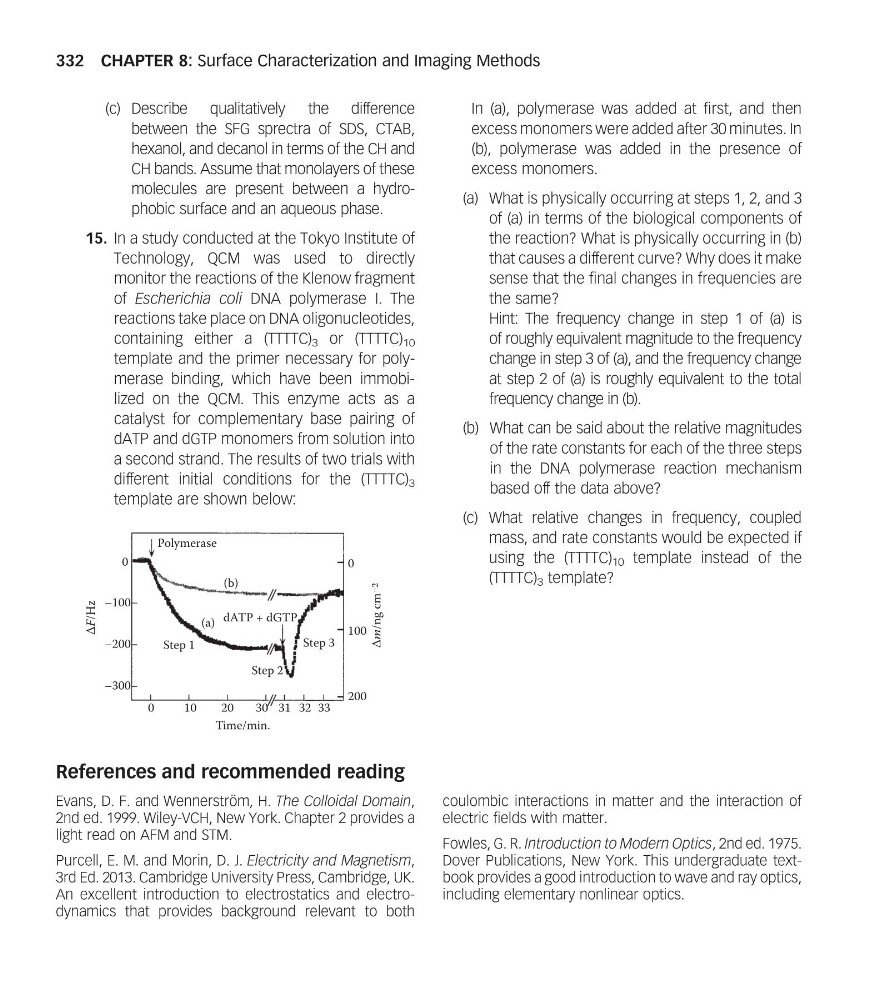
a second strand. The results of two trials with
different initial conditions for the (TTTTC) 3
template are shown below:
33
200
100
0
32
31
30
20
10
0
–300
–200
–100
0
(a)
Time/min.
Step 1
Step 2
Step 3
Polymerase
dATP + dGTP
Δm/ng cm 2
ΔF/Hz
(b)
In (a), polymerase was added at first, and then
excess monomers were added after 30 minutes. In
(b), polymerase was added in the presence of
excess monomers.
(a) What is physically occurring at steps 1, 2, and 3
of (a) in terms of the biological components of
the reaction? What is physically occurring in (b)
that causes a different curve? Why does it make
sense that the final changes in frequencies are
the same?
Hint: The frequency change in step 1 of (a) is
of roughly equivalent magnitude to the frequency
change in step 3 of (a), and the frequency change
at step 2 of (a) is roughly equivalent to the total
frequency change in (b).
(b) What can be said about the relative magnitudes
of the rate constants for each of the three steps
in the DNA polymerase reaction mechanism
based off the data above?
(c) What relative changes in frequency, coupled
mass, and rate constants would be expected if
using the (TTTTC) 10 template instead of the
(TTTTC) 3 template?
References and recommended reading
Evans, D. F. and Wennerström, H. The Colloidal Domain,
2nd ed. 1999. Wiley-VCH, New York. Chapter 2 provides a
light read on AFM and STM.
Purcell, E. M. and Morin, D. J. Electricity and Magnetism,
3rd Ed. 2013. Cambridge University Press, Cambridge, UK.
An excellent introduction to electrostatics and electrodynamics that provides background relevant to both
coulombic interactions in matter and the interaction of
electric fields with matter.
Fowles, G. R. Introduction to Modern Optics, 2nd ed. 1975.
Dover Publications, New York. This undergraduate textbook provides a good introduction to wave and ray optics,
including elementary nonlinear optics.
CHAPTER 8: Surface Characterization and Imaging Methods
332
between the SFG sprectra of SDS, CTAB,
hexanol, and decanol in terms of the CH and
CH bands. Assume that monolayers of these
molecules are present between a hydrophobic surface and an aqueous phase.
15. In a study conducted at the Tokyo Institute of
Technology, QCM was used to directly
monitor the reactions of the Klenow fragment
of Escherichia coli DNA polymerase I. The
reactions take place on DNA oligonucleotides,
containing either a (TTTTC) 3 or (TTTTC) 10
template and the primer necessary for polymerase binding, which have been immobilized on the QCM. This enzyme acts as a
catalyst for complementary base pairing of
dATP and dGTP monomers from solution into
a second strand. The results of two trials with
different initial conditions for the (TTTTC) 3
template are shown below:
33
200
100
0
32
31
30
20
10
0
–300
–200
–100
0
(a)
Time/min.
Step 1
Step 2
Step 3
Polymerase
dATP + dGTP
Δm/ng cm 2
ΔF/Hz
(b)
In (a), polymerase was added at first, and then
excess monomers were added after 30 minutes. In
(b), polymerase was added in the presence of
excess monomers.
(a) What is physically occurring at steps 1, 2, and 3
of (a) in terms of the biological components of
the reaction? What is physically occurring in (b)
that causes a different curve? Why does it make
sense that the final changes in frequencies are
the same?
Hint: The frequency change in step 1 of (a) is
of roughly equivalent magnitude to the frequency
change in step 3 of (a), and the frequency change
at step 2 of (a) is roughly equivalent to the total
frequency change in (b).
(b) What can be said about the relative magnitudes
of the rate constants for each of the three steps
in the DNA polymerase reaction mechanism
based off the data above?
(c) What relative changes in frequency, coupled
mass, and rate constants would be expected if
using the (TTTTC) 10 template instead of the
(TTTTC) 3 template?
References and recommended reading
Evans, D. F. and Wennerström, H. The Colloidal Domain,
2nd ed. 1999. Wiley-VCH, New York. Chapter 2 provides a
light read on AFM and STM.
Purcell, E. M. and Morin, D. J. Electricity and Magnetism,
3rd Ed. 2013. Cambridge University Press, Cambridge, UK.
An excellent introduction to electrostatics and electrodynamics that provides background relevant to both
coulombic interactions in matter and the interaction of
electric fields with matter.
Fowles, G. R. Introduction to Modern Optics, 2nd ed. 1975.
Dover Publications, New York. This undergraduate textbook provides a good introduction to wave and ray optics,
including elementary nonlinear optics.
CHAPTER 8: Surface Characterization and Imaging Methods
332