

9. The Sauerbrey equation underestimates the
mass adsorbed to the crystal surface in liquids
because it was originally developed for oscillation in air and does not account for the decrease
in resonant frequency due to the change in
viscosity. It is possible to amend the Sauerbrey
equation for an accurate measurement of mass
in liquid by correcting for these viscosity effects
according to the following equation:
Δf = f
3=2
o
ffiffiffiffiffiffiffiffiffiffiffiffiffiffiffiffiffiffiffi ffi
η l ρ l
πρ q μ q
s
where f 0 is the resonant frequency. ρ l is the
density of the liquid, η l is the viscosity of the
liquid, ρ q is the density of quartz (2.648 g/cm
3
),
and μ q is the shear modulus of quartz for AT-cut
crystal (2.947 × 10
11 g/cm s
2
). In which liquid,
water or deuterium oxide, is the detection limit
of a typical QCM-D instrument at its fundamental resonant frequency more sensitive?
What is the ratio of their sensitivities? (The
interested student should see the following
reference for more details: Kanazawa, K. K. and
Gordon, J. G. II, The Oscillation Frequency of a
Quartz Resonator in Contact with a Liquid, Anal.
Chimica Acta, , 1985, 175: 99–105.
10. (a) The text mentions that many techniques
cannot by themselves provide absolute measurements of properties such as refractive
index, thickness of a film, or density. Choose
two nonspectroscopic techniques discussed in
the chapter and describe how their combined
use provides more information than either
would alone. Outline a set of experiments that
you would undertake to learn as much as
possible about a particular film-forming substance such as SDS (or provide a compound).
(b) Choose a spectroscopic method, such as
IR, and describe how this technique could
add to your understanding of the material
and its adsorption properties.
11. Scanning tunneling microscopy is used to
image a metal surface with an electronic
decay length of 5 nm
−1
. If the tunneling
current increases by a factor of 5, then how
much has the height changed? Describe what
this height refers to in your own words. Hint:
See Example 8.4.
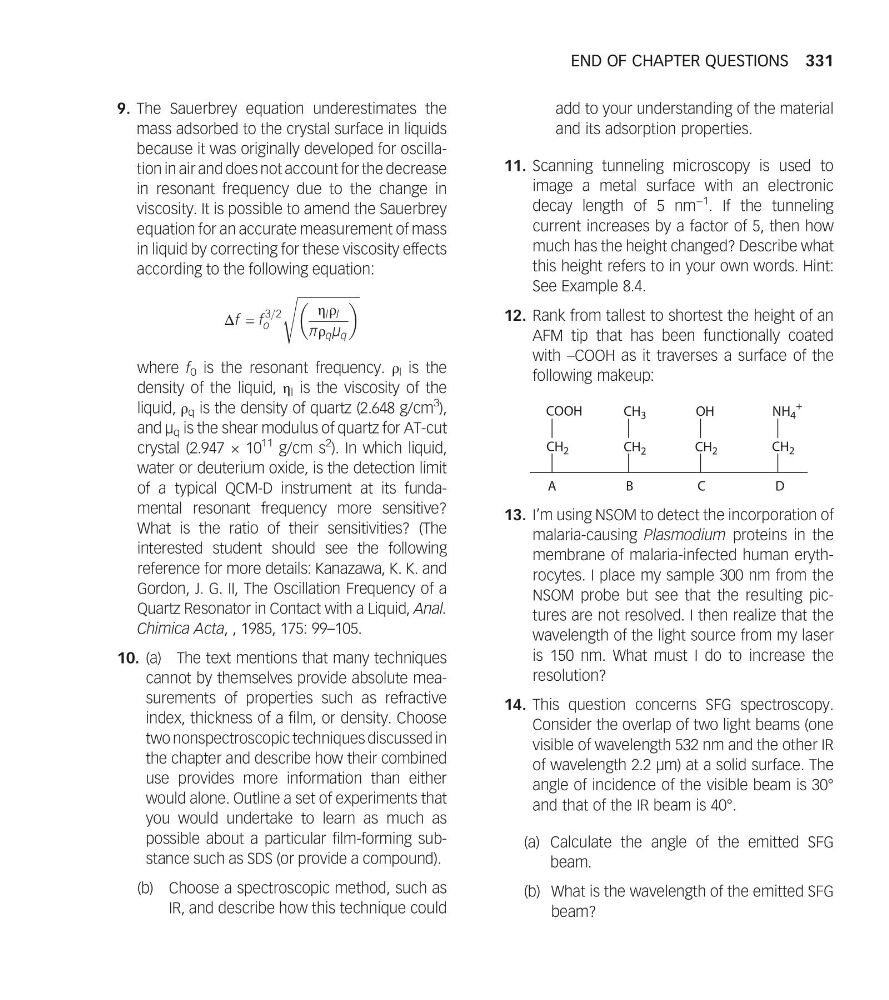
12. Rank from tallest to shortest the height of an
AFM tip that has been functionally coated
with –COOH as it traverses a surface of the
following makeup:
CH 2
CH 2
CH 2
CH 3
COOH
OH
CH 2
NH 4
+
A
B
C
D
13. I’m using NSOM to detect the incorporation of
malaria-causing Plasmodium proteins in the
membrane of malaria-infected human erythrocytes. I place my sample 300 nm from the
NSOM probe but see that the resulting pictures are not resolved. I then realize that the
wavelength of the light source from my laser
is 150 nm. What must I do to increase the
resolution?
14. This question concerns SFG spectroscopy.
Consider the overlap of two light beams (one
visible of wavelength 532 nm and the other IR
of wavelength 2.2 µm) at a solid surface. The
angle of incidence of the visible beam is 30°
and that of the IR beam is 40°.
(a) Calculate the angle of the emitted SFG
beam.
(b) What is the wavelength of the emitted SFG
beam?
END OF CHAPTER QUESTIONS 331
mass adsorbed to the crystal surface in liquids
because it was originally developed for oscillation in air and does not account for the decrease
in resonant frequency due to the change in
viscosity. It is possible to amend the Sauerbrey
equation for an accurate measurement of mass
in liquid by correcting for these viscosity effects
according to the following equation:
Δf = f
3=2
o
ffiffiffiffiffiffiffiffiffiffiffiffiffiffiffiffiffiffiffi ffi
η l ρ l
πρ q μ q
s
where f 0 is the resonant frequency. ρ l is the
density of the liquid, η l is the viscosity of the
liquid, ρ q is the density of quartz (2.648 g/cm
3
),
and μ q is the shear modulus of quartz for AT-cut
crystal (2.947 × 10
11 g/cm s
2
). In which liquid,
water or deuterium oxide, is the detection limit
of a typical QCM-D instrument at its fundamental resonant frequency more sensitive?
What is the ratio of their sensitivities? (The
interested student should see the following
reference for more details: Kanazawa, K. K. and
Gordon, J. G. II, The Oscillation Frequency of a
Quartz Resonator in Contact with a Liquid, Anal.
Chimica Acta, , 1985, 175: 99–105.
10. (a) The text mentions that many techniques
cannot by themselves provide absolute measurements of properties such as refractive
index, thickness of a film, or density. Choose
two nonspectroscopic techniques discussed in
the chapter and describe how their combined
use provides more information than either
would alone. Outline a set of experiments that
you would undertake to learn as much as
possible about a particular film-forming substance such as SDS (or provide a compound).
(b) Choose a spectroscopic method, such as
IR, and describe how this technique could
add to your understanding of the material
and its adsorption properties.
11. Scanning tunneling microscopy is used to
image a metal surface with an electronic
decay length of 5 nm
−1
. If the tunneling
current increases by a factor of 5, then how
much has the height changed? Describe what
this height refers to in your own words. Hint:
See Example 8.4.
12. Rank from tallest to shortest the height of an
AFM tip that has been functionally coated
with –COOH as it traverses a surface of the
following makeup:
CH 2
CH 2
CH 2
CH 3
COOH
OH
CH 2
NH 4
+
A
B
C
D
13. I’m using NSOM to detect the incorporation of
malaria-causing Plasmodium proteins in the
membrane of malaria-infected human erythrocytes. I place my sample 300 nm from the
NSOM probe but see that the resulting pictures are not resolved. I then realize that the
wavelength of the light source from my laser
is 150 nm. What must I do to increase the
resolution?
14. This question concerns SFG spectroscopy.
Consider the overlap of two light beams (one
visible of wavelength 532 nm and the other IR
of wavelength 2.2 µm) at a solid surface. The
angle of incidence of the visible beam is 30°
and that of the IR beam is 40°.
(a) Calculate the angle of the emitted SFG
beam.
(b) What is the wavelength of the emitted SFG
beam?
END OF CHAPTER QUESTIONS 331