

(b) In bulk solution, BSA adopts an ellipsoid
shape with dimensions of 140 Å × 40 Å
and it has a molecular weight of 66.43 kDa.
Using this information in conjunction with
the DPI mass values, how would you calculate the area occupied by each protein
molecule on the waveguide surface at
each pH?
(c) If we were to assume that the BSA proteins
adsorbed parallel to the waveguide surface
to form a saturated monolayer and that
they were not distorted on adsorption,
then we could use the bulk phase dimensions of BSA to calculate the nanofilm
thickness (it’s ~40 Å and each molecule
occupies ~5600 Å
2 on the surface at pH 5).
The nanofilm layer thickness values are
much less for the BSA proteins at pH 3 and
7, and the area-per-molecule values are
much greater than predicted. Thus, it can be
inferred that the BSA molecules at pH 3 and
7 are spread much more thinly on the
waveguide surface and that they assume a
much more distorted form. The relative
rates of adsorption of BSA at different pH to
the silicon surface are pH 3 > pH 5 > pH 7.
What forces are responsible for the
adsorption of BSA to the waveguide surface
at each pH? What explanation can be
offered for the observed order of the relative
rates of adsorption of BSA at differing pH?
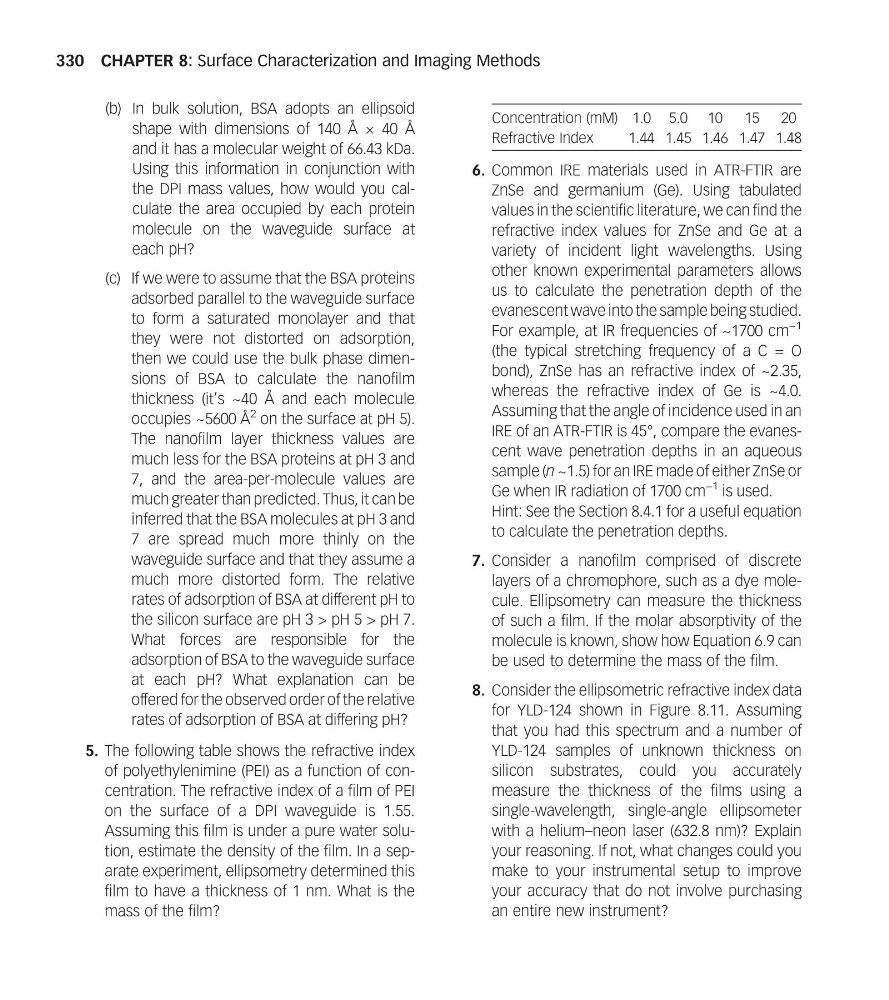
5. The following table shows the refractive index
of polyethylenimine (PEI) as a function of concentration. The refractive index of a film of PEI
on the surface of a DPI waveguide is 1.55.
Assuming this film is under a pure water solution, estimate the density of the film. In a separate experiment, ellipsometry determined this
film to have a thickness of 1 nm. What is the
mass of the film?
Concentration (mM) 1.0 5.0 10 15 20
Refractive Index
1.44 1.45 1.46 1.47 1.48
6. Common IRE materials used in ATR-FTIR are
ZnSe and germanium (Ge). Using tabulated
values in the scientific literature, we can find the
refractive index values for ZnSe and Ge at a
variety of incident light wavelengths. Using
other known experimental parameters allows
us to calculate the penetration depth of the
evanescent wave into the sample being studied.
For example, at IR frequencies of ~1700 cm
−1
(the typical stretching frequency of a C = O
bond), ZnSe has an refractive index of ~2.35,
whereas the refractive index of Ge is ~4.0.
Assuming that the angle of incidence used in an
IRE of an ATR-FTIR is 45°, compare the evanescent wave penetration depths in an aqueous
sample (n ~1.5) for an IRE made of either ZnSe or
Ge when IR radiation of 1700 cm
−1 is used.
Hint: See the Section 8.4.1 for a useful equation
to calculate the penetration depths.
7. Consider a nanofilm comprised of discrete
layers of a chromophore, such as a dye molecule. Ellipsometry can measure the thickness
of such a film. If the molar absorptivity of the
molecule is known, show how Equation 6.9 can
be used to determine the mass of the film.
8. Consider the ellipsometric refractive index data
for YLD-124 shown in Figure 8.11. Assuming
that you had this spectrum and a number of
YLD-124 samples of unknown thickness on
silicon substrates, could you accurately
measure the thickness of the films using a
single-wavelength, single-angle ellipsometer
with a helium–neon laser (632.8 nm)? Explain
your reasoning. If not, what changes could you
make to your instrumental setup to improve
your accuracy that do not involve purchasing
an entire new instrument?
CHAPTER 8: Surface Characterization and Imaging Methods
330
shape with dimensions of 140 Å × 40 Å
and it has a molecular weight of 66.43 kDa.
Using this information in conjunction with
the DPI mass values, how would you calculate the area occupied by each protein
molecule on the waveguide surface at
each pH?
(c) If we were to assume that the BSA proteins
adsorbed parallel to the waveguide surface
to form a saturated monolayer and that
they were not distorted on adsorption,
then we could use the bulk phase dimensions of BSA to calculate the nanofilm
thickness (it’s ~40 Å and each molecule
occupies ~5600 Å
2 on the surface at pH 5).
The nanofilm layer thickness values are
much less for the BSA proteins at pH 3 and
7, and the area-per-molecule values are
much greater than predicted. Thus, it can be
inferred that the BSA molecules at pH 3 and
7 are spread much more thinly on the
waveguide surface and that they assume a
much more distorted form. The relative
rates of adsorption of BSA at different pH to
the silicon surface are pH 3 > pH 5 > pH 7.
What forces are responsible for the
adsorption of BSA to the waveguide surface
at each pH? What explanation can be
offered for the observed order of the relative
rates of adsorption of BSA at differing pH?
5. The following table shows the refractive index
of polyethylenimine (PEI) as a function of concentration. The refractive index of a film of PEI
on the surface of a DPI waveguide is 1.55.
Assuming this film is under a pure water solution, estimate the density of the film. In a separate experiment, ellipsometry determined this
film to have a thickness of 1 nm. What is the
mass of the film?
Concentration (mM) 1.0 5.0 10 15 20
Refractive Index
1.44 1.45 1.46 1.47 1.48
6. Common IRE materials used in ATR-FTIR are
ZnSe and germanium (Ge). Using tabulated
values in the scientific literature, we can find the
refractive index values for ZnSe and Ge at a
variety of incident light wavelengths. Using
other known experimental parameters allows
us to calculate the penetration depth of the
evanescent wave into the sample being studied.
For example, at IR frequencies of ~1700 cm
−1
(the typical stretching frequency of a C = O
bond), ZnSe has an refractive index of ~2.35,
whereas the refractive index of Ge is ~4.0.
Assuming that the angle of incidence used in an
IRE of an ATR-FTIR is 45°, compare the evanescent wave penetration depths in an aqueous
sample (n ~1.5) for an IRE made of either ZnSe or
Ge when IR radiation of 1700 cm
−1 is used.
Hint: See the Section 8.4.1 for a useful equation
to calculate the penetration depths.
7. Consider a nanofilm comprised of discrete
layers of a chromophore, such as a dye molecule. Ellipsometry can measure the thickness
of such a film. If the molar absorptivity of the
molecule is known, show how Equation 6.9 can
be used to determine the mass of the film.
8. Consider the ellipsometric refractive index data
for YLD-124 shown in Figure 8.11. Assuming
that you had this spectrum and a number of
YLD-124 samples of unknown thickness on
silicon substrates, could you accurately
measure the thickness of the films using a
single-wavelength, single-angle ellipsometer
with a helium–neon laser (632.8 nm)? Explain
your reasoning. If not, what changes could you
make to your instrumental setup to improve
your accuracy that do not involve purchasing
an entire new instrument?
CHAPTER 8: Surface Characterization and Imaging Methods
330