

NSOM setups are often used in conjunction with other surface imaging
methods to provide complementary information. For example, NSOM
microscopes are commonly incorporated into conventional fluorescence
microscopes, and surface-enhanced Raman NSOM setups have also been
employed.
Overall, NSOM is a useful imaging method that can offer a wealth of
information about a nanomaterial being studied. While its maximum
resolution (often ~50 nm) is not quite as impressive as AFM, STM, or
electron microscopy, its versatility in being able to image a wide variety of
samples under “normal” conditions and its richness in the types of
information it provides usually compensate for this lower resolution.
End of chapter questions
1. Equation 8.1 can be used to determine the
surface tension of a liquid by measuring how far
the liquid travels up a narrow capillary tube. How
far would water rise up a narrow capillary of
radius 1 mm? Assume that water makes a zero
contact angle against the surface of the tube.
2. A paper plate of width 10 mm and thickness
1 mm is withdrawn from a surfactant solution.
A force of 0.77 mN is measured just before the
plate detaches from the surface of the solution.
Estimate the surface tension of the surfactant
solution.
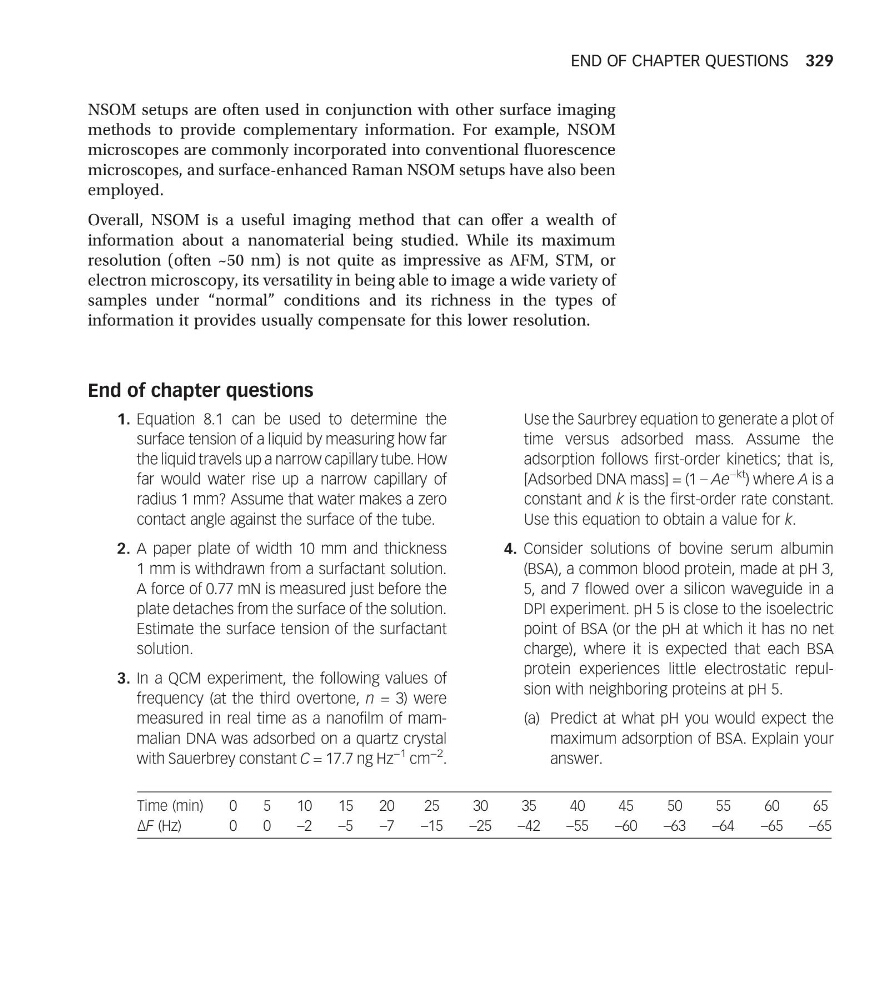
3. In a QCM experiment, the following values of
frequency (at the third overtone, n = 3) were
measured in real time as a nanofilm of mammalian DNA was adsorbed on a quartz crystal
with Sauerbrey constant C = 17.7 ng Hz
−1 cm
−2 .
Time (min)
0
5
10
15
20
25
30
35
40
45
50
55
60
65
ΔF (Hz)
0
0
–2
–5
–7
–15
–25
–42
–55
–60
–63
–64
–65
–65
Use the Saurbrey equation to generate a plot of
time versus adsorbed mass. Assume the
adsorption follows first-order kinetics; that is,
[Adsorbed DNA mass] = (1 – Ae
−kt ) where A is a
constant and k is the first-order rate constant.
Use this equation to obtain a value for k.
4. Consider solutions of bovine serum albumin
(BSA), a common blood protein, made at pH 3,
5, and 7 flowed over a silicon waveguide in a
DPI experiment. pH 5 is close to the isoelectric
point of BSA (or the pH at which it has no net
charge), where it is expected that each BSA
protein experiences little electrostatic repulsion with neighboring proteins at pH 5.
(a) Predict at what pH you would expect the
maximum adsorption of BSA. Explain your
answer.
END OF CHAPTER QUESTIONS 329
methods to provide complementary information. For example, NSOM
microscopes are commonly incorporated into conventional fluorescence
microscopes, and surface-enhanced Raman NSOM setups have also been
employed.
Overall, NSOM is a useful imaging method that can offer a wealth of
information about a nanomaterial being studied. While its maximum
resolution (often ~50 nm) is not quite as impressive as AFM, STM, or
electron microscopy, its versatility in being able to image a wide variety of
samples under “normal” conditions and its richness in the types of
information it provides usually compensate for this lower resolution.
End of chapter questions
1. Equation 8.1 can be used to determine the
surface tension of a liquid by measuring how far
the liquid travels up a narrow capillary tube. How
far would water rise up a narrow capillary of
radius 1 mm? Assume that water makes a zero
contact angle against the surface of the tube.
2. A paper plate of width 10 mm and thickness
1 mm is withdrawn from a surfactant solution.
A force of 0.77 mN is measured just before the
plate detaches from the surface of the solution.
Estimate the surface tension of the surfactant
solution.
3. In a QCM experiment, the following values of
frequency (at the third overtone, n = 3) were
measured in real time as a nanofilm of mammalian DNA was adsorbed on a quartz crystal
with Sauerbrey constant C = 17.7 ng Hz
−1 cm
−2 .
Time (min)
0
5
10
15
20
25
30
35
40
45
50
55
60
65
ΔF (Hz)
0
0
–2
–5
–7
–15
–25
–42
–55
–60
–63
–64
–65
–65
Use the Saurbrey equation to generate a plot of
time versus adsorbed mass. Assume the
adsorption follows first-order kinetics; that is,
[Adsorbed DNA mass] = (1 – Ae
−kt ) where A is a
constant and k is the first-order rate constant.
Use this equation to obtain a value for k.
4. Consider solutions of bovine serum albumin
(BSA), a common blood protein, made at pH 3,
5, and 7 flowed over a silicon waveguide in a
DPI experiment. pH 5 is close to the isoelectric
point of BSA (or the pH at which it has no net
charge), where it is expected that each BSA
protein experiences little electrostatic repulsion with neighboring proteins at pH 5.
(a) Predict at what pH you would expect the
maximum adsorption of BSA. Explain your
answer.
END OF CHAPTER QUESTIONS 329